

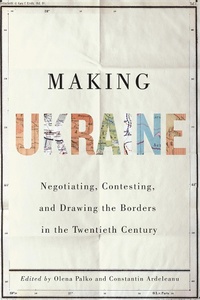
Making Ukraine
Negotiating, Contesting, and Drawing the Borders in the Twentieth Century
1st Edition
Published on 15. May 2022
409 pages
978-0-2280-1333-4 (ISBN)
Description

Russia's illegal annexation of Crimea in 2014 and the ongoing war in eastern Ukraine have brought scholarly and public attention to Ukraine's borders. Making Ukraine aims to investigate the various processes of negotiation, delineation, and contestation that have shaped the country's borders throughout the past century.
Essays by contributors from various historical fields consider how, when, and under what conditions the borders that historically define the country were agreed upon. A diverse set of national and transnational contexts are explored, with a primary focus on the critical period between 1917 and 1954. Chapters are organized around three main themes: the interstate treaties that brought about the new international order in Eastern Europe in the aftermath of the world wars, the formation of the internal boundaries between Ukraine and other Soviet republics, and the delineation of Ukraine's borders with its western neighbours. Investigating the process of bordering Ukraine in the post-Soviet era, contributors also pay close attention to the competing visions of future relations between Ukraine and Russia.
Through its broad geographic and thematic coverage, Making Ukraine illustrates that the dynamics of contemporary border formation cannot be fully understood through the lens of a sole state, frontier, or ideology and sheds light on the shared history of territory and state formation in Europe and the wider modern world.
Essays by contributors from various historical fields consider how, when, and under what conditions the borders that historically define the country were agreed upon. A diverse set of national and transnational contexts are explored, with a primary focus on the critical period between 1917 and 1954. Chapters are organized around three main themes: the interstate treaties that brought about the new international order in Eastern Europe in the aftermath of the world wars, the formation of the internal boundaries between Ukraine and other Soviet republics, and the delineation of Ukraine's borders with its western neighbours. Investigating the process of bordering Ukraine in the post-Soviet era, contributors also pay close attention to the competing visions of future relations between Ukraine and Russia.
Through its broad geographic and thematic coverage, Making Ukraine illustrates that the dynamics of contemporary border formation cannot be fully understood through the lens of a sole state, frontier, or ideology and sheds light on the shared history of territory and state formation in Europe and the wider modern world.
Reviews / Votes
"Making Ukraine brings together international experts to give for the first time a concise tour d'horizon about the border making of Ukraine from a historical perspective." H-Ukraine "Borderology is complex in this rich case-study book. The book's musings on border conflict and negotiation show that selective claims to land and country settlement can appear at almost any time in Eastern Europe." The Russian ReviewMore details
Language
English
Place of publication
Montreal, QC
Canada
Target group
Professional and scholarly
Edition type
Digital original
Illustrations
30 maps
30 maps
File size
24,93 MB
ISBN-13
978-0-2280-1333-4 (9780228013334)
Copyright in bibliographic data and cover images is held by Nielsen Book Services Limited or by the publishers or by their respective licensors: all rights reserved.
Schweitzer Classification
Other editions
Additional editions
Olena Palko | Constantin Ardeleanu
Making Ukraine
Negotiating, Contesting, and Drawing the Borders in the Twentieth Century
Book
05/2022
McGill-Queen's University Press
€97.99
Shipment within 15-20 days
Persons
Olena Palko is a Leverhulme Early Career Fellow at Birkbeck, University of London. Constantin Ardeleanu is professor of history at the "Lower Danube" University of Galati and long-term fellow at the New Europe College, Bucharest.
Content
- Cover
- Copyright
- Contents
- Maps
- Foreword
- Acknowledgments
- Note on Transliteration and Translation
- Introduction Making the Borders of Contemporary Ukraine
- Part One Negotiating Borders Great Power Diplomacy and Ukraine's Borders
- 1 Ukraine's Borders at the Brest-Litovsk Peace Conference, 1917-18
- 2 Poland's "Civilizing Mission" and Ukrainian Statehood at the Paris Peace Conference
- 3 The Path to the Treaty of Riga The Establishment of the Polish-Ukrainian Border, 1918-21
- 4 From the Molotov-Ribbentrop Pact to the Territorial Agreement of "the Big Three"
- Part Two Establishing the Borders of the Soviet Republics
- 5 Emerging States and Border-Making in Times of War
- 6 Contested Lines The Russo-Ukrainian Border, 1917-29
- 7 Overlapping Spaces Negotiating and Delineating the Ukrainian-Moldovan Border during the Interwar and Wartime Years
- 8 Crimea's 1954 Transfer to Ukraine A Practical yet Contested Union
- Part Three Delineating Ukraine's Western Border
- 9 The Formation of the Polish-Ukrainian Border in Volhynia, 1918-21
- 10 To Reach beyond the Carpathians The Integration of Transcarpathia into Soviet Ukraine, 1944-45
- 11 The Making of the Romanian-Ukrainian-Moldovan Border at the Maritime Danube in the Nineteenth and Twentieth Centuries
- Conclusion Making and Unmaking the Ukrainian-Russian Border since 1991
- Contributors
- Index
