

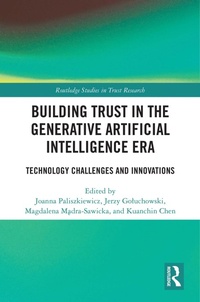
Building Trust in the Generative Artificial Intelligence Era
Technology Challenges and Innovations
Published on 27. June 2025
306 pages
978-1-040-38441-1 (ISBN)
Description

In an era where generative artificial intelligence (AI) is reshaping industries and daily life, trust has become a cornerstone for its successful adoption and application. Building Trust in the Generative Artificial Intelligence Era: Technology Challenges and Innovations explores how trust can be built, maintained, and evaluated in a world increasingly reliant on AI technologies. Designed to be accessible to a broad audience, thi book blends theoretical insights with practical approaches, offering readers a comprehensive understanding of the topic.
This book is divided into three parts. The first part examines the foundations of trust in generative AI, highlighting trends and ethical challenges such as "greenwashing" and remote work dynamics. The second part provides actionable frameworks and tools for assessing and enhancing trust, focusing on topics like cybersecurity, transparency, and explainability. The final section presents global case studies exploring university students' perceptions of ChatGPT, generative AI's applications in European agriculture, and its transformative impact on financial systems.
By addressing both the opportunities and risks of generative AI, this book delivers groundbreaking insights for academics, professionals, and policymakers worldwide. It emphasizes practical solutions, ensuring readers gain the knowledge needed to navigate the evolving technological landscape and foster trust in transformative AI systems.
This book is divided into three parts. The first part examines the foundations of trust in generative AI, highlighting trends and ethical challenges such as "greenwashing" and remote work dynamics. The second part provides actionable frameworks and tools for assessing and enhancing trust, focusing on topics like cybersecurity, transparency, and explainability. The final section presents global case studies exploring university students' perceptions of ChatGPT, generative AI's applications in European agriculture, and its transformative impact on financial systems.
By addressing both the opportunities and risks of generative AI, this book delivers groundbreaking insights for academics, professionals, and policymakers worldwide. It emphasizes practical solutions, ensuring readers gain the knowledge needed to navigate the evolving technological landscape and foster trust in transformative AI systems.
More details
Series
Language
English
Place of publication
London
United Kingdom
Publishing group
Taylor & Francis Ltd
Target group
College/higher education
Illustrations
6 Tables, black and white; 10 Line drawings, black and white; 10 Illustrations, black and white
File size
8,58 MB
ISBN-13
978-1-040-38441-1 (9781040384411)
Copyright in bibliographic data and cover images is held by Nielsen Book Services Limited or by the publishers or by their respective licensors: all rights reserved.
Schweitzer Classification
Other editions
Additional editions
Joanna Paliszkiewicz | Jerzy Goluchowski | Magdalena Madra-Sawicka
Building Trust in the Generative Artificial Intelligence Era
Technology Challenges and Innovations
Book
06/2025
1st Edition
Routledge
€208.10
Shipment within 10-20 days
Persons
Joanna Paliszkiewicz works as a Full Professor at the Warsaw University of Life Sciences (WULS-SGGW). She is the Director of the Management Institute. She also works for University of Economics Ho Chi Minh City (UEH), Vietnam. She is also an Adjunct Professor at the University of Vaasa in Finland. She obtained academic title "Full Professor" from the International School for Social and Business Studies in Slovenia. She is well recognized in Poland and abroad for her expertise in management issues: knowledge management and trust management. She has published over 220 papers/manuscripts and is the author/co-author/editor of 21 books.
Jerzy Goluchowski is a Full Professor at the University of Economics in Katowice. He has served as a Vice-Rector (2005-2009) and Dean (2009-2019; 2020-now) of the Faculty of Informatics and Communications and he is the Head of the Department of Communication Design and Analysis (since 2017)
Magdalena Madra-Sawicka is an Assistant Professor at Warsaw University of Life Sciences (WULS) in the Institute of Economics and Finance. She obtained PhD degree in 2010 and started working at SGGW WULS in 2010 at the Department of Economics and Organization of Enterprises and later in the Department of Finance at the Faculty of Economic Sciences.
Kuanchin Chen is Professor of Computer Information Systems, Director of the Center for Business Analytics, and John W. Snyder Fellow at Western Michigan University. He has more than 25 years of research, teaching, and consulting experience.
Jerzy Goluchowski is a Full Professor at the University of Economics in Katowice. He has served as a Vice-Rector (2005-2009) and Dean (2009-2019; 2020-now) of the Faculty of Informatics and Communications and he is the Head of the Department of Communication Design and Analysis (since 2017)
Magdalena Madra-Sawicka is an Assistant Professor at Warsaw University of Life Sciences (WULS) in the Institute of Economics and Finance. She obtained PhD degree in 2010 and started working at SGGW WULS in 2010 at the Department of Economics and Organization of Enterprises and later in the Department of Finance at the Faculty of Economic Sciences.
Kuanchin Chen is Professor of Computer Information Systems, Director of the Center for Business Analytics, and John W. Snyder Fellow at Western Michigan University. He has more than 25 years of research, teaching, and consulting experience.
Content
PART I: FOUNDATIONS OF TRUST BUILDING IN THE GENERATIVE ARTIFICIAL INTELLIGENCE ERA 1. Trust Building in the Generative AI - future perspectives and emerging trends 2. Technological and digital challenges for efficient substitution of creative environment in the era of Generative AI 3. Navigating ethical dilemmas: unveiling greenwashing in the AI era 4. Challenges of trust in remote work in the era of Generative AI 5. Generative AI as a driver of trust in innovation 6. Impact of Generative Artificial Intelligence (GAI) on trust and compliance of intelligent automation low-code software PART II: FRAMEWORKS FOR TRUST-BUILDING AND EVALUATION 7. Enhancing cybersecurity: trust dynamics in the age of Generative Artificial Intelligence 8. An overview of tools and methodologies for assessing trust in relation to generative models AI 9. Knowledge assessment in the age of Generative AI 10. Opening the black box: achieving trust through transparency and explainability in Generative AI 11. What will we learn from failures and trust AI applications in organizations? 12. Generative AI in finance - new challenges across trust building needs PART III: CASE STUDIES AND COMPARATIVE ANALYSES 13. Perception of ChatGPT by university students in Poland 14. The potential of using solutions based on Generative Artificial Intelligence in agriculture in European Union countries 15. Trust in Artificial Intelligence - generational differences 16. Trust and integration: AI adoption and socio-technical systems 17. The impact of awareness and risk-benefit perceptions on attitudes towards AI adoption in higher education 18. The limits of intuition in Artificial Intelligence 19. To trust or not to trust: Is Generative Artificial Intelligence taking sides in higher education research? 20. To trust or not to trust: Generative AI-supported academic scientific research publications as a matter of trust and ethics 21. Generative AI use among non-financial companies - trust perspective
