

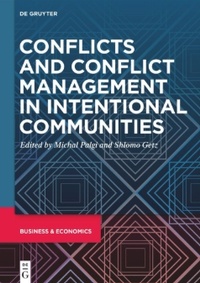
Conflicts and Conflict Management in Intentional Communities
Description

Intentional communities combine complex economic organizations with member-run governance. As in any human organization, conflicts arise-whether between members, officials, or external entities. These communities seek to manage disputes locally, often avoiding formal mechanisms like state courts. Many rely on bylaws and committees, adjusting their conflict-resolution strategies over time. Strategic decisions often require broad consensus, pushing members to refine their approaches to agreement.
This volume explores how various intentional communities-such as kibbutzim, eco-villages, and cooperative housing-navigate internal and external conflicts. The book contains both theoretical analysis and research articles written specifically for this volume, alongside innovative practical methods developed and tested to resolve conflicts that arise in intentional communities.
More details
Other editions
Additional editions
Persons
Michal Palgi, a professor of organizational sociology, is a senior researcher and the previous head of the Institute for Research of the Kibbutz and the Cooperative Idea at the University of Haifa. She was the chair and founder of the graduate program in Organizational Development and Consulting at the Emek Yezreel College in Israel and among the founders of the Action Research Center there. Prof. Michal Palgi is a former president of the International Sociological Association Research Committee on Participation, Organizational Democracy and Self-Management (RC10) and was Co-President of the International Work and Labor Network on "Regional and Local Development". She is a member of the International Communal Studies Association (ICSA) and its past president. Prof. Palgi was nominated as an advisor to the Austrian-German research project ODEM (Organizational Democracy - Resources of Organizations for social behavior readiness conducive to Democracy).
Prof. Palgi's main areas of research and activity are organizational democracy, organizational change; gender-based inequality; social justice; kibbutz society and community development. She has published extensively on kibbutz, organizational democracy, community development and gender.
Shlomo Getz is the head of the Institute for Research of the Kibbutz and the Cooperative Idea at the University of Haifa. He received his Ph.D. degree from the Hebrew University of Jerusalem. He was a faculty member at the department of sociology and anthropology at the Emek Yezreel College in Israel and a visiting professor at the university of California, Riverside. Dr. Getz's main area of research are institutional changes of the kibbutz, process of decommunization, cooperatives. Another field of research is personal and environmental resources of students in their college choice. He has published in both areas of research.
Content
- Intro
- Foreword
- Contents
- An Overview of the Book and a Short Review of the Theoretical Framework
- Part 1: Theory and research
- Chapter 1 Community Building Meets Conflict Transformation: An Integrated Approach
- Chapter 2 Man's Best Friend? Dogs and Social Conflict in the Israeli Kibbutz
- Chapter 3 After all, we are one community: Conflicts between the kibbutz and its new extension neighborhood residents as a reflection of changes in the social field
- Chapter 4 Ideological conflicts and their resolution in the kibbutz movement 1948-1956
- Part 2: Practical approaches to conflict resolution in intentional communities
- Chapter 5 Consensus building in communities
- Chapter 6 Conflict Circles: Practical Experimentation with Derivations of Restorative Circles in U.S. Intentional Communities
- Chapter 7 Cultural Context and Conflict in Intentional Communities
- Chapter 8 Power-With Instead of Power-Over: Preventing and Addressing Conflict in Communities with Sociocracy
- Contributors
- Index
