

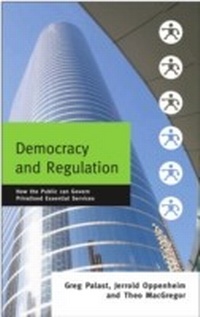
Democracy and Regulation
How the Public Can Govern Essential Services
1st Edition
Published on 20. December 2002
240 pages
978-1-84964-160-9 (ISBN)
Description

Essential services are being privatised the world over. Whether it's water, gas, electricity or the phone network, everywhere from Sao Paulo in Brazil to Leeds in the UK is following the US economic model and handing public services over to private companies whose principal interest is raising prices. Yet it's one of the world's best kept secrets that Americans pay astonishingly little for high quality public services.
This book, based on work for the United Nations International Labour Organisation is the first step-by-step guide to the way that public services are regulated in the United States. It explains how decisions are made by public debate in a public forum. Profits and investments of private companies are capped, and companies are forced to reduce prices for the poor, fund environmental investments and open themselves to financial inspection.
In a world where privatisation has so often led to economic disaster, this book is essential reading.
This book, based on work for the United Nations International Labour Organisation is the first step-by-step guide to the way that public services are regulated in the United States. It explains how decisions are made by public debate in a public forum. Profits and investments of private companies are capped, and companies are forced to reduce prices for the poor, fund environmental investments and open themselves to financial inspection.
In a world where privatisation has so often led to economic disaster, this book is essential reading.
Reviews / Votes
The authors (an economist-reporter, a lawyer, and a regulator) have a wealth of experience in utility regulation, and it is evident on every page. The recent electricity crisis in California (and Enron's participation) receives considerable attention. Throughout the book the democratic process receives most of the credit or blame. The authors' detailed description of the US utility regulatory system will be especially useful to those new to the topic. -- R. A. Miller, Wesleyan University in CHOICEMore details
Language
English
Place of publication
London
United Kingdom
Target group
Professional and scholarly
Illustrations
7 Figures; 17 Graphs; 4 Tables, black and white
ISBN-13
978-1-84964-160-9 (9781849641609)
Copyright in bibliographic data and cover images is held by Nielsen Book Services Limited or by the publishers or by their respective licensors: all rights reserved.
Schweitzer Classification
Other editions
Additional editions
Greg Palast | Jerrold Oppenheim | Theo MacGregor
Democracy and Regulation
How the Public Can Govern Essential Services
Book
12/2002
Pluto Press
€44.60
Article exhausted; check different version
Persons
Greg Palast is an investigative journalist whose articles have appeared in the New York Times, Observer, Washington Post, and The Nation and Salon.com. He has appeared on BBC Newsnight as special investigations reporter. He is the winner Financial Times David Thomas Prize, for Industrial Society Investigative Story of the Year. He has also been nominated by the UK Press Association as Business Writer of the Year. His books include The Best Democracy Money Can Buy (Pluto, 2002) and Democracy and Regulation: How the Public Can Govern Essential Services (Pluto, 2002).
Jerrold Oppenheim has represented Attorneys General, consumers, low-income consumers, labour unions, environmentalists, and industry before utility regulatory commissions and other forums for more than 30 years. He is the author of Democracy and Regulation: How the Public Can Govern Essential Services (Pluto, 2002).
Theo MacGregor was director of the Electric Power Division of the Massachusetts Department of Telecommunications and Energy, the state's utility regulator. She now runs MacGregor Energy Consultancy and provides expert analysis to state governments and other organisations about the electric industry. She is the author Democracy and Regulation: How the Public Can Govern Essential Services (Pluto, 2002).
Jerrold Oppenheim has represented Attorneys General, consumers, low-income consumers, labour unions, environmentalists, and industry before utility regulatory commissions and other forums for more than 30 years. He is the author of Democracy and Regulation: How the Public Can Govern Essential Services (Pluto, 2002).
Theo MacGregor was director of the Electric Power Division of the Massachusetts Department of Telecommunications and Energy, the state's utility regulator. She now runs MacGregor Energy Consultancy and provides expert analysis to state governments and other organisations about the electric industry. She is the author Democracy and Regulation: How the Public Can Govern Essential Services (Pluto, 2002).
Content
Democracy and Regulation: Introduction
1. Secrecy, Democracy And Regulation
2. Regulating In Public
3. Competition As Substitute For Regulation? Britain To California
4. Re-Regulation Is Not Deregulation
5. The Open Regulatory Process
6. Social Pricing
7. Issues That Are Publicly Decided
8. An Alternative: Democratic Negotiations
9. Be There: A Guide To Public Participation
10. A History Of Democratic Utility Regulation In The US
11. Regulating The Multinational Utility
12. Failed Experiments In The UK And The US
13. The Biggest Failures: California And Enron
14. International Democracy - Developing And Developed Countries
15. Conclusion
Notes
Index
1. Secrecy, Democracy And Regulation
2. Regulating In Public
3. Competition As Substitute For Regulation? Britain To California
4. Re-Regulation Is Not Deregulation
5. The Open Regulatory Process
6. Social Pricing
7. Issues That Are Publicly Decided
8. An Alternative: Democratic Negotiations
9. Be There: A Guide To Public Participation
10. A History Of Democratic Utility Regulation In The US
11. Regulating The Multinational Utility
12. Failed Experiments In The UK And The US
13. The Biggest Failures: California And Enron
14. International Democracy - Developing And Developed Countries
15. Conclusion
Notes
Index
