

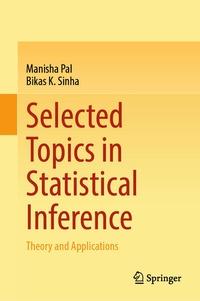
Selected Topics in Statistical Inference
Description

This book focuses exclusively on the domain of parametric inference and that, too, from a reader's perspective, i.e., covering only point estimation of parameter(s). It covers those topics in parametric inference which need clarity of exposure to students, researchers, and teachers alike; mere statements of theorems and proofs may not always reveal the inner beauty and significance of some aspects of inference. To ensure clarity, the book discusses the following topics at an advanced level-(1) sequential (unbiased) point estimation of 'p' and its functions; generalization to trinomial and tetranomial populations; (2) some aspects of the use of additional resources in finite population inference; (3) the concept of sufficiency vis-à-vis the notion of sufficient experiments and comparison of experiments; (4) estimation of the size of a finite population with special features; and (5) unbiased estimation of reliability in exponential samples and other settings. This book provides a platform for thought-provoking, creative, and challenging discussions on a variety of topics in statistical estimation theory, it is also ideal for research methodology course for statistics research scholars, and for clarification of basic ideas in topics discussed at basic/advanced levels.
More details
Other editions
Additional editions
Persons
Manisha Pal is a retired professor of Statistics from the University of Calcutta, India and is currently a senior professor in the Department of Statistics, St. Xavier's University, Kolkata, India. She has been involved in fruitful research since 1982 and has more than 125 research publications in peer-reviewed journals, having collaborated with many researchers in India and abroad. Her co-authored book, "Optimal Mixture Experiments", was published in Springer's prestigious 'Lecture Notes in Statistics' book series. Her areas of research interest are inventory control, reliability inference, skewed distributions, mixture experiments and data analysis.
Bikas K Sinha is a retired professor of Statistics from Indian Statistical Institute, Kolkata. He has contributed immensely to both statistical theory and applications. He has published a number of research monographs and textbooks with publishers of international repute, including Springer. With more than 110 research collaborators worldwide and more than 160 research publications in peer-reviewed journals, and three research monographs (co-authored) published by Springer in its Lecture Notes in Statistics Series (1989, 2002, 2014), his scholastic contributions have earned him international academic recognition in Statistics.
Content
Glimpses of the Book.- Sequential Binomial Estimation.- Use of Additional Resources in Finite Population Inference.- Notion of sufficiency in statistical inference - Theory and Applications.- Estimation of the Unknown Size of a Finite Population with Special Features.- Unbiased Estimation of Reliability in Exponential Samples.
