

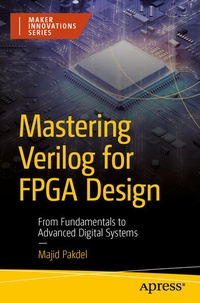
Mastering Verilog for FPGA Design
Description

This comprehensive guide aimed at both novice and experienced designers seeking to deepen their understanding of Verilog as a hardware description language (HDL) for field-programmable gate array (FPGA) design. The book bridges the gap between theoretical knowledge and practical application in FPGA design. As technology continues to evolve, mastering hardware description languages like Verilog is essential for engineers and designers. This book serves as a comprehensive resource that guides readers through the intricacies of Verilog and FPGA development, offering hands-on projects and detailed explanations to empower both beginners and experienced professionals in their design endeavors.The book also covers memory implementations, structural modeling, finite state machines (FSMs), and IP block design, providing a well-rounded education on advanced Verilog concepts.
Mastering Verilog for FPGA Design provides a thorough exploration of Verilog and its applications in FPGA design. The topics covered are not only fundamental for anyone looking to enter the field of digital design but are also increasingly relevant in a world that emphasizes rapid prototyping, customization, and the integration of complex systems. By mastering these concepts, readers will be well-equipped to tackle current and future challenges in digital design and development.
What You'll Learn
- Design real-world digital systems using Verilog and Vivado.
- Use Vivado to plan I/O and manage complete FPGA projects
- Create digital systems using structural and gate-level design
- Construct and simulate a full RISC-V processor in Verilog
- Master behavioral and structural modeling for robust design.
- Create custom memory, FSMs, and IP blocks from scratch.
Who This Book Is For
Mastering Verilog for FPGA Design is for anyone eager to build solid Verilog and FPGA skills: from curious students to seasoned engineers, inventive hobbyists, and educators. The structured approach, complete with examples and clear explanations, makes it an ideal guide for both self-learners and educational settings.
More details
Other editions
Additional editions
Person
Majid Pakdel is passionate about advancing the fields of electrical engineering and computer science. With a Bachelor's degree in Electrical-Telecommunications Engineering, a Master's in Electrical Power Engineering, and a Ph.D. in the same field, along with a recent Master's in Computer Engineering with a focus on Artificial Intelligence and Robotics, he has cultivated a diverse and comprehensive understanding of technology. Over the years, he has published over 20 papers and authored 8 books, driven by my commitment to sharing knowledge and fostering innovation.
Content
Chapter 1: Introduction to Vivado.- Chapter 2: Behavioral Modeling in Verilog.- Chapter 3: Test Bench Projects in Verilog.- Chapter 4: Implementations of Memory.- Chapter 5: Gate, Switch, and Structural Modeling.- Chapter 6: Finite State Machines.- Chapter 7: Block Design and IPs.- Chapter 8: Communication Interfaces and Miscellaneous Projects.- Chapter 9: Implementation of a RISC-V Processor.
