

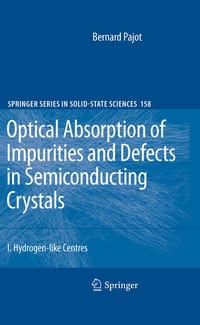
Optical Absorption of Impurities and Defects in Semiconducting Crystals
Description

Semiconducting and Insulating Crystals details how absorption spectroscopy provides information on the nature, concentration, charge state and configuration of impurities in crystals and also on their kinetics and transformations under annealing. After an introduction of the bulk optical properties of semiconductors and insulators and of impurities in crystals, this book presents the physical bases necessary for the understanding of impurity spectra. The description of various set-ups and accessories used in absorption spectroscopy is followed by a presentation of experimental results on specific impurities and classes of impurities and their relation with those obtained by various computation and by other experimental techniques.
Reviews / Votes
From the reviews:
"Provide a comprehensive and up to date overview of the field. . the book constitutes a valuable resource for linking the development of materials characterization for micro and opto electronics with the new needs of the growing photovoltaic industry. . a very useful manual for researchers from graduate to higher levels and for experimentalists who want to enter the subject. . The books should find a place in the bookshelf of every researcher interested in semiconductor materials and devices . ." (S. Sanguinetti, Il Nuovo Saggiatore, Vol. 27 (1-2), 2011)More details
Other editions
Additional editions
Person
B. Pajot has been a Directeur de Recherches of the Centre National de la Recherche Scientifique (CNRS). He has worked at Groupe de Physique des Solides, a laboratory associated to CNRS (now part of Institut des NanoSciences de Paris), where he has been mainly involved in the spectroscopy of impurities and defects in semiconductors.
B. Clerjaud is Physics Professor at Université Pierre et Marie Curie. He presently works at the Institut des NanoSciences de Paris. He has a long experience in the study of impurities in solids, in particular in the investigation of transition metals and light impurities.
