


Raspberry Pi Supercomputing and Scientific Programming
MPI4PY, NumPy, and SciPy for Enthusiasts
Published on 25. May 2017
XXII, 171 pages
978-1-4842-2878-4 (ISBN)
Description

Build an inexpensive cluster of multiple Raspberry Pi computers and install all the required libraries to write parallel and scientific programs in Python 3. This book covers setting up your Raspberry Pis, installing the necessary software, and making a cluster of multiple Pis.
Once the cluster is built, its power has to be exploited by means of programs to run on it. So, Raspberry Pi Supercomputing and Scientific Programming teaches you to code the cluster with the MPI4PY library of Python 3. Along the way, you will learn the concepts of the Message Passing Interface (MPI) standards and will explore the fundamentals of parallel programming on your inexpensive cluster. This will make this book a great starting point for supercomputing enthusiasts who want to get started with parallel programming.
The book finishes with details of symbolic mathematics and scientific and numerical programming in Python, using SymPi, SciPy, NumPy, and Matplotlib. You'll see how to process signals and images, carry out calculations using linear algebra, and visualize your results, all using Python code. With the power of a Raspberry Pi supercomputer at your fingertips, data-intensive scientific programming becomes a reality at home.
What You Will Learn
Who This Book Is For
Python 3 developers who seek the knowledge of parallel programming, Raspberry Pi enthusiasts, researchers, and the scientific Python community.
Once the cluster is built, its power has to be exploited by means of programs to run on it. So, Raspberry Pi Supercomputing and Scientific Programming teaches you to code the cluster with the MPI4PY library of Python 3. Along the way, you will learn the concepts of the Message Passing Interface (MPI) standards and will explore the fundamentals of parallel programming on your inexpensive cluster. This will make this book a great starting point for supercomputing enthusiasts who want to get started with parallel programming.
The book finishes with details of symbolic mathematics and scientific and numerical programming in Python, using SymPi, SciPy, NumPy, and Matplotlib. You'll see how to process signals and images, carry out calculations using linear algebra, and visualize your results, all using Python code. With the power of a Raspberry Pi supercomputer at your fingertips, data-intensive scientific programming becomes a reality at home.
What You Will Learn
-
Discover the essentials of supercomputing
-
Build a low-cost cluster of Raspberry Pis at home
-
Harness the power of parallel programming and the Message Passing Interface (MPI)
-
Use your Raspberry Pi for symbolic, numerical, and scientific programming
Who This Book Is For
Python 3 developers who seek the knowledge of parallel programming, Raspberry Pi enthusiasts, researchers, and the scientific Python community.
More details
Series
Edition
1st ed.
Language
English
Place of publication
Berkeley
United States
Publishing group
APRESS
Target group
Professional and scholarly
Product notice
Reflowable
Illustrations
XXII, 171 p. 95 illus., 90 illus. in color.
File size
5,78 MB
ISBN-13
978-1-4842-2878-4 (9781484228784)
DOI
10.1007/978-1-4842-2878-4
Schweitzer Classification
Other editions
Additional editions
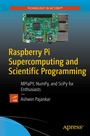
Ashwin Pajankar
Raspberry Pi Supercomputing and Scientific Programming
MPI4PY, NumPy, and SciPy for Enthusiasts
Book
05/2017
APress
€64.19
Shipment within 15-20 days
Person
Ashwin Pajankar is a Polymath. He is a Science Popularizer, a Programmer, a Maker, an Author, and a Youtuber. He graduated from IIIT Hyderabad with MTech in Computer Science and Engineering. He has keen interest in the promotion of Science, Technology, Engineering, and Mathematics (STEM) education. This is his Second book with Apress Publication.
Content
Chapter 1: Introduction to Single Board Computers and Raspberry Pi.- Chapter 2: Important Linux Commands and Remote Connectivity.- Chapter 3: Introduction to Python.- Chapter 4: Introduction to Supercomputers.- Chapter 5: Message Passing Interface.- Chapter 6: Building the Supercomputer.- Chapter 7: Overclocking Raspberry Pi.- Chapter 8: Parallel Programming in Python 3.- Chapter 9: Introduction to SciPy Stack and Symbolic Programming.- Chapter 10: Introduction to NumPy.- Chapter 11: Introduction to SciPy.- Chapter 12: Signal Processing with SciPy.- Chapter 13: Image processing with SciPy.- Chapter 14: Matplotlib.
