

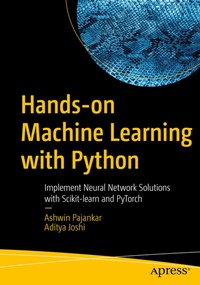
Hands-on Machine Learning with Python
Implement Neural Network Solutions with Scikit-learn and PyTorch
Published on 5. March 2022
XX, 335 pages
978-1-4842-7921-2 (ISBN)
Description

Here is the perfect comprehensive guide for readers with basic to intermediate level knowledge of machine learning and deep learning. It introduces tools such as NumPy for numerical processing, Pandas for panel data analysis, Matplotlib for visualization, Scikit-learn for machine learning, and Pytorch for deep learning with Python. It also serves as a long-term reference manual for the practitioners who will find solutions to commonly occurring scenarios.
The book is divided into three sections. The first section introduces you to number crunching and data analysis tools using Python with in-depth explanation on environment configuration, data loading, numerical processing, data analysis, and visualizations. The second section covers machine learning basics and Scikit-learn library. It also explains supervised learning, unsupervised learning, implementation, and classification of regression algorithms, and ensemble learning methods in an easy manner with theoreticaland practical lessons. The third section explains complex neural network architectures with details on internal working and implementation of convolutional neural networks. The final chapter contains a detailed end-to-end solution with neural networks in Pytorch.
After completing Hands-on Machine Learning with Python , you will be able to implement machine learning and neural network solutions and extend them to your advantage.
What You'll Learn
Who This Book Is For
Data scientists, machine learning engineers, and software professionals with basic skills in Python programming.
The book is divided into three sections. The first section introduces you to number crunching and data analysis tools using Python with in-depth explanation on environment configuration, data loading, numerical processing, data analysis, and visualizations. The second section covers machine learning basics and Scikit-learn library. It also explains supervised learning, unsupervised learning, implementation, and classification of regression algorithms, and ensemble learning methods in an easy manner with theoreticaland practical lessons. The third section explains complex neural network architectures with details on internal working and implementation of convolutional neural networks. The final chapter contains a detailed end-to-end solution with neural networks in Pytorch.
After completing Hands-on Machine Learning with Python , you will be able to implement machine learning and neural network solutions and extend them to your advantage.
What You'll Learn
- Review data structures in NumPy and Pandas
- Demonstrate machine learning techniques and algorithm
- Understand supervised learning and unsupervised learning
- Examine convolutional neural networks and Recurrent neural networks
- Get acquainted with scikit-learn and PyTorch
-
Predict sequences in recurrent neural networks and long short term memory
Who This Book Is For
Data scientists, machine learning engineers, and software professionals with basic skills in Python programming.
More details
Series
Edition
1st ed.
Language
English
Place of publication
Berkeley
United States
Publishing group
APRESS
Target group
Professional and scholarly
Product notice
Reflowable
Illustrations
XX, 335 p. 154 illus.
File size
12,18 MB
ISBN-13
978-1-4842-7921-2 (9781484279212)
DOI
10.1007/978-1-4842-7921-2
Schweitzer Classification
Other editions
Additional editions
Ashwin Pajankar | Aditya Joshi
Hands-on Machine Learning with Python
Implement Neural Network Solutions with Scikit-learn and PyTorch
Book
03/2022
APress
€64.19
Shipment within 15-20 days
Persons
Ashwin Pajankar holds a Master of Technology from IIIT Hyderabad, and has over 25 years of programming experience. He started his journey in programming and electronics with BASIC programming language and is now proficient in Assembly programming, C, C++, Java, Shell Scripting, and Python. Other technical experience includes single board computers such as Raspberry Pi and Banana Pro, and Arduino. He is currently a freelance online instructor teaching programming bootcamps to more than 60,000 students from tech companies and colleges. His Youtube channel has an audience of 10000 subscribers and he has published more than 15 books on programming and electronics with many international publications.
Aditya Joshi has worked in data science and machine learning engineering roles since the completion of his MS (By Research) from IIIT Hyderabad. He has conducted tutorials, workshops, invited lectures, and full courses for students and professionals who want to move tothe field of data science. His past academic research publications include works on natural language processing, specifically fine grain sentiment analysis and code mixed text. He has been the organizing committee member and program committee member of academic conferences on data science and natural language processing.
Aditya Joshi has worked in data science and machine learning engineering roles since the completion of his MS (By Research) from IIIT Hyderabad. He has conducted tutorials, workshops, invited lectures, and full courses for students and professionals who want to move tothe field of data science. His past academic research publications include works on natural language processing, specifically fine grain sentiment analysis and code mixed text. He has been the organizing committee member and program committee member of academic conferences on data science and natural language processing.
Content
Chapter 1: Getting Started with Python 3 and Jupyter Notebook.- Chapter 2: Getting Started with NumPy.- Chapter 3 : Introduction to Data Visualization.- Chapter 4 : Introduction to Pandas .- Chapter 5: Introduction to Machine Learning with Scikit-Learn.- Chapter 6: Preparing Data for Machine Learning.- Chapter 7: Supervised Learning Methods - 1.- Chapter 8: Tuning Supervised Learners.- Chapter 9: Supervised Learning Methods - 2.- Chapter 10: Ensemble Learning Methods.- Chapter 11: Unsupervised Learning Methods.- Chapter 12: Neural Networks and Pytorch Basics.- Chapter 13: Feedforward Neural Networks.- Chapter 14: Convolutional Neural Network.- Chapter 15: Recurrent Neural Network.- Chapter 16: Bringing It All Together.
