

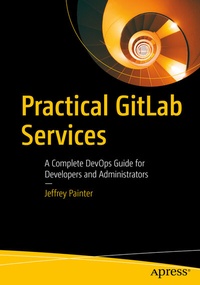
Practical GitLab Services
Description

Learn all about GitLab administration, the open-source DevOps platform helping millions develop and deploy safe and secure software. This book is designed to be your one-stop shop to get up and running with complete ease.
Start with the basics like setting up a GitLab account and exploring user options before moving on to GitLab's primary function as a source code management tool. From there, you'll learn about one of the most unique features of GitLab: CI/CD configuration files. The next step on the journey is a discussion of how to organize code into projects and groups, along with defining access permissions using roles. You'll also examine the various planning tools provided by GitLab.
With the basic features out of the way, you'll delve into more specialized services such as the built-in Docker image repository, the package registry, web page creation, and binary file storage. The book concludes with more advanced administrative topics such as working with GitLab's REST and GraphQL APIs, setting up a proof-of-concept GitLab service using Amazon Web Services (AWS), and spinning up a production service that takes high availability and disaster recovery into account.
With an abundance of information available for deploying secure software, selecting the right documentation can often be daunting. From planning to monitoring, Practical GitLab Services eliminates the unknown in your DevOps lifecycle.
What You Will Learn
- Use GitLab to manage source code files, track and plan issues, run builds and tests, and deploy software
- See how administrators can support developers using GitLab
- Set up your own standalone installation using AWS
Who This Book Is For
Software developers, potential GitLab administrators, supporting team members such as testers and project managers.
More details
Other editions
Additional editions
Person
Jeffrey Painter has spent the last 45 years in software development, working as a developer in various languages ranging from Fortran, C, C++, Java as well as Python and in a variety of roles from development to administration. The last seven years have been spent at Here Technologies as a system engineer first maintaining a farm of Jenkins servers for entire project teams and then prototyping and maintaining several self-managed GitLab servers.
Content
1. Only the Beginning.- 2. Just the Source.- 3. Working the Remote Life.- 4. Build, Test, Rinse and Repeat. - 5. Under One Condition.- 6. You Build It, You Keep It.- 7. Let's Get Organized.- 8. I Have an Issue with That.- 9. The Best Laid Plans.- 10. It's Nice to Share.- 11. There's an API for That.- 12. Well, Isn't That Special.- 13. I Can Do This on My Own.- 14. Things That Lurk in the Background.- 15. The Proof is in the Cloud.- 16. Working the Never-ending Queue.- 17. But Wait, There's More.- 18. It's an Admin's Life.- 19. Lights, Camera, Action.
