

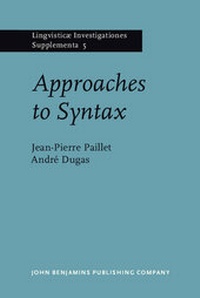
Approaches to Syntax
1st Edition
Published on 1. January 1982
VIII, 282 pages
978-90-272-8066-4 (ISBN)
Description

This volume is an enhanced version of the English translation from the French original edition 'Principes d'analyse syntaxique' (Québec, 1973). It provides a survey of theoretical approaches to syntax, including traditional grammars, structuralism, functionalism, and formal approaches.
More details
Other editions
Additional editions
Jean-Pierre Paillet | Andre Dugas
Approaches to Syntax
(English translation from the French original edition 'Principes d'analyse syntaxique', Québec, 1973)
Book
01/1982
John Benjamins Publishing Co
€116.60
Shipment within 10-15 days
Content
- APPROACHES TO SYNTAX
- Editorial page
- Title page
- Copyright page
- Table of contents
- FOREWORD
- 1. THE SCIENTIFIC STUDY OF HUMAN LANGUA GE
- 1. Speech acts:
- 2. Scientific study:
- 3. The naive speaker and his language:
- 4. Studying the results of speech acts:
- 5. The place of syntax:
- 2. TRADITIONAL GRAMMARS
- 1. Origin and foundations:
- 2. Development of the tradition:
- 3. General and particular grammars:
- 4. Inadequacies of the system:
- 5. Evolution of traditional grammar:
- 6. Innovators:
- 7. Importance of innovators:
- 3. THE EMERGENCE OF LINGUISTIC STRUCTURALISM
- 1. Prestructuralists:
- 2. Language is a form:
- 3. The notion of value:
- 4. The notion of function:
- 4. MARTINET'S FUNCTIONAL SYNTAX
- 1. Syntax and experience:
- 2. Functional classification of monemes:
- 3. Functional classification of syntagms:
- 4. Detailed classification of dependent monemes:
- 5. Schema of a functional analysis:
- 6. Comments:
- 5. TESNIERE'S STRUCTURAL SYNTAX
- 1. Syntactic connection:
- 2. The structure of simple sentences:
- 3. The origin of complexities:
- 4. Transference:
- 5. Summary:
- 6. Perspectives on Relational grammar:
- 6. PAKE'S TAGMEMICS
- 1. A theory of the structure of human beha viour:
- 2. Etic and emic standpoints:
- 3. Class/slot correlati ons:
- 4. The three modes:
- 5. Minimal and larger units:
- 6. Particles and waves:
- 7. Schema of a tagmemic analysis:
- 8. Tagmemics and other theories:
- 7. THE LONDON SCHOOL
- 1. Ethnological origins:
- 2. J.R. Firth's approach to linguistic description:
- 3. Problematical tasks:
- 4. For a complete theory of linguistic descriptions:
- 5. Categories:
- 6. Functional interpretation of the system:
- 7. The form of a description:
- 8. Implications of Halliday's theory of linguistic description:
- 8. FORMAL SYNTAX
- 1. Need for a formal syntax:
- 2. Principles of formal linguistics:
- 3. Basic syntactic phenomena:
- 4. Models:
- 9. BLOOMFIELDIAN SYNTAX
- 1. Morphemes and tagmemes:
- 2. Immediate Constituent Analysis:
- 3. Formalization of ICA:
- 4. Selectional problems:
- 10. STRATIFICATIONAL GRAMMARS
- 1. The notion of level:
- 2. Wellformedness of one level - tactic rules:
- 3. Correspondence between levels:
- 4. Sound to meaning. Meaning to sound:
- 5. Notation:
- 6. Tagmemics and stratificational grammar:
- 11. STRING ANALYSIS
- 1. Elementary sentences and adjuncts:
- 2. Order structures in String analysis:
- 3. Selectional structures in String analysis:
- 4. Relations between ICA and String analysis:
- 5. Relations of String analysis with functional syntax:
- 12. AUTOMATA AND SYNTAX
- 1. Notion of automaton:
- 2. Automata and languages:
- 3. Reformulation of the preceding models:
- 4. Problems of selectional structure:
- 13. TRANSFORMATIONS
- 1. Distributional analysis of discourse:
- 2. Selectional invariants:
- 3. Description of a language:
- 4. Transformations as linguistic signs:
- 5. A generative model of language:
- 14. GENERATIVE GRAMMAR
- 1. Two ways of considering the se lection problem:
- 2. A generative transformational model:
- 3. Consequences as to the notion of transformation:
- 4. Unification - generalized Deep Structure:
- 5. Representation of selectional structure:
- 6. Extensions:
- 15. RECENT DEVELOPMENTS IN TRANSFORMATIONAL GENERATIVE GRAMMAR
- 1. Description and theory:
- 2. Generative Semantics:
- 3. The lexicalist hypothesis:
- 4. The X system:
- 5. Conditions on transformations:
- 6. Structural descriptions: the road to "Move a
- 7. Trace theory and rules of interpretation:
- 8. Are transformations necessary?
- 16. STEPWISE GRAMMARS
- 1. Three types of syntactic regularities:
- 2. Syntax and computing:
- 3. Extended finite state automata:
- 4. A standard form for stepwise grammars:
- 5. Interpretations:
- 6. Stepwise grammars and the process of speaking:
- 7. Stepwise grammars and the lexicon:
- 17. SYNTAX AND SEMANTICS
- FORM AND FUNCTION
- 1. Syntactic wellformedness and functional considerations:
- 2. Direct and mediate theories:
- 3. Langue and parole:
- 4. Universals:
- FOOTNOTES
- Chapter 1
- Chapter 2
- Chapter 3
- Chapter 4
- Chapter 5
- Chapter 6
- Chapter 7
- Chapter 8
- Chapter 9
- Chapter 10
- Chapter 11
- Chapter 15
- Chapter 16
- BIBLIOGRAPHY
- INDEX
