

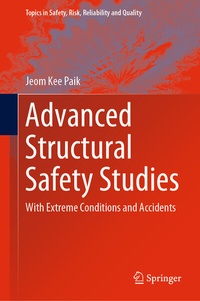
Advanced Structural Safety Studies
Description

This book describes principles, industry practices and evolutionary methodologies for advanced safety studies, which are helpful in effectively managing volatile, uncertain, complex, and ambiguous (VUCA) environments within the framework of quantitative risk assessment and management and associated with the safety and resilience of structures and infrastructures with tolerance against various types of extreme conditions and accidents such as fires, explosions, collisions and grounding. It presents advanced computational models for characterizing structural actions and their effects in extreme and accidental conditions, which are highly nonlinear and non-Gaussian in association with multiple physical processes, multiple scales, and multiple criteria. Probabilistic scenario selection practices and applications are presented. Engineering practices for structural crashworthiness analysis in extreme conditions and accidents are described. Multidisciplinary approaches involving advanced computational models and large-scale physical model testing are emphasized. The book will be useful to students at a post-graduate level as well as researchers and practicing engineers.
More details
Other editions
Additional editions
Person
Content
Table of Contents.- Preface.- About the Author.- Computer Programs Used.- Abbreviations.- 1. Principles of Structural Safety Studies.- 2. Probabilistic Selection of Event Scenarios.- 3. Limit State-Based Safety Studies.- 4. Risk-Based Safety Studies.- 5. Safety Assessment of Damaged Structures.- 6. Computational Models for Ship Structural Load Analysis in Ocean Waves.- 7. Computational Models for Offshore Structural Load Analysis in Collisions.- 8. Computational Models for Gas Cloud Temperature Analysis in Fires.- 9. Computational Models for Blast Pressure Load Analysis in Explosions.- 10. Computational Models for Nonlinear Structural Response Analysis in Extreme Loads.- 11. Computational Models for Structural Crashworthiness Analysis in Collisions and Grounding.- 12. Computational Models for Structural Crashworthiness Analysis in Fires.- 13. Computational Models for Structural Crashworthiness Analysis in Explosions.- 14. Quantitative Collision Risk Assessment and Management.-15. Quantitative Grounding Risk Assessment and Management.- 16. Quantitative Fire Risk Assessment and Management.- 17. Quantitative Explosion Risk Assessment and Management.- 18. Facilities for Physical Model Testing.- Appendices.- A.1 Latin Hypercube Sampling Program.- A.2 Passive Fire Protection Materials.- A.3 SI Units.- A.3.1 SI Unit Prefixes.- A.3.2 Conversion Factors.- Index.
