

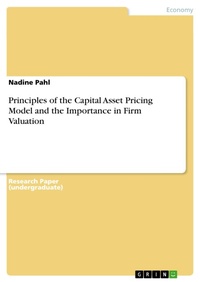
Principles of the Capital Asset Pricing Model and the Importance in Firm Valuation
1st Edition
Published on 30. March 2009
34 pages
978-3-640-29809-9 (ISBN)
Description

Research Paper (undergraduate) from the year 2007 in the subject Business economics - Investment and Finance, grade: 1,0, University of Applied Sciences Berlin, course: Financial Management, language: English, abstract: In everything you do, or don't do, there is a chance that something will happen that you didn't count on. Risk is the potential for unexpected things to happen.
Risk aversion is a common thing among almost all investors. Investors generally dislike uncertainty or risk and agree that a safe dollar is worth more than a risky one. Therefore, investors will have to be persuaded to take higher risk by the offer of higher returns. In this investment context, the additional compensation for taking on higher risk is a higher rate of return.Every investment has a risk element: The investor will always not be certainwhether the investment will be able to generate the required income. The degree of risk defers from industry to industry but also from company to company. It is not possible to eliminate the investment risk altogether but to
reduce is. Nevertheless, often there remains a risky part. According to the degree of risk, the investor demands a corresponding rate of return that is, of course, higher than the rate of return of risk-free investments. Taking on a risk should be paid off.
The Capital Asset Pricing Model (CAPM) is an economic model for valuing stocks, securities, derivatives and/or assets by relating risk and expected rate of return. CAPM is based on the idea that investors demand additional expected return if they are asked to accept additional risk.
Risk aversion is a common thing among almost all investors. Investors generally dislike uncertainty or risk and agree that a safe dollar is worth more than a risky one. Therefore, investors will have to be persuaded to take higher risk by the offer of higher returns. In this investment context, the additional compensation for taking on higher risk is a higher rate of return.Every investment has a risk element: The investor will always not be certainwhether the investment will be able to generate the required income. The degree of risk defers from industry to industry but also from company to company. It is not possible to eliminate the investment risk altogether but to
reduce is. Nevertheless, often there remains a risky part. According to the degree of risk, the investor demands a corresponding rate of return that is, of course, higher than the rate of return of risk-free investments. Taking on a risk should be paid off.
The Capital Asset Pricing Model (CAPM) is an economic model for valuing stocks, securities, derivatives and/or assets by relating risk and expected rate of return. CAPM is based on the idea that investors demand additional expected return if they are asked to accept additional risk.
More details
Other editions
Additional editions
Book
04/2009
2nd Edition
Grin Verlag
€18.95
Shipment within 7-9 days
