

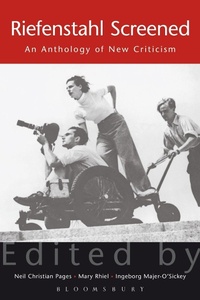
Riefenstahl Screened
An Anthology of New Criticism
1st Edition
Published on 16. May 2008
288 pages
978-1-4411-0453-3 (ISBN)
Description

Leni Riefenstahl is larger than life. From the lure of her persona as it enters our homes via television to our pleasure in the recognition of her film images at rock concerts, to her place as part of the history of the Nazi period, Riefenstahl lives on in our imagination and in our cultural productions. Thus, the editors' introduction to this volume examines the manner in which Riefenstahl 'haunts' debates on aesthetics and politics, and how her legacy reverberates in the contemporary cultural scene.
The editors view the collection as a three-part framework. The essays in the opening section of the book show that Riefenstahl is still very much alive and well - and controversial - in popular culture. Her films continue to determine the way in which we think about the Nazi period, providing instantly recognizable images and messages that often go unquestioned. We cannot separate these phenomena from Riefenstahl's years of avid self-fashioning. The second section of the book offers treatments of the shifting, mobile relationship between Riefenstahl's stubborn attempts to create and control her personae and her reactions to others' re-appropriations of the meanings of her life and work. Reading the texts and discourses surrounding 'Riefenstahl,' these scholars treat her memoirs - and her repeated assertions about herself - as a springboard into understanding anew how we might approach her films in a productive way. The closing section of the volume comprises essays that go right to the heart of the matter: Riefenstahl's films and photography. The new contexts-theoretical discussions and emerging discourses that animate these essays-include Scarry's treatise on beauty, justice and the global, the problems of history and memory, the place of Riefenstahl's filmmaking technique in contemporary cinema, and her appropriation of German musical traditions.
Fueled by the work of a diverse range of scholars, then, Riefenstahl Screened offers an opportunity to rethink the place of Leni Riefenstahl and her work in contemporary culture and in academic discourse. It insists upon a critical self-examination that maps a topography of how scholars and teachers avail themselves of Riefenstahl's corpus.
The editors view the collection as a three-part framework. The essays in the opening section of the book show that Riefenstahl is still very much alive and well - and controversial - in popular culture. Her films continue to determine the way in which we think about the Nazi period, providing instantly recognizable images and messages that often go unquestioned. We cannot separate these phenomena from Riefenstahl's years of avid self-fashioning. The second section of the book offers treatments of the shifting, mobile relationship between Riefenstahl's stubborn attempts to create and control her personae and her reactions to others' re-appropriations of the meanings of her life and work. Reading the texts and discourses surrounding 'Riefenstahl,' these scholars treat her memoirs - and her repeated assertions about herself - as a springboard into understanding anew how we might approach her films in a productive way. The closing section of the volume comprises essays that go right to the heart of the matter: Riefenstahl's films and photography. The new contexts-theoretical discussions and emerging discourses that animate these essays-include Scarry's treatise on beauty, justice and the global, the problems of history and memory, the place of Riefenstahl's filmmaking technique in contemporary cinema, and her appropriation of German musical traditions.
Fueled by the work of a diverse range of scholars, then, Riefenstahl Screened offers an opportunity to rethink the place of Leni Riefenstahl and her work in contemporary culture and in academic discourse. It insists upon a critical self-examination that maps a topography of how scholars and teachers avail themselves of Riefenstahl's corpus.
More details
Edition
1. Auflage
Language
English
Place of publication
London
United Kingdom
Publishing group
Bloomsbury Publishing PLC
Illustrations
10
ISBN-13
978-1-4411-0453-3 (9781441104533)
Copyright in bibliographic data and cover images is held by Nielsen Book Services Limited or by the publishers or by their respective licensors: all rights reserved.
Schweitzer Classification
Other editions
Additional editions
Neil Christian Pages | Ingeborg Majer O'Sickey | Mary Rhiel
Riefenstahl Screened
An Anthology of New Criticism
Book
07/2008
Continuum International Publishing Group Ltd.
€43.00
Shipment within 15-20 days

Neil Christian Pages | Ingeborg Majer O'Sickey | Mary Rhiel
Riefenstahl Screened
An Anthology of New Criticism
Book
07/2008
Continuum International Publishing Group Ltd.
€100.47
Article exhausted; check different version
Persons
Content
Introduction
Celia Applegate (University of Rochester): "To Be or Not To Be Wagnerian: the Music of Riefenstahl's Nazi-Era Documentaries"
David Bathrick (Cornell University): "Riefenstahl's Iconic Images"
Bärbel Dalichow (Film Museum Potsdam): Interview conducted and translated by Ingeborg Majer-O'Sickey
Karen M. Eng (University of Cincinnati): "Portraits of Representation: Reception, Ethics and Reflexivity in Leni Riefenstahl's African Photography"
Wulf Kansteiner (Binghamton University SUNY): "Liberating Nazi Iconology from the Prison House of History: The Reception of Ray Müller's The Wonderful, Horrible Life of Leni Riefenstahl in Germany"
Lutz Koepnick (Washington University, St. Louis): "Riefenstahl's Slow Motion: Watching Olympia with David Beckham"
Eric Rentschler (Harvard University): "The Blue Light Revisited"
Mary Rhiel (University of New Hampshire): "The Ups and Downs of Leni Riefenstahl"
Georg Sesslen (film critic): "Blood and Glamour" (translated by Neil Christian Pages)
Carsten Strathausen (University of Missouri, Columbia): "Aesthetic Power: The Case of Leni Riefenstahl"
Martina Thiele (University of Kiel): "Bodies in the Right Light: Leni Riefenstahl's Homepage as an Exercise in Self-Fashioning" (translated by Ingeborg Majer-O'Sickey)
Valerie Weinstein (University of Nevada, Reno): "Reading Rammstein, Remembering Riefenstahl: 'Fascist Aesthetics' and German Popular Culture"
Conclusion
Bibliography
Index
Celia Applegate (University of Rochester): "To Be or Not To Be Wagnerian: the Music of Riefenstahl's Nazi-Era Documentaries"
David Bathrick (Cornell University): "Riefenstahl's Iconic Images"
Bärbel Dalichow (Film Museum Potsdam): Interview conducted and translated by Ingeborg Majer-O'Sickey
Karen M. Eng (University of Cincinnati): "Portraits of Representation: Reception, Ethics and Reflexivity in Leni Riefenstahl's African Photography"
Wulf Kansteiner (Binghamton University SUNY): "Liberating Nazi Iconology from the Prison House of History: The Reception of Ray Müller's The Wonderful, Horrible Life of Leni Riefenstahl in Germany"
Lutz Koepnick (Washington University, St. Louis): "Riefenstahl's Slow Motion: Watching Olympia with David Beckham"
Eric Rentschler (Harvard University): "The Blue Light Revisited"
Mary Rhiel (University of New Hampshire): "The Ups and Downs of Leni Riefenstahl"
Georg Sesslen (film critic): "Blood and Glamour" (translated by Neil Christian Pages)
Carsten Strathausen (University of Missouri, Columbia): "Aesthetic Power: The Case of Leni Riefenstahl"
Martina Thiele (University of Kiel): "Bodies in the Right Light: Leni Riefenstahl's Homepage as an Exercise in Self-Fashioning" (translated by Ingeborg Majer-O'Sickey)
Valerie Weinstein (University of Nevada, Reno): "Reading Rammstein, Remembering Riefenstahl: 'Fascist Aesthetics' and German Popular Culture"
Conclusion
Bibliography
Index
