

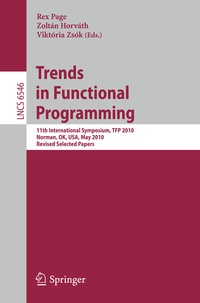
Trends in Functional Programming
11th International Symposium, TFP 2010, Norman, OK, USA, May 17-19, 2010. Revised Selected Papers
Published on 9. September 2011
X, 215 pages
978-3-642-22941-1 (ISBN)
Description

This book constitutes the thoroughly refereed post-conference proceedings of the 11th International Symposium on Trends in Functional Programming, TFP 2010, held in Norman, OK, USA, in May 2010. The 13 revised full papers presented were carefully reviewed and selected from 26 submissions during two rounds of reviewing and improvement. The papers cover new ideas for refactoring, managing source-code complexity, functional language implementation, graphical languages, applications of functional programming in pure mathematics, type theory, multitasking and parallel processing, distributed systems, scientific modeling, domain specific languages, hardware design, education, and testing.
More details
Other editions
Additional editions

Rex Page | Zoltan Horvath | Viktoria Zsók
Trends in Functional Programming
11th International Symposium, TFP 2010, Norman, OK, USA, May 17-19, 2010. Revised Selected Papers
Book
09/2011
Springer
€53.49
Shipment within 7-9 days
Content
- Title
- Preface
- Organization
- Table of Contents
- Evaluating Call-by-Need on the Control Stack
- Implementing Call-by-Need
- The Call-by-Need -Calculus, the de Bruijn Version
- Standard Reduction Machine
- The CK+ Machine
- CK+ Machine States
- Renaming Environment
- Continuations and the Continuation Stack
- Maintaining the Continuation Stack
- Relating Machine States to Terms
- CK+ Machine State Transitions
- Dealing with Answers
- Correctness
- Stack Compacting
- Related Work and Conclusion
- References
- Typing Coroutines
- Introduction
- CorDuroy
- Examples
- Operational Semantics
- Type System
- Soundness
- Preservation
- Progress
- Related Work
- Conclusion
- References
- An Expression Processor: A Case Study in Refactoring Haskell Programs
- Introduction
- Structural and Data-Type Refactorings
- Folding
- Merging
- Adding a Constructor to a Data Type
- Removing a Constructor from a Data Type
- Adding or Removing a Field to or from a Constructor
- Introduce Pattern Matching over an Argument Position
- Refactoring an Expression Processor
- Stage 1: Initial Implementation
- Stage 2: Introduce Binary Operators
- Stage 3: Generalisation
- Stage 4: Introduce Variables
- Stage 5: Merging
- Related Work
- Conclusions and Future Work
- Implementation and Design Difficulties
- Future Work
- References
- Static Balance Checking for First-Class Modular Systems of Equations
- Introduction
- Modular Systems of Equations
- Equation System Basics
- Abstraction over Systems of Equations
- FHM and Hydra
- The Type System
- Overview
- Generating Constraints
- Formalising the Type System
- Related Work
- Modelica
- Bunus and Fritzon
- Structural Constraint Delta
- Structural Types
- Future Work
- Conclusion
- References
- Graphical and Incremental Type Inference: A Graph Transformation Approach
- Introduction
- NiMo Language Elements
- Interfaces and Connections
- Net-Process Definitions
- Partial Application and Production in HO
- Graphical Typing
- Type Graph and Type Descriptors
- Type Graph Unification
- Structural Unification
- Non Structural Unification
- Incremental Type Inference for Nets
- Functional and Non-functional Components
- Net Type Operators
- The Type Inference Algorithm
- An Example
- A Second Example
- Related Work and Final Remarks
- References
- Hygienic Macros for ACL2
- Unhygienic Macros Are Not Abstractions
- The Meaning of Hygiene for ACL2
- Design Goals
- Reinterpreting ACL2
- Hygienic Macro Expansion
- Evaluating Hygiene
- Related Work and Conclusions
- References
- What's the Matter with Kansas Lava?
- Introduction
- What is Kansas Lava?
- In This Paper
- Testing Functional Circuits
- Observing Intermediate Values
- Circuit Instrumentation Using Probes
- Implementation
- Implementing Probes on Values
- Implementing Probes on Functions
- Testing the Deep Embedding
- Handling Large Circuits
- Extracting Subcircuits
- Locating Errors Automatically
- Related Work
- Conclusion and Future Work
- References
- Types and Type Families for Hardware Simulation and Synthesis The Internals and Externals of Kansas Lava
- Introduction
- Kansas Lava
- Sequential and Combinatorial Circuits
- Commutable Functors and Signals
- Phantom Types for Clock Domains
- Venturing into the Unknown
- Protocols for Signals
- Related Work
- Conclusions
- References
- Testing with Functional Reference Implementations
- Introduction
- STV Election Rules
- Specification of the Scottisch STV
- Format of the Test Cases
- Example Election
- Paradoxes
- Testing Election Software
- The Notion of Equivalence of Election Results
- Test Suites
- Test Suite Generation
- Implementations Under Test
- The Functional Reference Implementation
- Numbers with Five Digit Precision
- Administration of Candidates
- Size of Executable
- Issues Found
- Test Results
- The Law
- The Reference Implementation
- The IUTs
- Execution Speed
- Choices
- Vote Transfer Tables
- Conclusions
- References
- Every Animation Should Have a Beginning, a Middle, and an End
- Introduction
- The Active Language
- ChalkBoard
- Active Combinators
- Case Study
- Stage 1: Building Animation Pieces
- Stage 2: Combining Animation Pieces
- Related Work
- Conclusions and Future Work
- References
- Functional Video Games in the CS1 Classroom
- Introduction
- Introduction to Computer Science and Programming
- Topics Covered in CS1 and CS2 at Seton Hall University
- The Functional and HtDP Advantages
- The Functional Advantage
- The HtDP Advantage
- Video Games in CS1
- Aliens Attack v0.0
- Aliens Attack v0.1
- Aliens Attack v0.2
- Aliens Attack v0.3
- Aliens Attack v0.4
- Related Approaches
- Concluding Remarks
- References
- ComputErl - Erlang-Based Framework for Many Task Computing
- Introduction
- Goals and Requirements of ComputErl
- State of the Art
- Main Concepts of ComputErl
- Supported Computation Models
- Master-Slave
- Map-Reduce
- Pipeline
- Sample Applications
- Sleep Benchmark
- Mandelbrot Set Generation
- Distributed Grep
- Bioinformatics Application
- Conclusions and Future Work
- References
- Monad Factory: Type-Indexed Monads
- Introduction
- Problem
- Type-Indexed Monads
- Creating Type-Indexes
- Implementation
- Separation of Type-Indexed Monads
- Usage
- Related Work
- Conclusions and Future Work
- References
- Author Index
