

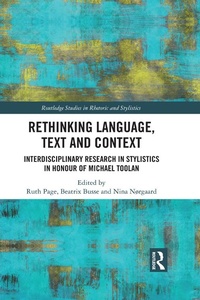
Rethinking Language, Text and Context
Interdisciplinary Research in Stylistics in Honour of Michael Toolan
1st Edition
Published on 14. August 2018
348 pages
978-1-351-18321-5 (ISBN)
Description

This collection of original research highlights the legacy of Michael Toolan's pioneering contributions to the field of stylistics and in so doing provides a critical overview of the ways in which language, text, and context are analyzed in the field and its related disciplines. Featuring work from an international range of contributors, the book illustrates how the field of stylistics has evolved in the 25 years since the publication of Toolan's seminal Language, Text and Context, which laid the foundation for the analysis of the language and style in literary texts. The volume demonstrates how technological innovations and the development of new interdisciplinary methodologies, including those from corpus, cognitive, and multimodal stylistics, point to the greater degree of interplay between language, text, and context exemplified in current research and how this dynamic relationship can be understood by featuring examples from a variety of texts and media. Underscoring the significance of Michael Toolan's extensive work in the field in the evolution of literary linguistic research, this volume is key reading for students and researchers in stylistics, discourse studies, corpus linguistics, and interdisciplinary literary studies.
More details
Series
Edition
1. Auflage
Language
English
Place of publication
London
United Kingdom
Publishing group
Taylor & Francis Ltd
Target group
College/higher education
Illustrations
36 Tables, black and white; 1 Line drawings, black and white; 8 Halftones, black and white; 47 Illustrations, black and white
ISBN-13
978-1-351-18321-5 (9781351183215)
Copyright in bibliographic data and cover images is held by Nielsen Book Services Limited or by the publishers or by their respective licensors: all rights reserved.
Schweitzer Classification
Other editions
Additional editions
Ruth Page | Beatrix Busse | Nina Norgaard
Rethinking Language, Text and Context
Interdisciplinary Research in Stylistics in Honour of Michael Toolan
Book
06/2020
1st Edition
Routledge
€53.22
Shipment within 15-20 days
Ruth Page | Beatrix Busse | Nina Norgaard
Rethinking Language, Text and Context
Interdisciplinary Research in Stylistics in Honour of Michael Toolan
Book
08/2018
1st Edition
Routledge
€206.40
Shipment within 15-20 days
Persons
Ruth Page is a Senior Lecturer at the University of Birmingham. Her publications include Stories and Social Media (Routledge, 2012), Narratives Online: Shared Stories and Social Media (2018), and Researching the Language of Social Media (Routledge, 2014). She is the editor of Discourse, Context & Media.
Beatrix Busse is Professor of English Linguistics at Heidelberg University. Her research interests include the history of English, English historical linguistic and Shakespeare studies, stylistics and corpus linguistics. She is the co-editor of the series Discourse Patterns and reviews editor of the International Journal of Corpus Linguistics.
Nina Norgaard is Associate Professor of Applied Linguistics and Director of the Centre for Multimodal Communication at the University of Southern Denmark. Her research interests lie within the fields of stylistics, multimodality, multimodal stylistics, critical discourse analysis and the semiotics of architecture. She has a keen interest in combining work and insights from the (traditionally separated) fields of stylistics and multimodality. Her major publications include Key Terms in Stylistics (2010; co-edited with Beatrix Busse and Rocio Montoro) and Multimodal Stylistics of the Novel: More than Words (2018).
Beatrix Busse is Professor of English Linguistics at Heidelberg University. Her research interests include the history of English, English historical linguistic and Shakespeare studies, stylistics and corpus linguistics. She is the co-editor of the series Discourse Patterns and reviews editor of the International Journal of Corpus Linguistics.
Nina Norgaard is Associate Professor of Applied Linguistics and Director of the Centre for Multimodal Communication at the University of Southern Denmark. Her research interests lie within the fields of stylistics, multimodality, multimodal stylistics, critical discourse analysis and the semiotics of architecture. She has a keen interest in combining work and insights from the (traditionally separated) fields of stylistics and multimodality. Her major publications include Key Terms in Stylistics (2010; co-edited with Beatrix Busse and Rocio Montoro) and Multimodal Stylistics of the Novel: More than Words (2018).
Content
Preface
Michael Burke
1. Introduction: Language, Text & Context Revisited.
Ruth Page, Beatrix Busse and Nina Norgaard
2. Covert Progression, Language and Context.
Dan Shen
3. La La Land: Counterfactuality, Disnarration and the Forked (Motorway) Path.
Marina Lambrou
4. Scribbling Suspense and Surprise.
Matt Evans and Mel Collins
5. Investigating Syntactic Simplicity in Popular Fiction: A Corpus Stylistics Approach.
Rocio Montoro
6. 'We work hard here': Exploring Person and Place Deixis in a Corpus of Historical Migrant Letters.
Emma Moreton
7. The Devil has all the Best Tunes: An Investigation of the Lexical Phenomenon of Brexit.
Lesley Jeffries and Dan McIntyre
8. Corpus Stylistics, Norms and Comparisons: Studying Speech in Great Expectations
Michaela Mahlberg and Viola Wiegand.
9. 'Intending to Mean, Pretending to Be': Reflections on the Limits on Genre.
Rukmini Bhaya Nair
10. Indeterminacy and Interpretation: What is Shown and what is Hidden in Michael Haneke's Cache.
Billy Clark
11. Reliability, Unreliability, Reader Manipulation and Plot Reversals: Strategies for Constructing and Challenging the Credibility of Characters in Agatha Christie's Detective Fiction.
Catherine Emmott and Marc Alexander
12. Metaphoric Interpretations of a Short Story by J.D. Salinger: A Reader Response Study.
Laura Hidalgo Downing
13. Winnie the Pooh Goes Paralinguistic.
Manuel Jobert
14. Quotation and Overhearing in Austen.
Joe Bray
15. Suppression, Silencing and Failure to Project: Ways of Losing Voice While Using It.
Chris Heffer
16. 'Hey YouTube': Positioning the Viewer in Vlogs.
Stephen Pihlaja
17. The Value of Intertextual Associations: How GM Technologies are Given Value Through Association.
Lexie Don
18. Public Women: Power, Gender and Semiotic Representations.
Carmen Rosa Caldas-Coulthard
19. The Citizen Caught Between Dialogue and Bureaucracy.
Wolfgang Teubert
Michael Burke
1. Introduction: Language, Text & Context Revisited.
Ruth Page, Beatrix Busse and Nina Norgaard
2. Covert Progression, Language and Context.
Dan Shen
3. La La Land: Counterfactuality, Disnarration and the Forked (Motorway) Path.
Marina Lambrou
4. Scribbling Suspense and Surprise.
Matt Evans and Mel Collins
5. Investigating Syntactic Simplicity in Popular Fiction: A Corpus Stylistics Approach.
Rocio Montoro
6. 'We work hard here': Exploring Person and Place Deixis in a Corpus of Historical Migrant Letters.
Emma Moreton
7. The Devil has all the Best Tunes: An Investigation of the Lexical Phenomenon of Brexit.
Lesley Jeffries and Dan McIntyre
8. Corpus Stylistics, Norms and Comparisons: Studying Speech in Great Expectations
Michaela Mahlberg and Viola Wiegand.
9. 'Intending to Mean, Pretending to Be': Reflections on the Limits on Genre.
Rukmini Bhaya Nair
10. Indeterminacy and Interpretation: What is Shown and what is Hidden in Michael Haneke's Cache.
Billy Clark
11. Reliability, Unreliability, Reader Manipulation and Plot Reversals: Strategies for Constructing and Challenging the Credibility of Characters in Agatha Christie's Detective Fiction.
Catherine Emmott and Marc Alexander
12. Metaphoric Interpretations of a Short Story by J.D. Salinger: A Reader Response Study.
Laura Hidalgo Downing
13. Winnie the Pooh Goes Paralinguistic.
Manuel Jobert
14. Quotation and Overhearing in Austen.
Joe Bray
15. Suppression, Silencing and Failure to Project: Ways of Losing Voice While Using It.
Chris Heffer
16. 'Hey YouTube': Positioning the Viewer in Vlogs.
Stephen Pihlaja
17. The Value of Intertextual Associations: How GM Technologies are Given Value Through Association.
Lexie Don
18. Public Women: Power, Gender and Semiotic Representations.
Carmen Rosa Caldas-Coulthard
19. The Citizen Caught Between Dialogue and Bureaucracy.
Wolfgang Teubert
