

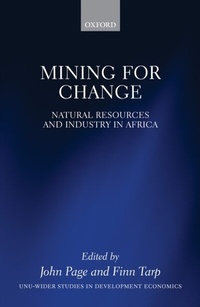
Mining for Change
Natural Resources and Industry in Africa
1st Edition
Published on 13. February 2020
496 pages
978-0-19-259186-9 (ISBN)
Description

For a growing number of countries in Africa the discovery and exploitation of natural resources is a great opportunity, but one accompanied by considerable risks. Countries dependent on oil, gas, and mining have tended to have weaker long-run growth, higher rates of poverty, and greater income inequality than less resource-abundant economies. For these resource producing economies relative prices make it more difficult to diversify into activities outside of the resource sector, limiting structural change.
Mining for Change: Natural Resources and Industry in Africa presents research undertaken to understand how better management of the revenues and opportunities associated with natural resources can accelerate diversification and structural change in Africa. It begins with essays on managing the boom, the construction sector, and linking industry to the major issues that frame the question of how to use natural resources for structural change. It reports the main research results for five countries-Ghana, Mozambique, Uganda, Tanzania and Zambia. Each country study covers managing the boom, the construction sector, and linking industry to the resource. Mining for Change argues that good policy can make a difference and sets out ideas for policy change and widening the options for structural change.
. An open access title available under the terms of a CC BY-NC-SA 3.0 IGO licence.
More details
Other editions
Additional editions
Book
02/2020
Oxford University Press
€151.60
Shipment within 15-20 days
Persons
John Page is a Senior Fellow in the Global Economy and Development Program at the Brookings Institution and a Non-resident Senior Fellow of the UNU World Institute for Development Economics Research (UNU-WIDER). He is also visiting professor at the National Graduate Institute for Policy Studies, Tokyo, Japan and a Research Associate of the Centre for the Study of African Economies at Oxford University. From 1980 to 2008 he was at the World Bank where his senior positions included: Director, Poverty Reduction, Director, Economic Policy, and Chief Economist, Africa. He is the author of several books and more than 100 published papers on economic development.
Finn Tarp is Professor at the University of Copenhagen (UCPH) and Coordinator of the UCPH Development Economics Research Group (DERG). Director of UNU-WIDER from 2009 to 2018, and now a Non-Resident Senior Fellow of UNU-WIDER. Professor Tarp is a leading international expert on development strategy and foreign aid, with an interest in poverty, income distribution and growth, micro- and macroeconomic policy and modelling, agricultural sector policy and planning, household/enterprise development, and economic adjustment and reform as well as climate change, sustainability, and natural resources. He has published widely in leading economics and development journals and books by international academic publishers.
Content
- Cover
- Mining for Change: Natural Resources and Industry in Africa
- Copyright
- Foreword
- Acknowledgements
- Contents
- List of Figures
- List of Tables
- List of Abbreviations
- Notes on Contributors
- 1: Overview
- 1. Introduction
- 2. Resource abundance, risk, and diversification
- 2.1 Commodity prices and volatility
- 2.2 Resource abundance and structural change
- 2.3 Implications for long-run growth
- 3. Understanding the boom
- 3.1 How much revenue and when?
- 3.2 Save or spend?
- 3.3 Paying it forward: debt financing
- 3.4 Setting the rules
- 3.5 The quality of public spending
- 4. The construction sector
- 4.1 Construction costs
- 4.2 Firm capabilities in construction
- 4.3 Materials, skills, finance
- 5. Rowing against the current: local content
- 5.1 The political economy of local content
- 5.2 Linking industry to the resource
- 6. Conclusions
- References
- PART I: FRAMING THE ISSUES
- 2: Understanding the Boom
- 1. Introduction
- 2. Sequence and timing
- 2.1 A sequence of asset transformations
- 2.2 The legal and institutional context
- 3. The literature
- 3.1 'Dutch disease' and volatility
- 3.2 Natural resources and institutions
- 4. Magnitudes
- 4.1 The construction sector and jobs
- 4.2 The environment for private business
- 4.3 Fiscal and monetary policy management
- 5. Institutions and policy stance
- Acknowledgements
- References
- 3: The Construction Sector in Developing Countries: Some Key Issues
- 1. Introduction
- 2. Background
- 3. Construction costs across time and space
- 3.1 What do we know about differences in unit costs?
- 3.2 How do construction costs affect the link between investment effort and investment outcomes?
- 4. Key bottlenecks in the construction sector
- 4.1 Organization and capabilities
- 4.2 Institutional constraints
- 4.2.1 Procurement
- 4.2.2 Financing
- 4.3 Critical inputs
- 4.4 Governance and corruption
- 5. Policy options
- 5.1 Institutional and regulatory reforms
- 5.2 Procurement and local content
- 6. Conclusion
- Acknowledgements
- References
- 4: Rowing against the Current: Economic Diversification in Africa
- 1. Introduction
- 2. Diversification initiatives
- 3. Dealing with Dutch disease
- 3.1 Regulatory reform
- 3.2 Infrastructure and skills
- 4. Linking industry to the resource
- 4.1 Building a public-private partnership
- 4.2 Improving coordination and reducing complexity
- 4.3 Training
- 5. Widening the options
- 5.1 Industries without smokestacks
- 5.2 Investing in knowledge
- 6. Conclusions
- References
- PART II: COUNTRY STUDIES
- 5: The Boom, the Bust, and the Dynamics of Oil Resource Management in Ghana
- 1. Introduction
- 2. Petroleum production and exploration in Ghana
- 2.1 Regulating exploration and production
- 2.2 The state of oil production
- 2.3 Comparing production with other African countries
- 2.4 Negotiating petroleum agreements in Ghana
- 3. Transparency and accountability measures
- 4. Petroleum revenues framework
- 5. Oil and macroeconomic performance
- 5.1 Dutch disease
- 5.2 Local content regulations
- 6. Conclusion
- References
- 6: The Construction Sector in Ghana
- 1. Introduction
- 2. Marginal costs of construction
- 2.1 Analyses of subsector costs
- 2.1.1 The housing subsector
- 2.1.2 Roads, drainage, and other social infrastructure subsectors
- 2.2 Patterns of inflation and subsector costs
- 2.3 Structure of the construction industry
- 2.4 Expenditure shocks and price dynamics
- 3. Bottlenecks to the supply response of the construction sector
- 3.1 Access to land and permits
- 3.2 Access to critical inputs
- 3.2.1 Skilled labour
- 3.2.2 Raw materials
- 3.3 Organization and capacity
- 3. Institutional and policy reforms in the construction sector
- References
- 7: Local Content Law and Practice: The Case of Ghana
- 1. Introduction
- 2. Contextualizing natural resource extraction and national development
- 3. The oil and gas sector, local content, and local participation
- 4. Policy and legislative development on local content and local participation in Ghana's oil and gas value chain
- 4.1 Policy development process
- 4.2 Legislative development process
- 5. Implementation of the local content policy and law on oil and gas in Ghana
- 5.1 Institutional arrangements for local content implementation
- 6. Current level of goods and services supplied by Ghanaian companies
- 7. Recruitment, training, and promotion of Ghanaian nationals for jobs in the oil sector
- 8. 'Local local' content
- 9. Challenges of local content implementation in Ghana's oil and gas sector
- 9.1 Local business capacities in the oil and gas industry
- 9.2 Discrimination against indigenous companies
- 9.3 Regulatory institutional challenges
- 10. Options for increasing local participation in the oil and gas industry in Ghana
- 11. Conclusion and policy recommendations
- Acknowledgements
- References
- 8: Mozambique-Bust before Boom: Reflections on Investment Surges and New Gas
- 1. Introduction
- 2. Mozambique's investment surge post-2010
- 3. The effects of an investment surge
- 4. Mozambique expectations and realities
- 5. A few implications
- 5.1 The fiscal starting point
- 5.2 Foregone opportunities
- 5.3 Macroeconomic choices
- 5.4 A sovereign wealth fund
- 5.5 Investing for structural transformation
- 6. The epidemiology of the investment boom problem
- 6.1 Macroeconomic problems
- 6.2 Fiscal financing problems
- 6.3 Transition problems
- Acknowledgements
- References
- 9: The Construction Sector in Mozambique
- 1. Introduction
- 2. Construction and development: conceptual approach
- 3. Overall evolution of the national economy since independence in 1975
- 4. Construction sector analysis
- 4.1 Historical background in Mozambique
- 4.1.1 Financing sources for construction projects
- 4.1.2 Structure of companies in the construction sector
- 4.1.3 Institutional features
- 4.2 Building materials sector
- 4.3 Construction sector value chain
- 4.4 Construction costs, household income levels, and procurement issues
- 5. Construction sector: bottlenecks and recommendations
- 6. Conclusion
- Acknowledgements
- References
- 10: Local Content and the Prospects for Economic Diversification in Mozambique
- 1. Introduction
- 2. The country and its extractive industries
- 3. Facing up to the fiscal crisis
- 4. The policy environment
- 4.1 Political trajectory of the policy environment
- 4.2 Industrial policy and MSME development
- 4.3 Local content and social investment in local economic development
- 5. Summary
- References
- 11: Gas in Tanzania: Adapting to New Realities
- 1. Introduction
- 2. The magnitude and timing of a prospective resource boom
- 2.1 Risks
- 2.1.1 Geological and engineering challenges
- 2.1.2 Market and commercial risks
- 2.1.3 Policy risks: the 'authorising environment'
- 2.2 Projections: production and prices
- 2.3 Projections: fiscal terms and cost recovery
- 3. Public policy and risk
- 3.1 Legal and regulatory requirements
- 3.2 Policy co-ordination and the authorizing environment
- 4. Public policy and the contribution of natural resources to growth, structural change, and industrialization
- 4.1 Jobs and construction
- 4.2 Externalities and private investment
- 4.3 Fiscal policy management and public investment
- 5. Conclusion
- Acknowledgements
- References
- 12: The Construction Sector in Tanzania
- 1. Introduction
- 2. Structure of the construction sector
- 2.1 Ministry of Works, Transport and Communication (MoWTC)
- 2.1.1 Architects and Quantity Surveyors Registration Board (AQRB)
- 2.1.2 Engineers Registration Board (ERB)
- 2.1.3 The Contractors Registration Board (CRB)
- 2.2 Clients
- 3. Behaviour of construction prices
- 3.1 Investment shocks in the construction sector
- 4. Key bottlenecks to supply response
- 4.1 Land issues in Tanzania
- 4.2 Issuance of construction permits in Tanzania
- 4.3 Skilled labour
- 4.4 Construction materials and equipment
- 5. Conclusion and policy recommendations
- 5.1 Raw materials and construction equipment/plant
- 5.2 Skills shortage
- 5.3 Access to land and construction permits
- 5.4 Contractors' challenges
- Acknowledgements
- References
- 13: Local Content: Are There Benefits for Tanzania?
- 1. Introduction
- 2. Local content legislation in Tanzanian extractive industries
- 2.1 General legislation
- 2.2 Mining sector
- 2.2.1 Background
- 2.2.2 Current local content
- 2.3 Oil and natural gas
- 2.3.1 Background
- 2.3.2 Current local content
- 3. Management of local content policies in Tanzania
- 4. Evaluating Tanzania's local content policies
- 4.1 Qualitative research
- 4.2 Testing for the impact of local content policy using the ASIP
- 5. Quantifying the value of local content using the 2013 Industrial Census
- 6. Lessons for Tanzania from country experiences with local content legislation
- 6.1 Quantitative analyses
- 6.2 Qualitative evidence
- 6.3 Summarizing the evidence
- 7. Conclusion
- References
- 14: Uganda's Oil: How Much, When, and How Will It Be Governed?
- 1. Introduction
- 2. Timing and sequencing of the oil boom
- 2.1 Uganda's oil timeline thus far
- 2.1.1 Exploration during colonial times
- 2.1.2 Exploration after independence
- 2.1.3 Slowdown of exploration activity and development of current legal framework
- 2.1.4 Development of infrastructure required for production
- 2.1.5 Critical infrastructure project 1: oil refinery
- 2.1.6 Critical infrastructure project 2: oil pipeline
- 2.2 Forecast of size and timing of revenue stream
- 2.2.1 Critical forecast sensitivity 1: oil price
- 2.2.2 Critical forecast sensitivity 2: recoverable reserves
- 2.2.3 Critical forecast sensitivity 3: delays
- 2.2.4 Revenue projections
- 3. Is Uganda ready for oil to flow?
- 3.1 Expectations for the oil sector
- 3.2 The current governance framework and its shortcomings
- 3.2.1 Ambiguity regarding the fiscal anchor and sovereign wealth fund
- 3.2.2 Vulnerability to price and political shocks
- 3.2.3 Narrow focus on development spending
- 3.3.3 Mitigating the risk of Dutch disease
- 3.3.4 How much to spend: the choice of fiscal rule
- 3.3.5 Poor quality of public investment management
- 4. Conclusion
- Acknowledgements
- References
- Government documents
- News reports
- Reference papers
- 15: Construction and Public Procurement in Uganda
- 1. Introduction
- 2. Overview and market structure of the construction sector
- 2.1 Demand side: the role of government contracts
- 2.2 Supply side: firm-level evidence
- 3. Regulatory framework and main stakeholders
- 3.1 Public procurement and the central role of PPDA
- 3.2 Doing business with the government
- 3.2.1 Choice of procurement method
- 3.2.2 Evaluation phase
- 3.3 Stakeholders in the construction sector
- 3.3.1 Main stakeholders in public procurement
- 3.3.2 Additional stakeholders
- 4. Challenges to sector development and efficiency
- 4.1 Corruption and inefficiency in public procurement
- 4.2 Access to finance
- 4.3 Marginal costs of construction
- 5. Conclusion
- Acknowledgements
- References
- 16: Enhancing Local Content in Uganda
- 1. Introduction
- 2. Prospects for local supplier development
- 3. The local content management framework
- 3.1 Overview of local content requirements in Uganda's oil industry
- 3.2 Evaluation of local content requirements
- 3.2.1 Clarity of scope and provisions for measurement
- 3.2.2 Presence of monitoring mechanisms
- 3.2.3 Feasibility of implementation
- 4. Assessing domestic supplier capabilities in Uganda
- 4.1 How are local firms integrated into the natural resource value chain?
- 4.2 What capabilities do domestic firms have to enter the resource value chain?
- 5. Conclusion
- References
- 17: The Boom-Bust Cycle of Global Copper Prices, Structural Change, and Industrial Development in Zambia
- 1. Introduction
- 2. Zambia's economic and political context
- 3. Extent of the mineral resource
- 4. How large are the resource revenues likely to be?
- 5. When are the revenues likely to come on line?
- 6. Fiscal policy and managing copper booms
- 7. How much spending? Fiscal projections
- 8. Revenue-sharing arrangements
- 9. Reducing sovereign debt
- 10. Exchange rate
- 11. Fiscal rules
- 12. Public investment
- 13. Conclusions
- References
- 18: The Construction Sector in Zambia
- 1. Introduction
- 2. Organization and change in Zambia's construction industry
- 2.1 Demographic, political and economic changes, and construction in Zambia
- 2.2 Construction industry organization: cost and pricing implications
- 2.3 Construction regulations and public institutions
- 2.3.1 Important procurement laws and regulations in construction in Zambia
- 2.3.2 Important governance and regulatory institutions and other stakeholders
- 3. Bottlenecks in the construction sector
- 3.1 Firm-level bottlenecks
- 3.2 Industry-wide bottlenecks
- 3.3 Macroeconomic factors serving as construction bottlenecks
- 4. Summary of options for dealing with key bottlenecks
- 4.1 Institutional, governance, and regulatory reforms
- 4.2 Industry-support policies and reforms
- References
- 19: Local Content in Zambia-a Faltering Experience?
- 1. Introduction
- 2. LC and industrialization: a brief review
- 2.1 What constitutes LC?
- 2.2 LC, economic linkages, industrialization, and structural change
- 2.3 The importance of technological change and entrepreneurship
- 2.4 Global and regional value chains and LC
- 3. The evolution of LC in Zambia
- 3.1 LC, manufacturing, and industrialization in Zambia: a historical perspective
- 3.1.1 LC and import-substitution industrialization, 1964-91
- 3.1.2 LC, market liberalization, and privatization, 1991-present
- 3.1.3 Privatization stymied LC development and the manufacturing sector
- 3.2 Current LC initiatives
- 3.3 LC, supply chains, and domestic supplier firms
- 4. The policy and legislative space for LC
- 5. LC and industrialization: the structural impediments
- 5.1 ISI: a defective industrialization and LC agenda?
- 5.2 Post-1991 reforms: an elusive industrialization and LC agenda?
- 6. Back to basics: mending the role of LC in industrialization
- 6.1 Improve the competitiveness and productivity of the manufacturing sector
- 6.1.1 Develop a domestic raw material base
- 6.1.2 Improve workforce skills
- 6.1.3 Improve R&D and innovation
- 6.2 Strengthen the policy and legislative base for LC growth and industrialization
- 6.2.1 Strengthening mineral legislation
- 6.2.2 Rationalizing the use of incentives
- 6.2.3 Harmonizing legislation across sectors
- 6.3 Build the capabilities of endogenous SME manufacturing firms and suppliers
- 6.4 Strengthen the macroeconomic environment
- References
- PART III: POLICY IMPLICATIONS
- 20: Implications for Public Policy
- 1. Introduction
- 2. Managing a modest boom
- 2.1 Managing expectations
- 2.2 How much spending?
- 2.3 Improving the quality of public spending
- 3. Construction and 'investing to invest'
- 3.1 Increasing the capabilities of local contractors
- 3.2 Relaxing supply constraints
- 3.3 Dealing with corruption and collusion
- 4. Linking industry to the resource
- 4.1 Local content
- 4.2 A public-private partnership
- 4.3 Training
- 5. Widening the options
- 5.1 Dealing with Dutch disease
- 5.2 Broadening the horizon: industries without smokestacks and investing in knowledge
- 5.3 Spatial industrial policy
- 6. Conclusions
- References
- Index
