

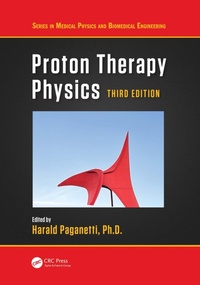
Proton Therapy Physics
3rd Edition
Published on 20. March 2025
700 pages
978-1-040-27670-9 (ISBN)
Description

Expanding on the highly successful previous two editions, this third edition of Proton Therapy Physics has been updated throughout and includes several new chapters on "Adaptive Proton Therapy," "Imaging for Planning," "Flash Proton Therapy," and "Outcome Modeling for Patient Selection." Suitable for both newcomers in medical physics and more seasoned specialists in radiation oncology, this book provides an in-depth overview of the physics of this radiation therapy modality, eliminating the need to dig through information scattered across medical physics literature.
After tracing the history of proton therapy, this book explores the atomic and nuclear physics background necessary for understanding proton interactions with tissue. The text then covers dosimetry, including beam delivery, shielding aspects, computer simulations, detector systems, and measuring techniques for reference dosimetry. Important for daily operations, acceptance testing, commissioning, quality assurance, and monitor unit calibrations are outlined. This book moves on to discussions of imaging for planning and image guidance as well as treatment monitoring. Aspects of treatment planning for single- and multiple-field uniform doses, dose calculation concepts and algorithms, and precision and uncertainties for nonmoving and moving targets are outlined. Finally, the biological implications of using protons from a physics perspective as well as outcome modeling are discussed.
This book is an ideal practical guide for physicians, dosimetrists, radiation therapists, and physicists who already have some experience in radiation oncology. It is also an invaluable reference for graduate students in medical physics programs, physicians in their last year of medical school or residency, and those considering a career in medical physics.
Key Features:
* Updated with the latest technologies and methods in the field, covering all delivery methods of proton therapy, including beam scanning and passive scattering.
* Discusses clinical aspects, such as treatment planning and quality assurance.
* Offers insight into the past, present, and future of proton therapy from a physics perspective.
Dr. Harald Paganetti is a distinguished figure in the field of radiation oncology, serving as Professor of Radiation Oncology at Harvard Medical School and Director of Physics Research at Massachusetts General Hospital. He earned his PhD in experimental nuclear physics from the Rheinische-Friedrich-Wilhelms University in Bonn, Germany, in 1992.
After tracing the history of proton therapy, this book explores the atomic and nuclear physics background necessary for understanding proton interactions with tissue. The text then covers dosimetry, including beam delivery, shielding aspects, computer simulations, detector systems, and measuring techniques for reference dosimetry. Important for daily operations, acceptance testing, commissioning, quality assurance, and monitor unit calibrations are outlined. This book moves on to discussions of imaging for planning and image guidance as well as treatment monitoring. Aspects of treatment planning for single- and multiple-field uniform doses, dose calculation concepts and algorithms, and precision and uncertainties for nonmoving and moving targets are outlined. Finally, the biological implications of using protons from a physics perspective as well as outcome modeling are discussed.
This book is an ideal practical guide for physicians, dosimetrists, radiation therapists, and physicists who already have some experience in radiation oncology. It is also an invaluable reference for graduate students in medical physics programs, physicians in their last year of medical school or residency, and those considering a career in medical physics.
Key Features:
* Updated with the latest technologies and methods in the field, covering all delivery methods of proton therapy, including beam scanning and passive scattering.
* Discusses clinical aspects, such as treatment planning and quality assurance.
* Offers insight into the past, present, and future of proton therapy from a physics perspective.
Dr. Harald Paganetti is a distinguished figure in the field of radiation oncology, serving as Professor of Radiation Oncology at Harvard Medical School and Director of Physics Research at Massachusetts General Hospital. He earned his PhD in experimental nuclear physics from the Rheinische-Friedrich-Wilhelms University in Bonn, Germany, in 1992.
Reviews / Votes
The third edition improves on an excellent book, finding a new balance between traditional and innovative subjects. The basics of proton therapy are covered with the same quality and depth as in previous editions. Some of the introductory chapters are by different authors, which allows for a fresh look at aspects like proton therapy physics or pencil beam scanning. Then, chapters are dedicated to more recent developments in proton therapy, such as ultra-high dose rate and FLASH, accurate methods for proton range estimation based on CT imaging, and (online) adaptive proton therapy.Interestingly, the last section on Biological Effects and Outcomes has been expanded, and it now includes a chapter dedicated to the use of outcome modeling for patient selection. Accurate patient selection is crucial for proton therapy worldwide, and it is great for physicists to have the chance to appreciate the bigger picture of this radiation therapy technique and see how they can contribute to it in many aspects.
As in previous editions, all chapters are written by renowned experts. The text strikes an excellent balance between depth and accessibility, making it an engaging and enjoyable read for both experts and those new to proton therapy, including students, residents, and scientists.
- Marco Schwarz, Professor at University of Washington, April 2025
More details
Series
Edition
3rd edition
Language
English
Place of publication
London
United Kingdom
Publishing group
Taylor & Francis Ltd
Target group
Professional and scholarly
College/higher education
Illustrations
14 Tables, black and white; 69 Line drawings, color; 99 Line drawings, black and white; 81 Halftones, color; 19 Halftones, black and white; 150 Illustrations, color; 118 Illustrations, black and white
File size
46,99 MB
ISBN-13
978-1-040-27670-9 (9781040276709)
Copyright in bibliographic data and cover images is held by Nielsen Book Services Limited or by the publishers or by their respective licensors: all rights reserved.
Schweitzer Classification
Other editions
Additional editions
Harald Paganetti, Ph.D.
Proton Therapy Physics
Book
03/2025
3rd Edition
CRC Press
€183.40
Shipment within 10-20 days
Person
Dr. Harald Paganetti is a distinguished figure in the field of radiation oncology, serving as Professor of Radiation Oncology at Harvard Medical School and Director of Physics Research at Massachusetts General Hospital. He earned his PhD in experimental nuclear physics from the Rheinische-Friedrich-Wilhelms University in Bonn, Germany, in 1992.
Content
Chapter 1: Proton Therapy: History and Rationale. Chapter 2: Physics of Proton Interactions in Matter. Chapter 3: Proton Accelerators and Gantries. Chapter 4: Proton Beam Scanning. Chapter 5: Beam Delivery Using Passive Scattering. Chapter 6: Proton FLASH Radiotherapy. Chapter 7: Secondary Radiation Production, Shielding and Activation. Chapter 8: Detectors, Relative Dosimetry, and Microdosimetry. Chapter 9: Absolute and Reference Dosimetry. Chapter 10: Monitor Unit Calculation. Chapter 11: Monte Carlo Simulations in Proton Therapy. Chapter 12: Acceptance Testing and Commissioning. Chapter 13: Quality Assurance. Chapter 14: In Vivo Treatment Verification. Chapter 15: Image Guidance in Proton Therapy. Chapter 16: Imaging for Treatment Planning. Chapter 17: Dose Calculation Algorithms. Chapter 18: Physics of Treatment Planning for Single-Field Uniform Dose. Chapter 19: Physics of Treatment Planning Using Scanned Beams. Chapter 20: Precision and Uncertainties in Planning and Delivery. Chapter 21: Precision and Uncertainties for Moving Targets. Chapter 22: Treatment Plan Optimization. Chapter 23: Adaptive Proton Therapy. Chapter 24: The Physics of Proton Biology. Chapter 25: Fully Exploiting the Benefits of Protons: Using Risk Models for Normal Tissue Complications in Treatment Optimization. Chapter 26: Outcome Modeling for Treatment Selection. Index.
