


Developments in German Politics 4
4th Edition
Published on 24. July 2014
352 pages
978-1-137-30164-2 (ISBN)
Description

This provides authoritative coverage as well as wide-ranging and integrated analysis of politics and policy in Germany today and of its role in Europe and the wider world. Bringing together extensively revised and updated chapters by leading authorities, it will be essential for students and anyone interested in European politics.
More details
Series
Edition
4th edition
Language
English
Place of publication
London
United Kingdom
Publishing group
Bloomsbury Publishing PLC
ISBN-13
978-1-137-30164-2 (9781137301642)
Copyright in bibliographic data and cover images is held by Nielsen Book Services Limited or by the publishers or by their respective licensors: all rights reserved.
Schweitzer Classification
Other editions
Additional editions
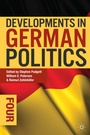
Stephen Padgett | William E. Paterson | Reimut Zohlnhöfer
Developments in German Politics 4
Book
07/2014
4th Edition
Red Globe Press
€62.80
Shipment within 10-20 days
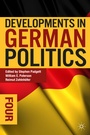
Stephen Padgett | William E. Paterson | Reimut Zohlnhöfer
Developments in German Politics 4
Book
07/2014
4th Edition
Red Globe Press
€192.70
Shipment within 10-20 days
Content
- Cover
- Introduction
- From sick man of Europe to economic powerhouse
- Explaining the reform miracle
- Withstanding the global economic crisis
- The political context
- Partisan de-alignment and electoral volatility
- Political protest and the 'angry citizen'
- Party system fragmentation
- Political leadership
- Germany's shrinking European vocation
- Germany and the eurozone crisis
- Foreign and security policy
- 1 Government at the Centre
- The federal government in context
- Inside the federal executive
- Chancellor, chancellery, party and coalition
- What future for the centre?
- 2 The Reform of German Federalism
- The evolution of Germany's federal system
- Uniformity in diversity
- The need to reform German federalism
- The first federal reform commission
- The outcome of the First Federal Reform Commission
- Taking forward the reform agenda: the new grand coalition
- The second set of federal reforms: tackling financial relations
- Understanding non-reform: the two faces of German federalism
- Conclusion
- 3 Partisan Dealignment and Voting Choice
- The erosion of traditional party loyalties
- From habituation to voter choice
- The changing basis of electoral choice
- The two German electorates
- 4 Parties and the Party System
- The party system: an overview
- Growing fragmentation and less reliable voters
- A shrinking party on the ground
- Organizational reform
- Leadership change and policy reforms
- The stability of the party in government
- Conclusion
- 5 Political Leadership
- The institutional parameters of executive leadership
- Patterns of leadership selection
- Assessing leadership performance
- The presidentialization of political leadership
- Conclusion
- 6 The Politics of Social Protest
- Patterns and trends in the social movement sector
- Reactions to and impacts of protest politics
- Comparative aspects and outlook
- 7 The German Model in Transition
- Fundamental features of the German model
- Continuity and change in the German model
- The German model and the great recession
- The German model and the crisis of the eurozone
- Conclusion
- 8 Economic Policy
- Germany's economic problems at the turn of the century
- The German 'economic policy reform miracle': adopting Agenda 2010 and beyond
- The German response to the financial crisis
- Back to normal? The economic policy reforms of the Christian-Liberal government since 2009
- Conclusion
- 9 Germany and the European Union
- The European context
- From reflexive multilateralism to reluctant hegemon
- Tremors but not (yet) an earthquake
- Merkel's European policy
- The changing parameters of domestic politics
- Changing bilateral relations
- Managing the euro crisis
- Conclusion
- 10 Germany and the Euro
- Monetary integration in Europe: a brief primer
- Germany and the euro
- Conflicts about the common currency
- The German experience with the euro since 1999
- The euro crisis after 2010
- Analysing the German response
- Conclusion
- 11 Foreign and Security Policy
- Germany in the EU and NATO
- Germany's changing security environment
- Libya and Germany's commitment to multilateral crisis management
- Germany on the global stage
- Conclusion
- 12 Welfare State Reform and Social Policy
- Historical overview
- Pension and labour market reforms
- Family policy reforms
- Socio-economic outcomes
- Drivers of change
- Conclusion
- 13 Energy and Climate Protection Policy
- Climate protection and energy: trends and targets
- Policy context
- Energy security
- Sustainability
- Economic efficiency/affordability
- Managing the Energiewende
- Conclusion
- 14 Citizenship, Migration and Cultural Pluralism
- Historical background
- The reassessment of labour migration
- The quest for integration and citizenship
- Ethnic Germans, asylum and family reunification
- Conclusion
- Guide to Further Reading
- Bibliography
- Index
