

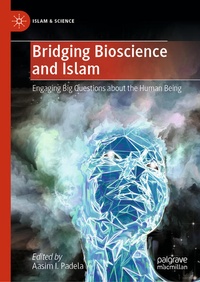
Bridging Bioscience and Islam
Description

This book advances scholarly discourse at the interface of Islam, biomedicine, and the human being. Most commonly, discourses between science and religion center on conflict and commensurability. As the truth claims of one domain of knowledge are measured against the claims from the other, scholars, students, and members of the interested public seek to identify areas of contention, zones of overlap, and spaces for alignment. Recent advancements in neuroscience, genetics, and exobiology have yielded new data about the human being, thus providing avenues for renewed dialogue between science and religion. This volume seizes this opportunity to address fundamental questions about the human being by bridging bioscientific and Islamic understandings. Specifically, the volume brings together scientists, theologians, and educators to tackle questions of human origin, nature/essence, capacities, fatedness, future, and uniqueness, and to reflect upon teaching at the Islam and science interface. In doing so, it offers fresh multidisciplinary discussions on epistemology, theological anthropology, moral theology, ontology, and bioethics while centering discussions on the human being.
Reviews / Votes
"
Bridging Bioscience and Islam
is a compelling and urgently needed resource for educators, offering a rich intellectual framework for teaching science while engaging the profound questions students already carry about life, human origins, agency, and purpose. By challenging the assumed divide between Islam and bioscience, this volume empowers educators to move beyond compartmentalised curricula and model an integrated, confident approach to knowledge-one that nurtures coherent identities, ethical depth, and rigorous scientific inquiry." (Nadeem Memon, Centre for Islamic Thought and Education, Adelaide University, Australia)
"Asking what it means to be human is to stand at the crossroads of knowledge traditions. As bioscience probes origins, capacities and futures through empirical inquiry, Islam reflects on the human being through revelation, metaphysics and moral purpose. This book inhabits that crossroads, not to arbitrate between competing truths but to cultivate a disciplined conversation; one that bridges methods, honors epistemic limits and realigns the human being as both a biological reality and a theologically meaningful subject. In doing so, the book offers a timely and rigorous contribution to contemporary conversations at the intersection of Islam and science, specifically the life sciences." (Shaikh Mohd Saifuddeen, Institute of Islamic Understanding Malaysia, Kuala Lumpur, Malaysia)
"
Bridging Bioscience and Islam
offers an intricate and deep dive into pre-modern Islamic theology, retrieving its rich intellectual traditions to serve as vital resources for contemporary bioethical inquiry. Bridging classical scholarship with modern bioscience allows authors to demonstrate how early frameworks of knowledge might provide meaningful answers to the most complex "Big Questions" facing humanity today." (Ebrahim Moosa, Mirza Family Professor in Islamic Thought & Muslim Societies, University of Notre Dame; author of "Muslim Theological Encounters with Science" (2026))
"
Bridging Bioscience and Islam
is a rigorously edited and accomplished volume that makes a substantive contribution to scholarship and pedagogy at the intersection of Islam and the biosciences. Authored by leading educators and researchers, its chapters combine pedagogical clarity with deep scholarly engagement, offering evaluative frameworks, normative insights, and original analysis. Filling critical lacunae across Islamic studies, bioethics, and the medical humanities, this work is an essential resource for academics, educators, and professionals navigating religion-science discourse." (Özgür Koca, Associate Professor of Islamic Studies and Philosophy at Bayan Islamic Graduate School; Author "Islam, Causality, and Freedom: From the Medieval to the Modern Era" (2020) and "Islam, Causality, and Science: Perspectives on Reconciliation of Islamic Tradition and Modern Science" (2024))
More details
Other editions
Additional editions
Person
Aasim I. Padela , MD, MSc, is a physician-scholar and internationally recognized thought and research leader at the intersection of Islam and biomedicine. A tenured Professor of Emergency Medicine, Bioethics, and the Medical Humanities at the Medical College of Wisconsin, he also founded the Initiative on Islam and Medicine, a leading nonprofit 'think-and-do' tank.
Content
Part I. Preliminaries on the Engagement of Islam and Bioscience .- 1. Introduction: Islam, Bioscience, and the Human Being.- 2. First Principles, Certainty, and Uncertainty: Unburdening Ourselves of the Science.- Part II. Core Chapters Bridging Islamic and Bioscientific Knowledge to Address "Big Questions" about the Human Being .- 3. Scientific Advances in Understanding Human Nature: An Islamic Occasionalist Perspective.- 4. Human Origins and Evolution in Light of Revealed Truths: Theological Anthropology, Scholarly Consensus, and Similarity.- 5. Are We Programmed or Do We Have Free Will? Discussions on Fate and Genetic Determinism in Islam and Bioscience.- 6. Assessing Evidence for Extraterrestrial Intelligent Life and Implications for Human Uniqueness.- 7. Is Human Height Changing, and Should Medicine Intervene? Transhumanism, Biomedicine, and Islamic Bioethics.- 8. Radical Life Extension: Intersecting Bioscientific Possibilities and Islamic Sensibilities Raudah M. Yunus.- Part III. Practical Perspectives from the Field .- 9. The Importance of Teaching Muslim Students about Scientific and Religious Constructions of the Human Being.- 10. Addressing "Big Questions" about the Human Being through Bioscience and Islam: Findings from an Educational Intervention across Two Countries.
