

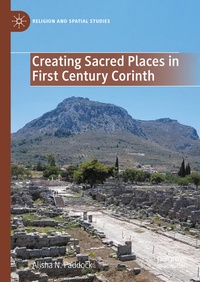
Creating Sacred Places in First Century Corinth
Description

This book applies spatial theories from human and cultural geography to the archaeological remains of Ancient Corinth in order to consider how sacred places could have been created in the first century. Building on Philip Sheldrake's theory, among others, the book defines sacred place as a space with significance. Significance is found in the group's spiritual history, their identity, and the proper behaviours required to keep the group remaining a group. The book further argues that if any of these elements of place are not recognized nor upheld, the group risks becoming placeless.
More details
Other editions
Additional editions
Person
Dr. Alisha N. Paddock graduated from Manhattan Christian College (MCC) with a B.A. in Cross-Cultural Ministry in 2002. She went on to receive her Master of Divinity with New Testament Concentration from Emmanuel Christian Seminary at Milligan University in 2007. While teaching New Testament and Greek courses at MCC, she pursued her Ph.D. in Religious Studies from the University of Birmingham (UK).
Content
CHAPTER 1: Introduction.- CHAPTER 2: The Spaces of Corinth.- CHAPTER 3: The Spaces of Corinth.- CHAPTER 4: Place As History in The Corinthian Ekklesia.- CHAPTER 5: Place As Identity in The Corinthian Ekklesia.- CHAPTER 6: Place As Behaviour in The Corinthian Ekklesia.- CHAPTER 7: Creating Sacred Places In First Century Corinth.
