

Shadow of Liberation
Description

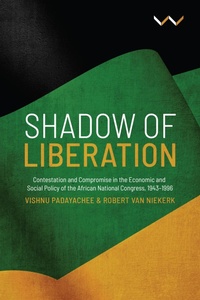
Shadow of Liberation explores the intricate twists, turns, contestations and compromises of ANC economic and social policymaking with a focus on the transition era of the 1990's and the early years of democracy
With the damning revelations by the Zondo Commission of Inquiry into State Capture on the massive corruption of the South African body politic, the timing of this book could not be more relevant. South Africans need to confront the economic and social policy choices that the liberation movement made and to see how these decisions may have facilitated the conditions for corruption to emerge and flourish. Answers are needed. Padayachee and van Niekerk focus their attention on the primary question of how and why the ANC, given its historical anti-inequality, re-distributive stance, come in the 1990s, to such a dramatic turn around and move towards an essentially market-dominated approach. Were they pushed or did they go willingly? What role if any did Western governments and international financial institutions play? And what of the role of the late apartheid state and South African business? Did leaders and comrades 'sell out' the ANC's emancipatory policy vision? Shadow of Liberation tries to provide answers to these questions drawing on the best available primary archival evidence as well as extensive interviews with key protagonists across the political, non-government and business spectrum. The authors argue that the ANC's emancipatory policy agenda was broadly to establish a social democratic welfare state upholding rights of social citizenship. However its economic policy framework to realise this emancipatory mission was either non-existent or egregiously misguided.
More details
Persons
Vishnu Padayachee is Distinguished Professor and Derek Schrier and Cecily Cameron Chair in Development Economics at the School of Economic and Business Sciences at the University of the Witwatersrand, Johannesburg. He was a member of the Steering Committee of the Macroeconomic Research Group (MERG).
Robert Van Niekerk (Author)
Robert van Niekerk is Chair of Public Governance at the Wits School of Governance. He was active in policy-making processes for a democratic South Africa in education and health during and after the 1990's transition era, including serving as a coordinator and policy analyst for the health section of the National Commission on Higher Education.
