

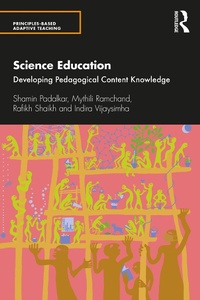
Science Education
Developing Pedagogical Content Knowledge
1st Edition
Published on 26. July 2022
220 pages
978-1-000-59166-8 (ISBN)
Description

The book presents key perspectives on teaching and learning science in India. It offers adaptive expertise to teachers and educators through a pedagogic content knowledge (PCK) approach. Using cases and episodes from Indian science classrooms to contextualise ideas and practices, the volume discusses the nature of science, and aspects of assessments and evaluations for both process skills and conceptual understanding of the subject. It examines the significance of science education at school level and focuses on meaningful learning and development of scientific and technological aptitude. The chapters deal with topics from physics, chemistry and biology at the middle- and secondary-school levels, and are designed to equip student-teachers with theoretical and practical knowledge abilities about science, science learning and the abilities to teach these topics along with teaching.
The book draws extensively from research on science education and teacher education and shifts away from knowledge transmission to the active process of constructivist teaching-learning practices. The authors use illustrative examples to highlight flexible planning for inclusive classrooms. Based on studies on cognitive and developmental psychology, pedagogical content knowledge of science, socio-cultural approaches to learning science, and the history and philosophy of science, the book promotes an understanding of science characterized by empirical criteria, logical arguments and sceptical reviews.
With its accessible style, examples, exercises and additional references, it will be useful for students and teachers of science, science educators, BEd and MEd programmes for education, secondary and higher secondary school teachers, curriculum designers and developers of science. It will interest research institutes, non-governmental organisations, professionals and public and private sector bodies involved in science outreach, science education and teaching and learning practices.
The book draws extensively from research on science education and teacher education and shifts away from knowledge transmission to the active process of constructivist teaching-learning practices. The authors use illustrative examples to highlight flexible planning for inclusive classrooms. Based on studies on cognitive and developmental psychology, pedagogical content knowledge of science, socio-cultural approaches to learning science, and the history and philosophy of science, the book promotes an understanding of science characterized by empirical criteria, logical arguments and sceptical reviews.
With its accessible style, examples, exercises and additional references, it will be useful for students and teachers of science, science educators, BEd and MEd programmes for education, secondary and higher secondary school teachers, curriculum designers and developers of science. It will interest research institutes, non-governmental organisations, professionals and public and private sector bodies involved in science outreach, science education and teaching and learning practices.
More details
Series
Edition
1. Auflage
Language
English
Place of publication
London
United Kingdom
Publishing group
Taylor & Francis Ltd
Target group
College/higher education
Illustrations
25 Tables, black and white; 13 Line drawings, black and white; 13 Illustrations, black and white
ISBN-13
978-1-000-59166-8 (9781000591668)
Copyright in bibliographic data and cover images is held by Nielsen Book Services Limited or by the publishers or by their respective licensors: all rights reserved.
Schweitzer Classification
Other editions
Additional editions
Shamin Padalkar | Mythili Ramchand | Rafikh Shaikh
Science Education
Developing Pedagogical Content Knowledge
Book
07/2022
1st Edition
Routledge India
€61.10
Shipment within 15-20 days
Shamin Padalkar | Mythili Ramchand | Rafikh Shaikh
Science Education
Developing Pedagogical Content Knowledge
Book
07/2022
1st Edition
Routledge India
€205.40
Shipment within 15-20 days
Persons
Shamin Padalkar is Assistant Professor at the Centre of Excellence in Teacher Education (CETE, formerly CEIAR), Tata Institute of Social Sciences, Mumbai, India. She teaches courses on cognition and learning and science education. She has a master's degree in physics and a doctoral degree in science education. Her research interests are visuospatial thinking and representational competence in science, nature of science and teacher education. She was involved in the Connected Learning Initiative and is now engaged with CL4STEM, an international collaboration with Bhutan, Nigeria and Tanzania.
Mythili Ramchand is Professor at at the Centre of Excellence in Teacher Education (CETE), Tata Institute of Social Sciences, Mumbai, India. She teaches philosophy of education and action research. Currently, she anchors a unique Post Graduation Certification programme on Contemporary Education Perspectives for teacher-educators, offered by TISS. She is leading a comparative research on initial teacher education across BRICS countries and the UK. She has consulted for several organisations and been in the panel of committees on teacher education curriculum renewal and reforms.
Rafikh Shaikh works at the Centre for Excellence in Teacher Education (CETE), Tata Institute of Social Sciences, Mumbai, India. He teaches courses in science education and cognition. He has a master's degree in microbiology and is pursuing a PhD in Science Education. His research interests include education technology, computer-supported collaborative learning and frugal tools for science education. He has been involved in various science outreach programmes and received the Foldscope Fellowship from Foldscope Instrument-Stanford University.
Indira Vijaysimha is former Associate Professor, Azim Premji University, India, where she taught courses on science education, teacher development and sustainability education. She is a founder of the Poorna Trust which manages Poorna Learning Centre in Bangalore. She served as a member of the Academics and Pedagogy group of the Azim Premji Foundation and spearheaded a two-year quality improvement programme in collaboration with a BEd college. She continues to work in the areas of teacher education, sustainability education and science education.
Mythili Ramchand is Professor at at the Centre of Excellence in Teacher Education (CETE), Tata Institute of Social Sciences, Mumbai, India. She teaches philosophy of education and action research. Currently, she anchors a unique Post Graduation Certification programme on Contemporary Education Perspectives for teacher-educators, offered by TISS. She is leading a comparative research on initial teacher education across BRICS countries and the UK. She has consulted for several organisations and been in the panel of committees on teacher education curriculum renewal and reforms.
Rafikh Shaikh works at the Centre for Excellence in Teacher Education (CETE), Tata Institute of Social Sciences, Mumbai, India. He teaches courses in science education and cognition. He has a master's degree in microbiology and is pursuing a PhD in Science Education. His research interests include education technology, computer-supported collaborative learning and frugal tools for science education. He has been involved in various science outreach programmes and received the Foldscope Fellowship from Foldscope Instrument-Stanford University.
Indira Vijaysimha is former Associate Professor, Azim Premji University, India, where she taught courses on science education, teacher development and sustainability education. She is a founder of the Poorna Trust which manages Poorna Learning Centre in Bangalore. She served as a member of the Academics and Pedagogy group of the Azim Premji Foundation and spearheaded a two-year quality improvement programme in collaboration with a BEd college. She continues to work in the areas of teacher education, sustainability education and science education.
Content
Introduction, 1. Science Education: An Overview, 2. Nature of Science, 3. A Cognitive Approach to Learning Physics, 4. An Inquiry-Based Approach to Learning Chemistry, 5. A Socio-cultural Approach to Learning Biology, 6. Assessment in Science Education, 7. Inclusive Science Education, Appendix: Resources and Tools for Practice
