

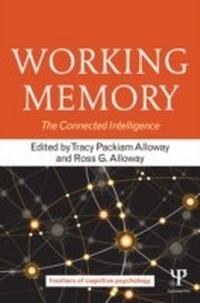
Working Memory
The Connected Intelligence
1st Edition
Published on 28. October 2013
320 pages
978-1-136-20816-4 (ISBN)
Description

Working memory - the conscious processing of information - is increasingly recognized as one of the most important aspects of intelligence. This fundamental cognitive skill is deeply connected to a great variety of human experience - from our childhood, to our old age, from our evolutionary past, to our digital future.
In this volume, leading psychologists review the latest research on working memory and consider what role it plays in development and over the lifespan. It is revealed how a strong working memory is connected with success (academically and acquiring expertise) and a poor working memory is connected with failure (addictive behavior and poor decision-making). The contributions also show how working memory played a role in our cognitive evolution and how the everyday things we do, such as what we eat and how much we sleep, can have an impact on how well it functions. Finally, the evidence on whether or not working memory training is beneficial is explored.
This volume is essential reading for students, researchers, and professionals with an interest in human memory and its improvement, including those working in cognitive psychology, cognitive neuroscience, developmental psychology, gerontology, education, health, and clinical psychology.
In this volume, leading psychologists review the latest research on working memory and consider what role it plays in development and over the lifespan. It is revealed how a strong working memory is connected with success (academically and acquiring expertise) and a poor working memory is connected with failure (addictive behavior and poor decision-making). The contributions also show how working memory played a role in our cognitive evolution and how the everyday things we do, such as what we eat and how much we sleep, can have an impact on how well it functions. Finally, the evidence on whether or not working memory training is beneficial is explored.
This volume is essential reading for students, researchers, and professionals with an interest in human memory and its improvement, including those working in cognitive psychology, cognitive neuroscience, developmental psychology, gerontology, education, health, and clinical psychology.
Reviews / Votes
"The collection's strength is its breadth: essays cover how working memory is related to general intelligence, specific expertise, and decision making; changes in working memory from childhood to old age; how working memory is affected by the body; and the potential for improvements in working memory through training...Summing Up: Recommended."- K. G. Akers, Emory University, for CHOICE, June 2013"This volume represents how the concept of working memory has increased in importance in contemporary psychology over the past 40 years. Once a concept relevant to cognitive psychologists, now analyses of working memory have been extended into practically every area of psychology -- intelligence, emotion, development, expertise, anxiety, emotion and addiction, among other topics. This volume provides cutting edge chapters by experts examining the central importance of working memory in contemporary psychology. The volume would be perfect for a seminar as well as an important reference for experts."-Henry L. Roediger, III, Ph.D., Washington University in St. Louis
More details
Series
Language
English
Place of publication
London
United Kingdom
Publishing group
Taylor & Francis Ltd
Target group
College/higher education
Product notice
Reflowable
Illustrations
22 s/w Abbildungen, 2 s/w Tabellen, 22 s/w Zeichnungen
2 Tables, black and white; 22 Line drawings, black and white; 22 Illustrations, black and white
File size
6,52 MB
ISBN-13
978-1-136-20816-4 (9781136208164)
Copyright in bibliographic data and cover images is held by Nielsen Book Services Limited or by the publishers or by their respective licensors: all rights reserved.
Schweitzer Classification
Other editions
Additional editions
Book
12/2012
1st Edition
Psychology Press Ltd
€96.20
Shipment within 3-4 weeks
Book
12/2012
1st Edition
Psychology Press Ltd
€206.90
Shipment within 3-4 weeks
Persons
Tracy Packiam Alloway, Ph.D., is interested in the role of working memory in education, particularly in individuals with learning disorders. Her research has received widespread media attention and appeared in over 250 news articles. She has also been invited to comment on television and radio as an expert on working memory.
Ross G. Alloway, Ph.D., is involved in cutting-edge research on the impact of a highly saturated technological environment on the brain. He has co-published work on the growth and decline of working memory over the lifespan, as well as the importance of working memory in education, which was featured on the BBC Radio and in the UK Sunday Times.
Ross G. Alloway, Ph.D., is involved in cutting-edge research on the impact of a highly saturated technological environment on the brain. He has co-published work on the growth and decline of working memory over the lifespan, as well as the importance of working memory in education, which was featured on the BBC Radio and in the UK Sunday Times.
Content
Part I: Working Memory: The Connected Intelligence. T.P. Alloway, R.G. Alloway, Working Memory: An Introduction. A.R.A. Conway, B.N. Macnamara, P.M.J. Engel de Abreu, Working Memory and Intelligence: An Overview. F.L. Coolidge, T.Wynn, K.A. Overmann, The Evolution of Working Memory. Part II: Working Memory across the Lifespan. T.P. Alloway, R.G. Alloway, Working Memory in Development. C. Basak, E.M. Zelinski, A Hierarchical Model of Working Memory and its Change in Healthy Older Adults. Part III: Working Memory and Expertise. K.A. Ericsson, J.H. Moxley, Working Memory that Mediates Experts' Performance: Why it is Qualitatively Different from Traditional Working Memory. D.Z. Hambrick, E.J. Meinz, Working Memory Capacity and Musical Skill. Part IV: Working Memory and the Body and Mind. S. Kanoski, Working Memory and Diet. P. Whitney, P.J. Rosen, Sleep Deprivation and Performance: The Role of Working Memory. L. Visu-Petra, L. Cheie, A.C. Miu, Working Memory and Anxiety: Exploring the Interplay of Individual Differences across Development. A.S. Moss, D.A. Monti, A. Newberg, Working Memory and Mindfulness. Part V: Working Memory and Decision Making. A. Mattarella-Micke, S.L. Beilock, The Integration of Emotion and Cognitive Control. B.J. Nagel, M.M. Herting, A. Cservenka,Working Memory and Addictive Behavior. Part VI: The Future of Working Memory: Training. S.M. Jaeggi, M. Buschkuehl, Training Working Memory. C. Lustig, P.A. Reuter-Lorenz,Training Working Memory: Insights from Neuroimaging.
