

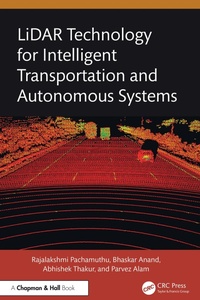
LiDAR Technology for Intelligent Transportation and Autonomous Systems
Published on 5. November 2025
272 pages
978-1-040-42707-1 (ISBN)
Description

This book explores the critical role of LiDAR technology in autonomous navigation and advanced driver assistance systems (ADAS). It explores the fundamental principles of LiDAR, comparing it with other sensor technologies like radar and cameras while examining the various types of LiDAR systems, including time-of-flight, flash, and frequency-modulated continuous wave systems. It emphasises real-world use cases, including setting up LiDAR data acquisition systems and addressing challenges like sensor calibration, alignment, and integration into autonomous systems.
* Discusses in detail LiDAR's working principles, laser pulse wavelengths, point cloud data, motion compensation, and datasets commonly used in LiDAR research.
* Examines the effects of ambient light, adverse weather conditions (rain, fog, snow), and practical strategies for mitigating these challenges.
* Describes advanced methods for object detection, segmentation, and multi-object tracking using LiDAR point clouds, including solutions like AnchorPoint and Smart3DMOT.
* Presents techniques for creating high-definition 3D maps and implementing SLAM (Simultaneous Localization and Mapping) that are essential for autonomous navigation.
* Offers practical insights into autonomous navigation, including LiDAR-based localization, path planning, obstacle avoidance, and real-world case studies like autonomous shuttles.
* Explores multi-LiDAR calibration, emphasizing alignment, fusion, and synchronization to enhance coverage and reduce blind spots in autonomous systems.
? Offers a detailed guide on open-source LiDAR processing tools like PCL, Open3D, and ROS for data handling and visualization.
By combining theoretical principles with practical applications and case studies, this book serves as a reference book for academics and researchers in computer science, electronics, communication engineering, and autonomous technologies.
* Discusses in detail LiDAR's working principles, laser pulse wavelengths, point cloud data, motion compensation, and datasets commonly used in LiDAR research.
* Examines the effects of ambient light, adverse weather conditions (rain, fog, snow), and practical strategies for mitigating these challenges.
* Describes advanced methods for object detection, segmentation, and multi-object tracking using LiDAR point clouds, including solutions like AnchorPoint and Smart3DMOT.
* Presents techniques for creating high-definition 3D maps and implementing SLAM (Simultaneous Localization and Mapping) that are essential for autonomous navigation.
* Offers practical insights into autonomous navigation, including LiDAR-based localization, path planning, obstacle avoidance, and real-world case studies like autonomous shuttles.
* Explores multi-LiDAR calibration, emphasizing alignment, fusion, and synchronization to enhance coverage and reduce blind spots in autonomous systems.
? Offers a detailed guide on open-source LiDAR processing tools like PCL, Open3D, and ROS for data handling and visualization.
By combining theoretical principles with practical applications and case studies, this book serves as a reference book for academics and researchers in computer science, electronics, communication engineering, and autonomous technologies.
More details
Language
English
Place of publication
London
United Kingdom
Publishing group
Taylor & Francis Ltd
Target group
Professional and scholarly
Illustrations
14 Tables, black and white; 58 Line drawings, black and white; 37 Halftones, black and white; 95 Illustrations, black and white
File size
26,25 MB
ISBN-13
978-1-040-42707-1 (9781040427071)
Copyright in bibliographic data and cover images is held by Nielsen Book Services Limited or by the publishers or by their respective licensors: all rights reserved.
Schweitzer Classification
Other editions
Additional editions
Rajalakshmi Pachamuthu | Bhaskar Anand | Abhishek Thakur
LiDAR Technology for Intelligent Transportation and Autonomous Systems
Book
11/2025
1st Edition
CRC Press
€207.90
Shipment within 15-20 days
Persons
Rajalakshmi Pachamuthu is currently a Professor at the Indian Institute of Technology Hyderabad, India, and the Project Director of the Technology Innovation Hub on Autonomous Navigation (TIHAN), a Section 8 company established at IIT Hyderabad under the National Mission on Interdisciplinary Cyber Physical Systems (NM-ICPS). She received a PhD from the Indian Institute of Technology Madras, India, in 2008. With more than 250 internationally reputed research publications, her research interests include Autonomous vehicles, Advanced Driver Assistance Systems (ADAS), drone-based sensing, the Internet of Things, artificial intelligence, cyber-physical systems, sensor networks, and wireless networks. She has directed 17 projects as a PI & Co-PI, including the Project Director TIHAN and Data Acquisition Systems (UAV, RoV.) under DST's NM-ICPS. She has been a member of various national and international bodies, including the Expert Committee - Engineering Sciences (Start-up Research Grant, National Post-Doctoral Fellowships, and Early Career Research Award Schemes) since July 2021. She was awarded as many awards, including 'CYIENT Chair Professor in Future Communications' at IITH in April 2021 for a period of 3 years and The Digital Trail Blazer Award 2016' by India Today in December 2016 at the National Level.
Bhaskar Anand received his PhD from the Indian Institute of Technology Hyderabad and his master's degree in communication systems from the Sardar Vallabhbhai National Institute of Technology (SVNIT) Surat, India, in 2016. He also worked as a Postdoctoral Fellow at TIHAN, Indian Institute of Technology Hyderabad, India. He is currently an Assistant Professor in the Department of Electronics and Communication Engineering at Koneru Lakshmaiah Education Foundation, Hyderabad, Telangana, India. His research interests include AI-based traffic sensing using LiDAR point cloud, sensor fusion, mapping and path planning for autonomous vehicles, and image processing.
Abhishek Thakur is currently a PhD research scholar with a prestigious prime minister's research fellow by the Government of India in the Department of Electrical Engineering at the Indian Institute of Technology Hyderabad, India. He received his Bachelor's degree in Electronics & Communication Engineering from the Indian Institute of Information Technology, Manipur, India, in 2019. He is also a member of the IEEE Intelligent Transportation Systems Society (ITSS) Committee on Young Professionals. His research interests include LiDAR-based Mapping and Localization for Autonomous Navigation, LiDAR data processing, and sensor fusion for Autonomous vehicles.
Parvez Alam is currently a PhD research scholar in the Department of Artificial Intelligence at the Indian Institute of Technology Hyderabad, India. His research interests include point cloud processing using AI, autonomous driving, edge AI, reinforcement learning, LLM for robots, and artificial general intelligence (AGI).
Bhaskar Anand received his PhD from the Indian Institute of Technology Hyderabad and his master's degree in communication systems from the Sardar Vallabhbhai National Institute of Technology (SVNIT) Surat, India, in 2016. He also worked as a Postdoctoral Fellow at TIHAN, Indian Institute of Technology Hyderabad, India. He is currently an Assistant Professor in the Department of Electronics and Communication Engineering at Koneru Lakshmaiah Education Foundation, Hyderabad, Telangana, India. His research interests include AI-based traffic sensing using LiDAR point cloud, sensor fusion, mapping and path planning for autonomous vehicles, and image processing.
Abhishek Thakur is currently a PhD research scholar with a prestigious prime minister's research fellow by the Government of India in the Department of Electrical Engineering at the Indian Institute of Technology Hyderabad, India. He received his Bachelor's degree in Electronics & Communication Engineering from the Indian Institute of Information Technology, Manipur, India, in 2019. He is also a member of the IEEE Intelligent Transportation Systems Society (ITSS) Committee on Young Professionals. His research interests include LiDAR-based Mapping and Localization for Autonomous Navigation, LiDAR data processing, and sensor fusion for Autonomous vehicles.
Parvez Alam is currently a PhD research scholar in the Department of Artificial Intelligence at the Indian Institute of Technology Hyderabad, India. His research interests include point cloud processing using AI, autonomous driving, edge AI, reinforcement learning, LLM for robots, and artificial general intelligence (AGI).
Content
1. Introduction to LiDAR 2. LiDAR data compression 3. Ground Segmentation on LiDAR Data 4. LiDAR 3D point Cloud segmentation 5. LiDAR Based Object Detection 6. LiDAR Based Multi-Object Tracking 7. LiDAR based 3D map creation 8. LiDAR based Localization for Autonomous Navigation 9. Multi LiDAR Calibration and Setups 10. Tools for LiDAR data Processing
