

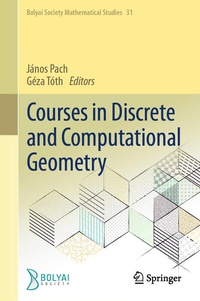
Courses in Discrete and Computational Geometry
Description

In the Fall of 2023, the Erdos Center (Budapest) hosted a special semester on "Discrete Geometry and Convexity", which brought together some of the strongest experts in the field and many outstanding young researchers. The program featured intensive one-week mini-courses during a Summer School, followed by conferences and workshops presenting cutting-edge research. Part I of the present volume includes the notes of three lecture series on (1) approximation in discrete geometry, (2) random polytopes, and (3) a structure theory for graphs embedded in the plane. Part II starts with a classic: Matousek's until now unpublished elegant lecture notes concerning the algorithmic complexity of recognizing intersection graphs of segments and some other geometric objects. It is complemented by the first systematic and comprehensive survey of the corresponding complexity class: the existential theory of reals. This volume will be a valuable resource for graduate students, young researchers, and experts in related fields interested in discrete and computational geometry.
More details
Other editions
Additional editions
Persons
János Pach is a research professor at the Rényi Institute, Budapest. His main fields of interest are discrete and computational geometry, convexity, and combinatorics. He has written more than 350 research papers. His books, "Research Problems in Discrete Geometry'' (with Brass and Moser) and ``Combinatorial Geometry" (with Agarwal) were translated into Japanese, Russian, and Chinese. He is the co-editor-in-chief of Discrete & Computational Geometry. He received the Lester Ford Award from the Mathematical Association of America (1990), the Rényi Prize and the Academy Award from the Hungarian Academy of Sciences (1993, 1998), and the Szele Prize from the Bolyai Mathematical Society (2019). He was elected the ACM Fellow (2011), a member of Academia Europaea (2014) and the Hungarian Academy of Sciences (2022). He was an invited speaker at the International Congress of Mathematicians (2014) and a plenary speaker at the European Congress of Mathematics (2021).
Géza Tóth is a research professor and the head of the Department of Geometry at the Rényi Institute, Budapest, working on problems in discrete and computational geometry and combinatorics. He received his PhD degree at Courant Institute, New York University in 1997, as a student of János Pach, winning the Best Dissertation Prize in mathematics and the Sokol Award, the highest university-wide prize for fresh PhDs. He wrote more than 100 research articles and he is the co-editor-in-chief of Studia Scientiarum Mathematicarum Hungarica and the editor of Computational Geometry and Acta Mathematica Hungarica. Among other distinctions, he received the Erdos Prize of the Hungarian Academy of Sciences in 2008 and the Rényi Prize of the Rényi Institute in 2010.
Content
Part I. Lecture notes.- Chapter 1. Graph Product Structure Theory with Applications.- Chapter 2. Threshold for the measure of random polytopes.- Chapter 3. Approximation in geometry.- Part II. The Existential Theory of the Reals.- Chapter 4. Intersection graphs of segments and ?R.- Chapter 5. The Existential Theory of the Reals as a Complexity Class: A
Compendium.
