

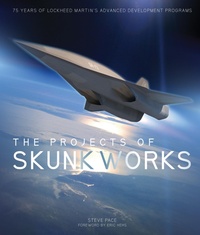
The Projects of Skunk Works
75 Years of Lockheed Martin's Advanced Development Programs
Published on 1. December 2016
256 pages
978-0-7603-5157-4 (ISBN)
Description

The stories behind more than 50 secret projects undertaken by the famed Lockheed Martin Skunk Works on behalf of the US Armed Forces, DARPA, and the CIA - all illustrated with official Skunk Works photography and commissioned artworks.
Hatched in June 1943 after a special request of the US Army Air Forces to develop a turbojet-powered fighter to counter growing German threats, Lockheed Martin's Skunk Works has gone on to develop remarkable aeronautical and space technologies, including stealth. Some have made it into production, while others never quite made it off drafting boards and computer screens, but proved fascinating nonetheless.
This generously illustrated history tackles Skunk Works programs ranging from jet fighters and jet engines to missiles and rockets, helicopters, research aircraft, airships, unmanned aerial vehicles and recon drones, and even the seagoing stealth ship Sea Shadow - more than 50 in all.
Author Steve Pace examines the historical context which led government organizations to approach the Skunk Works, as well as the technologies and projects developed there (often on a handshake and unburdened by bureaucracies), and the anecdotes and legends associated with each program. Pace includes official Skunk Works photography of the projects taken both at its headquarters and at test facilities such as Area 51. In addition, commissioned color artworks help further illustrate many of these projects featured herein. In addition to profiling legendary aircraft like the F-80, F-94, F-104, U-2, SR-71, F-117, and F-35, Pace takes on more obscure projects from the past as well as those still to come, such as the hypersonic SR-72 and High Speed Strike Weapon, and even offers a peak into what the future might hold with the proposed TR-X.
Hatched in June 1943 after a special request of the US Army Air Forces to develop a turbojet-powered fighter to counter growing German threats, Lockheed Martin's Skunk Works has gone on to develop remarkable aeronautical and space technologies, including stealth. Some have made it into production, while others never quite made it off drafting boards and computer screens, but proved fascinating nonetheless.
This generously illustrated history tackles Skunk Works programs ranging from jet fighters and jet engines to missiles and rockets, helicopters, research aircraft, airships, unmanned aerial vehicles and recon drones, and even the seagoing stealth ship Sea Shadow - more than 50 in all.
Author Steve Pace examines the historical context which led government organizations to approach the Skunk Works, as well as the technologies and projects developed there (often on a handshake and unburdened by bureaucracies), and the anecdotes and legends associated with each program. Pace includes official Skunk Works photography of the projects taken both at its headquarters and at test facilities such as Area 51. In addition, commissioned color artworks help further illustrate many of these projects featured herein. In addition to profiling legendary aircraft like the F-80, F-94, F-104, U-2, SR-71, F-117, and F-35, Pace takes on more obscure projects from the past as well as those still to come, such as the hypersonic SR-72 and High Speed Strike Weapon, and even offers a peak into what the future might hold with the proposed TR-X.
More details
Language
English
Place of publication
Minneapolis
United States
Publishing group
Quarto Publishing Group USA Inc
Illustrations
379 photos
File size
37,70 MB
ISBN-13
978-0-7603-5157-4 (9780760351574)
Copyright in bibliographic data and cover images is held by Nielsen Book Services Limited or by the publishers or by their respective licensors: all rights reserved.
Schweitzer Classification
Other editions
Additional editions
Book
12/2016
Voyageur Press
€50.99
Article exhausted; check different version
Persons
STEVE PACE is a freelance aviation history writer and a passionate fan of civilian, military, and experimental aircraft. He was raised in Seattle, Washington, where his father worked at the Boeing Airplane Company for more than 30 years. As the son of an aircraft builder he became interested in aviation at an early age, and instead of buying candy, pop and marbles, he bought model airplane kits.
Pace is a contributing editor to Flight Journal and the author of 30 aviation history books and numerous articles and short features on a variety of aircraft and related subjects. He resides in Tacoma, Washington.
Pace is a contributing editor to Flight Journal and the author of 30 aviation history books and numerous articles and short features on a variety of aircraft and related subjects. He resides in Tacoma, Washington.
Content
- Cover
- Tiltle
- Dedication
- Copyright
- Contents
- Foreword
- Introduction
- 01: The 1940s: Forming the Wings to Come
- Lightning: The XP-38 and YP-38
- TDN L-133 and TDN L-1000
- XP-49
- Constellation: The C-69
- Shooting Star: The F-80
- XP-80A
- Chain Lightning: The XP-58
- Saturn: The Model 75
- Constitution: The XR6V
- Racey: The P-80R
- T-Bird: The T-33
- Starfire: The F-94
- Penetration Fighter: The XF-90
- 02: The 1950s: Forthcoming Technologies
- Flying Stovepipe: The X-7A andthe XQ-5 Kingfisher
- SeaStar: The T2V
- Starfighter: The F-104
- Vertical Riser: The XFV-1
- Hercules: The YC-130
- Suntan: TDN CL-400
- USAF Neptune: The RB-69A
- Aquatone: The U-2
- Catching the Third Wire:The U-2 Joins the US Navy
- U-2R: Rebirth of the U-2
- TR-1A: The Ultimate U-2
- JetStar
- SAMOS: Satellite Missile Observation System
- Corona Reconnaissance Satellite System
- 03: The 1960s: Advancing the State of the Art
- Oxcart: The A-12
- Kedlock: The YF-12A
- Tagboard: The D-21 and M-21
- Senior Bowl: The D-21B and B-52H
- Senior Crown: The SR-71
- SST: Supersonic Transport
- F-X: Fighter-Experimental
- 04: The 1970s: Era of Wizardry
- CL-1200/X-27 Lancer
- F-X Program
- Advanced Day Fighter/Lightweight Fighter Program
- Project Harvey
- Have Blue XST
- X-24C: Hypersonic Research Airplane
- Senior Prom: Stealth Cruise Missile
- Senior Trend: The F-117A
- 05: The 1980s: Bewildering Ventures
- Senior Peg:The Advanced Technology Bomber
- ATA: Advanced Tactical Aircraft
- ASTOVL: Advanced Short Takeoff andVertical Landing
- Sea Shadow: Stealth upon the Waves
- SSF: The STOVL Strike Fighter
- RIVET
- 06: The 1990s: Manned versus Unmanned
- ATF: Advanced Tactical Fighter
- NATF: Naval Advanced Tactical Fighter
- MRF: Multi-Role Fighter
- A-X and A/F-X: The Advanced Attackand Advanced/Fighter-AttackPrograms
- CALF: Common AffordableLightweight Fighter
- JAST: Joint Advanced Strike Technology
- VentureStar: The X-33
- DarkStar: The RQ-3
- LightStar UAV: The P-420
- UCAV: Unmanned Combat Aerial Vehicle
- JASSM: Joint Air-to-SurfaceStandoff Missile
- 07: The 2000s: Out with the Old,in with the New
- QSST: Quiet Supersonic Transport
- JSF: Joint Strike Fighter
- RATTLRS: Revolutionary Approach toTime Critical Long Range Strike
- Polecat: The P-175 Unmanned AerialSystem Demonstrator
- Hybrid Air Vehicle: The P-791
- ACCA: The X-55A AdvancedComposite Cargo Aircraft
- ISIS: Integrated Sensor is Structure
- RQ-170 Sentinel
- Desert Hawk
- NASA/Lockheed Martin N-PlusAircraft Program
- 08: The 2010s: The Quantum Leaps
- FALCON: Hypersonic Test Vehicle
- SACD: Speed Agile Concept Demonstrator
- UCLASS: Unmanned Carrier-LaunchedAirborne Surveillance and Strike
- MUTT: The X-56A Multi-UtilityTechnology Testbed
- NGAD: Next Generation Air Dominance
- VARIOUS: VTOL AdvancedReconnaissance Insertion OrganicUnmanned System
- TR-X: Tactical Reconnaissance-Experimental
- HSSW: High-Speed Strike Weapon
- SR-72: Hypersonic Demonstrator Aircraft
- HWB: Hybrid Wing Body
- LBFD: Low Boom Flight Demonstrator
- ARES: Aerial ReconfigurableEmbedded System
- LRSB: Long Range Strike Bomber
- LRASM: The AGM-158C Long RangeAnti-Ship Missile
- Appendix A: Timeline
- Appendix B: Skunk Works Related Patents
- Appendix C: L- and CL-Numbersand Associations
- Appendix D: Lockheed Model Numbers
- Appendix E: Chief Skunks-Presidents,Executive Vice Presidents, and GeneralManagers of the Skunk Works
- Bibliography
- Index
- A
- B
- C
- D
- E
- F
- G
- H
- I
- J
- K
- L
- M
- N
- O
- P
- Q
- R
- S
- T
- U
- V
- W
- X
- Y
- Acknowledgments
