

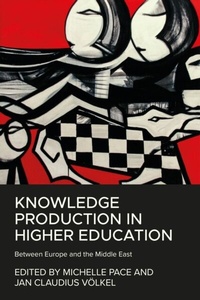
Knowledge Production in Higher Education
Between Europe and the Middle East
1st Edition
Published on 14. February 2023
288 pages
978-1-5261-6058-4 (ISBN)
Description

Mindful of divisive labels in constructions of the 'Middle East and North Africa' (MENA) and of 'Europe', the editors and contributors of Knowledge production in higher education reflexively immerse themselves in an investigation of how knowledge about these regions is produced at higher educational establishments. Zooming in on mutual scholarship about 'Europe' and/or 'the MENA' opens up a wide range of possibilities for supplanting visions of so-called traditional Orientalists, to abandon the sets of magnifying glasses through which the Other is studied. For those interested in the decolonisation of academia and issues of positionality this is a must read.
This book is relevant to United Nations Sustainable Development Goal 4, Quality education -- .
This book is relevant to United Nations Sustainable Development Goal 4, Quality education -- .
Reviews / Votes
'This book addresses one of the key questions of our time - how research on the MENA and Europe has been influenced by the differing perspectives of educational traditions in a range of countries. The scholars brought together here elucidate the importance of not only bringing but also understanding diverse perspectives that emanate from the systems of training in Europe and the MENA, making clear that this impacts both the questions we ask and the hypotheses we consider. A must-read for scholars as they reflect on their own positionality and those of others in the field.'Michael Robbins, Project Director, Arab Barometer
'In this insightful volume, the editors and their co-authors critically highlight what readers already think they know about "Orient-al" or "Occident-al" knowledge production in higher education. The result offers intelligent interventions that point out what students - and sometimes also faculty - do not actually know about knowledge reproduction of the "other". This is a timely thought-provoking treatise!'
Larbi Sadiki, Professor of Arab Democratization, University of Qatar
'While a growing literature focuses on knowledge production and higher education in and on the Middle East, this timely volume is unique for considering the Middle East and Europe together. It explores the deeply political and expressly dialogic relationships that have produced fields, paradigms and perspectives, while eschewing unilinear genealogies and histories and focusing not only on epistemologies but crucially also on pedagogies.'
Seteney Shami, Founding Director, Arab Council for the Social Sciences
'Curiosity about the other has been a drive towards creating disciplines, expeditions, and exchange between various parts of the world. Among those parts - but not limited to them - are what is predominantly referred to as the Middle East and North Africa (MENA) and/or Southwest Asia and North Africa (SWANA) region, and Europe. Seeking knowledge, learning, and literature on those regions has been regulated by state and capitalist interests that shaped how these regions are represented. In the recently edited volume by Michelle Pace and Jan Claudius Volkel, the authors outline how the MENA creates knowledge on Europe and vice-versa. The different chapters examine various elements from methodological limitations to funding on both 'sides,' while maintaining the initial argument that there are nuances to knowledge creation. Thus, the diversity and variety of knowledge and its means of production should be borderless.'
Dafne Carletti & Sara Tonsy, Journal of European Integration -- .
More details
Language
English
Place of publication
Manchester
United Kingdom
Target group
College/higher education
Professional and scholarly
Edition type
Digital original
Illustrations
2 black & white illustrations
2 black & white illustrations
ISBN-13
978-1-5261-6058-4 (9781526160584)
Copyright in bibliographic data and cover images is held by Nielsen Book Services Limited or by the publishers or by their respective licensors: all rights reserved.
Schweitzer Classification
Other editions
Additional editions
Michelle Pace | Jan Claudius Voelkel
Knowledge Production in Higher Education
Between Europe and the Middle East
Book
02/2023
Manchester University Press
€135.70
Shipment within 15-20 days
Persons
Michelle Pace is Professor in Global Studies at Roskilde University
Jan Claudius Voelkel is Senior Researcher at the Arnold Bergstraesser Institute, Freiburg -- .
Jan Claudius Voelkel is Senior Researcher at the Arnold Bergstraesser Institute, Freiburg -- .
Content
Introduction - Michelle Pace and Jan Claudius Voelkel
Part I: History
1 Between nostalgia and the colonies: the evolution of French scholarship on the Middle East - Timo Behr
2 Orient-ations: German scholarship on the Middle East since the nineteenth century - Sonja Hegasy, Stephan Stetter and Rene Wildangel
3 Middle Eastern Studies in Italy: a field in search of an identity and recognition within and outside academia - Giulia Cimini and Claudia De Martino
Part II: Liminality
4 Malta: Boundaries, identity and positionality in the teaching of the Middle East - James Sater
5 Teaching Europe in Palestine: resisting the 'new normal'? - Asem Khalil
6 Teaching Europe and the Middle East at universities in Turkey - Aylin Gueney, Emre Iseri and Goekay OEzerim
Part III: Orientalism
7 Is decolonisation the decisive factor - or even the relevant term? 250 years of Middle East Studies in Denmark - Jakob Skovgaard-Petersen
8 Challenges to a transformative education: 'EUrientalism' at Egyptian universities - Bassant Hassib and Jan Claudius Voelkel
9 Teaching the enlightened student: political polarisation and the ongoing quest for critical thinking - Anne de Jong
Part IV: Hierarchies
10 Knowledge production at a time of pandemic: navigating between Syria and the UK - Juline Beaujouan
11 Who teaches the Middle East in Europe? A gender perspective - Merve OEzdemirkiran-Embel
12 'In-between' the academic and policy communities: the position(ality) of think tank(er)s in knowledge production in and on the Middle East and Europe - Daniela Huber
A potential paradigm shift in knowledge production: some concluding reflections - Michelle Pace and Jan Claudius Voelkel
Index -- .
Part I: History
1 Between nostalgia and the colonies: the evolution of French scholarship on the Middle East - Timo Behr
2 Orient-ations: German scholarship on the Middle East since the nineteenth century - Sonja Hegasy, Stephan Stetter and Rene Wildangel
3 Middle Eastern Studies in Italy: a field in search of an identity and recognition within and outside academia - Giulia Cimini and Claudia De Martino
Part II: Liminality
4 Malta: Boundaries, identity and positionality in the teaching of the Middle East - James Sater
5 Teaching Europe in Palestine: resisting the 'new normal'? - Asem Khalil
6 Teaching Europe and the Middle East at universities in Turkey - Aylin Gueney, Emre Iseri and Goekay OEzerim
Part III: Orientalism
7 Is decolonisation the decisive factor - or even the relevant term? 250 years of Middle East Studies in Denmark - Jakob Skovgaard-Petersen
8 Challenges to a transformative education: 'EUrientalism' at Egyptian universities - Bassant Hassib and Jan Claudius Voelkel
9 Teaching the enlightened student: political polarisation and the ongoing quest for critical thinking - Anne de Jong
Part IV: Hierarchies
10 Knowledge production at a time of pandemic: navigating between Syria and the UK - Juline Beaujouan
11 Who teaches the Middle East in Europe? A gender perspective - Merve OEzdemirkiran-Embel
12 'In-between' the academic and policy communities: the position(ality) of think tank(er)s in knowledge production in and on the Middle East and Europe - Daniela Huber
A potential paradigm shift in knowledge production: some concluding reflections - Michelle Pace and Jan Claudius Voelkel
Index -- .
