

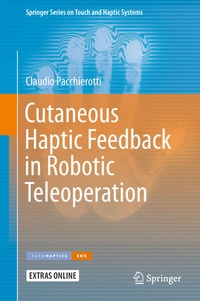
Cutaneous Haptic Feedback in Robotic Teleoperation
Description

This work addresses the challenge of providing effective cutaneous haptic feedback in robotic teleoperation, with the objective of achieving the highest degree of transparency whilst guaranteeing the stability of the considered systems. On the one hand, it evaluates teleoperation systems that provide only cutaneous cues to the operator, thus guaranteeing the highest degree of safety. This cutaneous-only approach shows intermediate performance between no force feedback and full haptic feedback provided by a grounded haptic interface, and it is best suitable for those scenarios where the safety of the system is paramount, e.g., robotic surgery. On the other hand, in order to achieve a higher level of performance, this work also investigates novel robotic teleoperation systems with force reflection able to provide mixed cutaneous and kinesthetic cues to the operator. Cutaneous cues can compensate for the temporary reduction of kinesthetic feedback necessary to satisfy certain stability conditions.
This state-of-the-art volume is oriented toward researchers, educators, and students who are interested in force feedback techniques for robotic teleoperation, cutaneous device design, cutaneous rendering methods and perception studies, as well as readers from different disciplines who are interested in applying cutaneous haptic technologies and methods to their field of interest.
More details
Other editions
Additional editions
Content
Foreword.- Introduction.- Part I: Force Feedback via Cutaneous Cues Only.- Sensory Subtraction in Teleoperation: Substituting Haptic Force with Cutaneous Stimuli.- Needle Insertion in Simulated Soft Tissue.- Peg-in-Hole in Simulated and Real Scenarios.- Remote Palpation Using the Da Vinci Surgical System.- Part II: Force Feedback via Mixed Cutaneous and Kinesthetic Cues.- Cutaneous and Kinesthetic Cues to Improve Transparency in Teleoperation.- Cutaneous and Kinesthetic Cues for Enhanced Navigation Feedback in Teleoperation.- Conclusion and Future Works
