

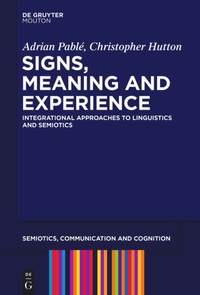
Signs, Meaning and Experience
Integrational Approaches to Linguistics and Semiotics
1st Edition
Published on 24. April 2015
XVII, 180 pages
978-1-5015-0228-6 (ISBN)
Description

Integrationism offers a radically contextual approach to the sign and represents a direct challenge to academic linguistics. This book sets out for the general reader its key claims and insights and explores criticisms offered of its approach, as well as the paradoxes that arise from its attack on the notion of linguistic expertise. For the first time integrationism is subjected to an extended contrastive analysis with semiotics.
More details
Other editions
Additional editions
Adrian Pablé | Christopher Hutton
Signs, Meaning and Experience
Integrational Approaches to Linguistics and Semiotics
Book
04/2015
1st Edition
De Gruyter Mouton
€149.95
Article not available at the moment
Adrian Pablé | Christopher Hutton
Signs, Meaning and Experience
Integrational Approaches to Linguistics and Semiotics
E-Book
04/2015
1st Edition
De Gruyter Mouton
€149.95
Available for download
Persons
Adrian Pablé, Christopher Hutton, The University of Hong Kong, Hong Kong.
Content
- Intro
- Preface
- 1. Theoretical Foundations
- Intellectual background: integrationism, linguistics and semiotics
- The metalanguage of linguistics and expertise
- 'Integration'
- Parameters and principles
- 'First-order' and 'second-order'
- Surrogationalism
- The language myth
- Segregationalism and structuralism
- The semiotics of writing
- Is there such a thing as 'data'?
- The status of the anecdote
- Aims of integrationism
- Integrationism beyond language
- Integrationism: a summary
- 2. Topics and Issues
- 2.1 Language and expertise
- Case studies
- On 'folk' and 'scientific' linguistic beliefs
- Lay and professional metalinguistic knowledge
- Questions for reflection
- 2.2 What 'a language' is (not)
- Case studies
- Language games
- The 'foul language fiasco'
- Questions for reflection
- 2.3 A new epistemology
- Case studies
- Dialect perception
- Autism and 'linguistic' knowledge
- Questions for reflection
- 2.4 The myth of names
- Case Studies
- The castles of Bellinzona
- Names in intercultural communication
- Questions for reflection
- 2.5 Responsibility and the sign-maker
- Case studies
- The truth about truth-conditional semantics
- Language, responsibility, and online forums
- Questions for reflection
- 2.6 Integrating reality
- Case studies
- The subjectivity of the 'real'
- The Great Wall of China
- Questions for reflection
- 2.7 Cognitive mythology
- Case studies
- 'Logical thinking'
- Autoglottic space
- Questions for reflection
- 2.8 Signs, communication and integration
- Case studies
- Integrating language and practical action
- The railroad sign code and (un)successful integration
- Questions for reflection
- 2.9 The 'language gap'
- Case studies
- Monkeys and communication
- The origin of language
- Questions for reflection
- 2.10 Language and freedom (of speech)
- Case studies
- Freedom of expression and trademark law
- Language and liberty
- Questions for reflection
- 3. Discussion Materials
- Research questions & methodology
- The origin of language
- Alternative frameworks
- Saussure: code and communication
- 4. Conclusion
- Further Readings
- References
- Index
