

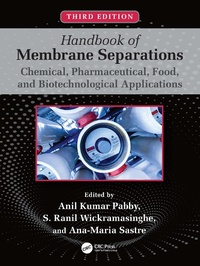
Handbook of Membrane Separations
Chemical, Pharmaceutical, Food, and Biotechnological Applications
3rd Edition
Published on 22. December 2023
600 pages
978-1-003-81157-2 (ISBN)
Description

The third edition of the Handbook of Membrane Separations: Chemical, Pharmaceutical, Food, and Biotechnological Applications provides a comprehensive discussion of membrane applications. Fully updated to include the latest advancements in membrane science and technology, it is a one-of-its-kind overview of the existing literature. This fully illustrated handbook is written by experts and professionals in membrane applications from around the world.
Key Features:
Includes entirely new chapters on organic solvent-resistant nanofiltration, membrane condensers, membrane-reactors in hydrogen production, membrane materials for haemodialysis, and integrated membrane distillation
Covers the full spectrum of membrane technology and its advancements
Explores membrane applications in a range of fields, from biotechnological and food processing to industrial waste management and environmental engineering
This book will appeal to both newcomers to membrane science as well as engineers and scientists looking to expand their knowledge on upcoming advancements in the field.
Key Features:
Includes entirely new chapters on organic solvent-resistant nanofiltration, membrane condensers, membrane-reactors in hydrogen production, membrane materials for haemodialysis, and integrated membrane distillation
Covers the full spectrum of membrane technology and its advancements
Explores membrane applications in a range of fields, from biotechnological and food processing to industrial waste management and environmental engineering
This book will appeal to both newcomers to membrane science as well as engineers and scientists looking to expand their knowledge on upcoming advancements in the field.
More details
Edition
3rd edition
Language
English
Place of publication
London
United Kingdom
Publishing group
Taylor & Francis Ebooks
Target group
College/higher education
Professional and scholarly
Illustrations
90 Tables, black and white; 134 Line drawings, color; 152 Line drawings, black and white; 10 Halftones, color; 5 Halftones, black and white; 144 Illustrations, color; 157 Illustrations, black and white
ISBN-13
978-1-003-81157-2 (9781003811572)
Copyright in bibliographic data and cover images is held by Nielsen Book Services Limited or by the publishers or by their respective licensors: all rights reserved.
Schweitzer Classification
Other editions
Additional editions
Anil K. Pabby | S. Ranil Wickramasinghe | Ana-Maria Sastre
Handbook of Membrane Separations
Chemical, Pharmaceutical, Food, and Biotechnological Applications
Book
09/2025
3rd Edition
CRC Press
€195.70
Shipment within 10-20 days
Anil K. Pabby | S. Ranil Wickramasinghe | Ana-Maria Sastre
Handbook of Membrane Separations
Chemical, Pharmaceutical, Food, and Biotechnological Applications
Book
12/2023
3rd Edition
CRC Press
€401.77
Shipment within 10-20 days
Persons
Dr. Anil Kumar Pabby is recently retired from one of the pioneer research centers of India, Bhabha Atomic Research Centre (BARC), Tarapur, Mumbai, Maharashtra, as Scientific Officer (Senior Scientist) and associated with Department of Atomic Energy activities including research and development work under a DAE program. He did his Ph.D. from University of Mumbai, India and subsequently carried out his postdoctoral work at Technical university of Catalunya, Barcelona, Spain. Dr. Pabby has more than 190 publications to his credit including 20 chapters and two patent on non-dispersive membrane technology. He was invited to join as an associate editor of International journal 'Journal of Radioanalytical and Nuclear Chemistry' during 2002-2005. He has also served as consultant to IAEA, Vienna, Austria for developing technical book volume on "Application of membrane technologies for liquid radioactive waste processing". Dr. Pabby has taken a leading role in publishing "Handbook of membrane separation: Chemical, pharmaceutical, food and biotechnological applications' in July 2008 by CRC Press, New York, USA. The second edition of this book is published in April 2015. Dr. Pabby has been a regular reviewer for several national and international journals and also serving in editorial board of few reputed international journals. His research interest includes membrane based solvent extraction, liquid membrane and its modeling aspects, pressure driven membrane processes, macrocyclic compounds etc. Dr Pabby has been elected as a Fellow of the Maharashtra Academy of Sciences (FMASc) in 2003 for his outstanding contribution in membrane science and technology. Also, he has been awarded with prestigious Tarun Datta Memorial award (instituted by Indian Association Nuclear Chemist and Allied Scientist ) for his contribution in Nuclear and Radiochemistry for the year 2005. He is appointed as Associate Professor and Ph.D. guide and also M.Tech guide, Homi Bhabha National Institute, Mumbai. He is serving as Secretary, Indian Association Nuclear Chemist and Allied Scientist, Tarapur chapter since 2008. He has delivered several keynote/plenary/invited talk in national and international conferences. He has also served as chairman of the different sessions in conference in India and abroad .
Dr. Ranil Wickramasinghe has published over 200 peer reviewed journal articles, several book chapters and is co-editor of a book on responsive membrane and materials. He is active in the American Institute of Chemical Engineeers and the North American Membrane Society. He is executive editor of Separation Science and Technology. Prof Wickramasinghe's research interests are in membrane science and technology. His research focuses on synthetic membrane-based separation processes for purification of pharmaceuticals and biopharmaceuticals, treatment and reuse of water and for the production of biofuels. Typical unit operations include: microfiltration, ultrafiltration, virus filtration, nanofiltration, membrane extraction etc. A current research focus is surface modification of membranes in order to impart unique surface properties. His group is actively developing responsive membranes. These membranes change their physical properties in response to changed environmental conditions. A second research focus is the development of catalytic membranes for biomass hydrolysis by grafting catalytic groups to the membrane surface. Prof Wickramasinghe obtained his Bachelor's and Master's degrees from the University of Melbourne, Australia in Chemical Engineering. He obtained his PhD from the University of Minnesota, also in Chemical Engineering. He worked for 5 years in the biotechnology/biomedical industry in the Boston area before joining the faculty of Chemical Engineering at Colorado State University. He joined the Department of Chemical Engineering at the University of Arkansas in 2011 where he holds the Ross E Martin Chair in Emerging Technologies and is an Arkansas Research Alliance Scholar.
Ana Maria Sastre is a professor of Chemical Engineering at the Universitat Politecnica de Catalunya (Barcelona, Spain), where she has been teaching Chemistry for more than 40 years. She received the Ph.D. from Autonomous University of Barcelona in 1982 and has been working for many years in the field of solvent extraction, solvent impregnated resins and membrane technology and adsorption processes. She was a visiting fellow at Department of Inorganic Chemistry, The Royal Institute of Technology, Sweden, during 1980-1981 and carried out postdoctoral research work during October 1986-April 1987 at Laboratoire de Chimie Minerale, de l'Ecole Europeenne des Hautes Etudes des Industries Chimiques d'Estrasbourg, France. During 2015 she was Fulbright visiting scholar at Chemical and Biomolecular Engineering Department of the University of California, Berkeley. Prof. Sastre has published more than 200 journal publications and more than 80 papers in international conferences. She holds 7 patent applications. She has advised 13 Ph.D. students and 16 master theses and is a reviewer of many international journals. She was awarded the "Narcis Monturiol medal for scientific and technological merits" given by the Generalitat de Catalunya for outstanding contribution in science and technology in 2003. Prof. Sastre has been the head of the Chemical Engineering Department from 1999 till 2005 and from 2006 till 2013 has been Vicepresident for Academic Policy of the Universitat Politecnica de Catalunya.
Dr. Ranil Wickramasinghe has published over 200 peer reviewed journal articles, several book chapters and is co-editor of a book on responsive membrane and materials. He is active in the American Institute of Chemical Engineeers and the North American Membrane Society. He is executive editor of Separation Science and Technology. Prof Wickramasinghe's research interests are in membrane science and technology. His research focuses on synthetic membrane-based separation processes for purification of pharmaceuticals and biopharmaceuticals, treatment and reuse of water and for the production of biofuels. Typical unit operations include: microfiltration, ultrafiltration, virus filtration, nanofiltration, membrane extraction etc. A current research focus is surface modification of membranes in order to impart unique surface properties. His group is actively developing responsive membranes. These membranes change their physical properties in response to changed environmental conditions. A second research focus is the development of catalytic membranes for biomass hydrolysis by grafting catalytic groups to the membrane surface. Prof Wickramasinghe obtained his Bachelor's and Master's degrees from the University of Melbourne, Australia in Chemical Engineering. He obtained his PhD from the University of Minnesota, also in Chemical Engineering. He worked for 5 years in the biotechnology/biomedical industry in the Boston area before joining the faculty of Chemical Engineering at Colorado State University. He joined the Department of Chemical Engineering at the University of Arkansas in 2011 where he holds the Ross E Martin Chair in Emerging Technologies and is an Arkansas Research Alliance Scholar.
Ana Maria Sastre is a professor of Chemical Engineering at the Universitat Politecnica de Catalunya (Barcelona, Spain), where she has been teaching Chemistry for more than 40 years. She received the Ph.D. from Autonomous University of Barcelona in 1982 and has been working for many years in the field of solvent extraction, solvent impregnated resins and membrane technology and adsorption processes. She was a visiting fellow at Department of Inorganic Chemistry, The Royal Institute of Technology, Sweden, during 1980-1981 and carried out postdoctoral research work during October 1986-April 1987 at Laboratoire de Chimie Minerale, de l'Ecole Europeenne des Hautes Etudes des Industries Chimiques d'Estrasbourg, France. During 2015 she was Fulbright visiting scholar at Chemical and Biomolecular Engineering Department of the University of California, Berkeley. Prof. Sastre has published more than 200 journal publications and more than 80 papers in international conferences. She holds 7 patent applications. She has advised 13 Ph.D. students and 16 master theses and is a reviewer of many international journals. She was awarded the "Narcis Monturiol medal for scientific and technological merits" given by the Generalitat de Catalunya for outstanding contribution in science and technology in 2003. Prof. Sastre has been the head of the Chemical Engineering Department from 1999 till 2005 and from 2006 till 2013 has been Vicepresident for Academic Policy of the Universitat Politecnica de Catalunya.
Content
About the Editors
List of Contributors
Foreword
Preface
I MEMBRANE APPLICATIONS IN CHEMICAL, BIOCHEMICAL, FOOD
PROCESSING AND PHARMACEUTICAL INDUSTRIES
Membranes applications in chemical biochemical, food
processing and pharmaceutical industries: An Introduction
Anil K Pabby, S. R. Wickrmasinghe and A.M. Sastre
2. Reverse Osmosis Membrane
Dipak Rana, Takeshi Matsuura, Mohd Azraai Kassim,
Ahmad Fauzi Ismail
3. Organic solvent resistant nanofiltratin
Parag R. Nemade , Olviya S. Gonsalves, P. S. V. Vaishnavi
4. Membrane condensers for air purification and water recovery
M. Frappa, F. Macedonio, E. Drioli
5. Membranes in gas separation
May-Britt Haegg, Liyuan Deng and Zhongde Dai
6. Techniques to enhance performance of liquid-phase membrane
processes by improved control of concentration polarization
S. Chang and Anthony G. Fane
7. Current challenges in reducing membrane fouling
M.F.A. Goosen
8. Membranes Processes and Developments for Biochemical and
Pharmaceutical Separations
Chidambaram T. and S R Wickrmasinghe
9. Expansive applications of chitosan and its derivatives in membrane
technology
P. Satishkumar, Arun M. Isloor and Ramin Farnood
10. A review on Diverse Membrane Materials for Hemodialysis
Pallavi K.C, Arun M. Isloor, and
Sowmya M. Kumar, Abdul Wahab Mohammad
11. Role of Membranes and Membrane-Reactor in Hydrogen Production
Nitish Mittal, Dhaval Bhandari
12. Advances and applications of ionic liquids for the extraction of
organics and metal ions
Adrian Hernandez-Fernandez, V.M. Ortiz-Martinez, A.P. de los Rios,
F.J. Hernandez-Fernandez, S. Sanchez-Segado
13. Membrane applications in dairy science
George Q. Chen and Sandra E. Kentish
14. Metal-Organic Framework Containing Polymeric Membranes for
Fuel Cells
Shivarama B, Arun M. Isloor , Ch.Sn. Murthy and Balakrishna
Prabhu, Ahmad Fauzi Ismail
15. Recent developments on supported Pd membranes for hydrogen
separation and membrane reactors
David Alfredo Pacheco Tanaka and Fausto Gallucci
II MEMBRANE APPLICATIONS IN INDUSTRIAL WASTE
MANAGEMENT (INCLUDING NUCLEAR), ENVIRONMENTAL
ENGINEERING AND FUTURE TRENDS IN MEMBRANE SCIENCE
16 Membranes applications in industrial waste
management (including nuclear), environmental engineering and
future trends in membrane science: Introduction
Anil K. Pabby, S. R. Wickramasinghe and A.M. Sastre
17 Integrated membrane distillation approaches for sustainable desalination
and water/resource recovery
V Sangeetha and Noel Jacob Kaleekkal
18. Advancement in Membrane Methods for Liquid Radioactive Waste
Processing: Current Opportunities, Challenges and the Global World
Scenario
Grazyna Zakrzewska-Koltuniewicz
19. Polymer Inclusion Membranes
Spas D. Kolev, M. Ines G. S. Almeida and Robert W. Cattrall
20. Electromembrane processes: Recent advances, applications, and
future perspectives
Madupathi Madhumala, Tallam Aarti and Sundergopal Sridhar
21. Membrane applications for valorization routes of industrial brines and
mining waters: examples of resource recovery schemes
J. Lopez, M. Reig, J.L. Cortina
22. Concentration-driven membrane processes for the recovery of
valuable compounds from industrial wastes
Eugenio Bringas, M. Fresnedo San Roman, Ana M. Urtiaga,
Inmaculada Ortiz
23. Salts recovery from brines through Membrane Crystallization
Processes
M. Frappa, F. Alessandro, E. Drioli, F. Macedonio
24. A sustainable approach for dye removal from industrial effluent
using membrane based techniques-Recent advances and future
perspectives
Pallavi Mahajan-Tatpate, Vikrant Gaikwad, Anil K Pabby
25. Membrane bioreactors for waste water treatment: Recent
advances, challenges and future perspectives
Nethravathi, Arun M. Isloor and Ahmad Fauzi Ismail
26. Process Intensification in water treatment using membrane technology
Enrico Drioli, Francesca Macedonio, Elena Tocci
List of Contributors
Foreword
Preface
I MEMBRANE APPLICATIONS IN CHEMICAL, BIOCHEMICAL, FOOD
PROCESSING AND PHARMACEUTICAL INDUSTRIES
Membranes applications in chemical biochemical, food
processing and pharmaceutical industries: An Introduction
Anil K Pabby, S. R. Wickrmasinghe and A.M. Sastre
2. Reverse Osmosis Membrane
Dipak Rana, Takeshi Matsuura, Mohd Azraai Kassim,
Ahmad Fauzi Ismail
3. Organic solvent resistant nanofiltratin
Parag R. Nemade , Olviya S. Gonsalves, P. S. V. Vaishnavi
4. Membrane condensers for air purification and water recovery
M. Frappa, F. Macedonio, E. Drioli
5. Membranes in gas separation
May-Britt Haegg, Liyuan Deng and Zhongde Dai
6. Techniques to enhance performance of liquid-phase membrane
processes by improved control of concentration polarization
S. Chang and Anthony G. Fane
7. Current challenges in reducing membrane fouling
M.F.A. Goosen
8. Membranes Processes and Developments for Biochemical and
Pharmaceutical Separations
Chidambaram T. and S R Wickrmasinghe
9. Expansive applications of chitosan and its derivatives in membrane
technology
P. Satishkumar, Arun M. Isloor and Ramin Farnood
10. A review on Diverse Membrane Materials for Hemodialysis
Pallavi K.C, Arun M. Isloor, and
Sowmya M. Kumar, Abdul Wahab Mohammad
11. Role of Membranes and Membrane-Reactor in Hydrogen Production
Nitish Mittal, Dhaval Bhandari
12. Advances and applications of ionic liquids for the extraction of
organics and metal ions
Adrian Hernandez-Fernandez, V.M. Ortiz-Martinez, A.P. de los Rios,
F.J. Hernandez-Fernandez, S. Sanchez-Segado
13. Membrane applications in dairy science
George Q. Chen and Sandra E. Kentish
14. Metal-Organic Framework Containing Polymeric Membranes for
Fuel Cells
Shivarama B, Arun M. Isloor , Ch.Sn. Murthy and Balakrishna
Prabhu, Ahmad Fauzi Ismail
15. Recent developments on supported Pd membranes for hydrogen
separation and membrane reactors
David Alfredo Pacheco Tanaka and Fausto Gallucci
II MEMBRANE APPLICATIONS IN INDUSTRIAL WASTE
MANAGEMENT (INCLUDING NUCLEAR), ENVIRONMENTAL
ENGINEERING AND FUTURE TRENDS IN MEMBRANE SCIENCE
16 Membranes applications in industrial waste
management (including nuclear), environmental engineering and
future trends in membrane science: Introduction
Anil K. Pabby, S. R. Wickramasinghe and A.M. Sastre
17 Integrated membrane distillation approaches for sustainable desalination
and water/resource recovery
V Sangeetha and Noel Jacob Kaleekkal
18. Advancement in Membrane Methods for Liquid Radioactive Waste
Processing: Current Opportunities, Challenges and the Global World
Scenario
Grazyna Zakrzewska-Koltuniewicz
19. Polymer Inclusion Membranes
Spas D. Kolev, M. Ines G. S. Almeida and Robert W. Cattrall
20. Electromembrane processes: Recent advances, applications, and
future perspectives
Madupathi Madhumala, Tallam Aarti and Sundergopal Sridhar
21. Membrane applications for valorization routes of industrial brines and
mining waters: examples of resource recovery schemes
J. Lopez, M. Reig, J.L. Cortina
22. Concentration-driven membrane processes for the recovery of
valuable compounds from industrial wastes
Eugenio Bringas, M. Fresnedo San Roman, Ana M. Urtiaga,
Inmaculada Ortiz
23. Salts recovery from brines through Membrane Crystallization
Processes
M. Frappa, F. Alessandro, E. Drioli, F. Macedonio
24. A sustainable approach for dye removal from industrial effluent
using membrane based techniques-Recent advances and future
perspectives
Pallavi Mahajan-Tatpate, Vikrant Gaikwad, Anil K Pabby
25. Membrane bioreactors for waste water treatment: Recent
advances, challenges and future perspectives
Nethravathi, Arun M. Isloor and Ahmad Fauzi Ismail
26. Process Intensification in water treatment using membrane technology
Enrico Drioli, Francesca Macedonio, Elena Tocci
