


Understanding Cryptography
Description

Cryptography is now ubiquitous - moving beyond the traditional environments, such as government communications and banking systems, we see cryptographic techniques realized in Web browsers, e-mail programs, cell phones, manufacturing systems, embedded software, smart buildings, cars, and even medical implants. Today's designers need a comprehensive understanding of applied cryptography.
After an introduction to cryptography and data security, the authors explain the main techniques in modern cryptography, with chapters addressing stream ciphers, the Data Encryption Standard (DES) and 3DES, the Advanced Encryption Standard (AES), block ciphers, the RSA cryptosystem, public-key cryptosystems based on the discrete logarithm problem, elliptic-curve cryptography (ECC), digital signatures, hash functions, Message Authentication Codes (MACs), and methods for key establishment, including certificates and public-key infrastructure (PKI). Throughout the book, the authors focuson communicating the essentials and keeping the mathematics to a minimum, and they move quickly from explaining the foundations to describing practical implementations, including recent topics such as lightweight ciphers for RFIDs and mobile devices, and current key-length recommendations.
The authors have considerable experience teaching applied cryptography to engineering and computer science students and to professionals, and they make extensive use of examples, problems, and chapter reviews, while the book's website offers slides, projects and links to further resources. This is a suitable textbook for graduate and advanced undergraduate courses and also for self-study by engineers.
The authors' website (http://www.crypto-textbook.com/) provides extensive notes, slides, video lectures; the authors' YouTube channel (https://www.youtube.com/channel/UC1usFRN4LCMcflV7UjHNuQg) includes video lectures.
More details
Other editions
New editions
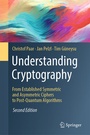
Additional editions
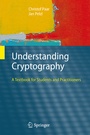
Persons
Prof. Dr.-Ing. Christof Paa r has the Chair for Embedded Security at the University of Bochum, Germany, and is Adjunct Professor at the University of Massachusetts at Amherst, USA. Prof. Paar has taught cryptography for 15 years to engineering and computer science students in the US and in Europe, and he has taught many industrial practitioners at organizations such as Motorola, Philips and NASA. He has more than 100 publications in applied cryptography and is a cofounder of the Workshop on Cryptographic Hardware and Embedded Systems (CHES), the key academic event in this field.
Prof. Dr.-Ing. January Pelzl started his career at Bosch Telecom GmbH. He has a Ph.D. in applied cryptography, and as a researcher he investigated the practical aspects of elliptic-curve-based cryptography and cryptanalysis. He has published extensively about his theoretical and industrial work through leading international conferences and journals, and he has taught many IT security and cryptography courses in industry. He was the Managing Director of "ESCRYPT GmbH" in Bochum. Since January 2015 he is the professor of "Computer Security" in Hochschule Hamm-Lippstadt.
The authors' website (http://www.crypto-textbook.com/) provides extensive notes, slides, video lectures; the authors' YouTube channel (https://www.youtube.com/channel/UC1usFRN4LCMcflV7UjHNuQg) includes video lectures.
