

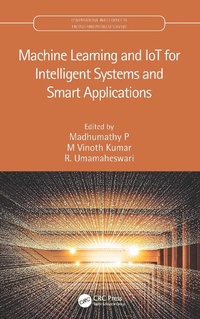
Machine Learning and IoT for Intelligent Systems and Smart Applications
1st Edition
Published on 17. November 2021
242 pages
978-1-000-48498-4 (ISBN)
Description

The fusion of AI and IoT enables the systems to be predictive, prescriptive, and autonomous, and this convergence has evolved the nature of emerging applications from being assisted to augmented, and ultimately to autonomous intelligence. This book discusses algorithmic applications in the field of machine learning and IoT with pertinent applications. It further discusses challenges and future directions in the machine learning area and develops understanding of its role in technology, in terms of IoT security issues. Pertinent applications described include speech recognition, medical diagnosis, optimizations, predictions, and security aspects.
Features:
Focuses on algorithmic and practical parts of the artificial intelligence approaches in IoT applications.
Discusses supervised and unsupervised machine learning for IoT data and devices.
Presents an overview of the different algorithms related to Machine learning and IoT.
Covers practical case studies on industrial and smart home automation.
Includes implementation of AI from case studies in personal and industrial IoT.
This book aims at Researchers and Graduate students in Computer Engineering, Networking Communications, Information Science Engineering, and Electrical Engineering.
Features:
Focuses on algorithmic and practical parts of the artificial intelligence approaches in IoT applications.
Discusses supervised and unsupervised machine learning for IoT data and devices.
Presents an overview of the different algorithms related to Machine learning and IoT.
Covers practical case studies on industrial and smart home automation.
Includes implementation of AI from case studies in personal and industrial IoT.
This book aims at Researchers and Graduate students in Computer Engineering, Networking Communications, Information Science Engineering, and Electrical Engineering.
More details
Series
Edition
1. Auflage
Language
English
Place of publication
London
United Kingdom
Publishing group
Taylor & Francis Ltd
Target group
Professional and scholarly
Product notice
Reflowable
Illustrations
28 Tables, black and white; 103 Line drawings, black and white; 32 Halftones, black and white; 135 Illustrations, black and white
ISBN-13
978-1-000-48498-4 (9781000484984)
Copyright in bibliographic data and cover images is held by Nielsen Book Services Limited or by the publishers or by their respective licensors: all rights reserved.
Schweitzer Classification
Other editions
Additional editions
Madhumathy P | M. Vinoth Kumar | R. Umamaheswari
Machine Learning and IoT for Intelligent Systems and Smart Applications
Book
10/2024
1st Edition
CRC Press
€71.80
Shipment within 10-20 days
Madhumathy P | M. Vinoth Kumar | R. Umamaheswari
Machine Learning and IoT for Intelligent Systems and Smart Applications
Book
11/2021
1st Edition
CRC Press
€170.90
Shipment within 10-20 days
Persons
Dr. Madhumathy P is working as an Associate Professor at RV Institute of Technology and Management (RVITM), Bengaluru, Karnataka, India. She completed her engineering from Anna University in 2006. M.E (gold medalist) from AVIT in 2009 and Ph.D. from Anna University in 2015. She has rich experience in teaching for about 14 years. Her area of interests includes Computer Networks, Wireless Communication, Wireless sensor Networks, Internet of Things, Wireless Channel Modeling, Mobile Communication and topics related to Networks and Wireless Communication domains. She has published more than 75 papers in international, national journals and conferences. She is a life member in ISTE and senior member from IEEE. She serves as a reviewer for IEEE, IET, Springer, Inderscience and Elsevier journals. She has registered and published three Indian patent. She has received a grant for the title "A Complex Programmable Logic Device Based Green House Monitoring System for Agriculture" from VGST, Govt. of Karnataka, under SMYSR program, Published a book titled "Computer Communication Networks" with ISBN number 978-81-937245-1-4. Acted as publication chair for international IEEE conference held at DSATM. She has conducted and coordinated many workshops and FDPs.
Dr. M Vinoth Kumar, obtained his Bachelor's degree in Computer Science and Engineering from Periyar University, Salem, Tamilnadu, India. He obtained his Master's degree in Computer Science and Engineering and PhD in Computer Science majoring in Agent Programming from Anna University, Chennai, Tamilnadu, India. Currently, he is an Associate professor at the Faculty of Information Science and Engineering, RV Institute of Technology and Management, Bengaluru, Karnataka, India. His specializations includes Artificial Intelligence, Machine learning and Big Data Computing. His current research interests are convolutional neural network and medical image processing. He has published 45 research papers in reputed national, International journals and conferences. He has filed 6 innovative patents and 1 patent is granted by Indian patent office. He is the reviewer and editorial member in Indexed national and International Journals. He is the life member of Computer Society of India(CSI), Indian Science Congress Association(ISCA) and associate member of Institute of Engineers(India), Indian Society of Technical Education(ISTE).
Dr. R. Umamaheswari, currently working as Assistant Professor in Department of Electronics & Instrumentation Engineering at SRM Valliammai Engineering College, Kattankulathur, Tamilnadu, India. She has completed her Ph. D in the field of wireless communication in the year 2017 from Anna University. She completed her Masters in VLSI Design Engineering (2011) from Anna University and Bachelors in Electronics and Instrumentation Engineering (2004) from Madras University. She received gold medal in her Master's Degree. She has more than 10 years of teaching experience. She specializes herself in the core area of soft computing techniques. She is an innovative person with deep knowledge in Artificial Intelligence, Neuro-fuzzy systems and IoT. She has published more than 25 research articles in national and international journals. She has published three text books for Basic electrical, electronics and instrumentation engineering for second semester anna university syllabus. She has filed three patents in India. She has organized guest lecture, seminars, faculty development programme under the banner of All India Council of Technical Education (AICTE). She delivered guest lecture in various institutions and also shared various chair-positions in conferences, seminars. She is Life Member of professional societies like ISTE, ISC, CSI, IAENG.
Dr. M Vinoth Kumar, obtained his Bachelor's degree in Computer Science and Engineering from Periyar University, Salem, Tamilnadu, India. He obtained his Master's degree in Computer Science and Engineering and PhD in Computer Science majoring in Agent Programming from Anna University, Chennai, Tamilnadu, India. Currently, he is an Associate professor at the Faculty of Information Science and Engineering, RV Institute of Technology and Management, Bengaluru, Karnataka, India. His specializations includes Artificial Intelligence, Machine learning and Big Data Computing. His current research interests are convolutional neural network and medical image processing. He has published 45 research papers in reputed national, International journals and conferences. He has filed 6 innovative patents and 1 patent is granted by Indian patent office. He is the reviewer and editorial member in Indexed national and International Journals. He is the life member of Computer Society of India(CSI), Indian Science Congress Association(ISCA) and associate member of Institute of Engineers(India), Indian Society of Technical Education(ISTE).
Dr. R. Umamaheswari, currently working as Assistant Professor in Department of Electronics & Instrumentation Engineering at SRM Valliammai Engineering College, Kattankulathur, Tamilnadu, India. She has completed her Ph. D in the field of wireless communication in the year 2017 from Anna University. She completed her Masters in VLSI Design Engineering (2011) from Anna University and Bachelors in Electronics and Instrumentation Engineering (2004) from Madras University. She received gold medal in her Master's Degree. She has more than 10 years of teaching experience. She specializes herself in the core area of soft computing techniques. She is an innovative person with deep knowledge in Artificial Intelligence, Neuro-fuzzy systems and IoT. She has published more than 25 research articles in national and international journals. She has published three text books for Basic electrical, electronics and instrumentation engineering for second semester anna university syllabus. She has filed three patents in India. She has organized guest lecture, seminars, faculty development programme under the banner of All India Council of Technical Education (AICTE). She delivered guest lecture in various institutions and also shared various chair-positions in conferences, seminars. She is Life Member of professional societies like ISTE, ISC, CSI, IAENG.
Content
Chapter 1 A Study on Feature Extraction and Classification Techniques for Melanoma Detection
Chapter 2 Machine Learning based Microstrip Antenna Design in Wireless Communications
Chapter 3 LCL-T Filter Based Analysis of Two Stage Single Phase Grid Connected Module with Intelligent FANN Controllers
Chapter 4 Motion Vector Analysis Using Machine Learning Models to Identify Lung Damages for COVID-19 Patients
Chapter 5 Enhanced Effective Generative Adversarial Networks Based LRSD and SP Learned Dictionaries with Amplifying CS
Chapter 6 Deep Learning Based Parkinson's Disease Prediction System
Chapter 7 Non-Uniform Data Reduction Technique with Edge Preservation to Improve Diagnostic Visualization of Medical Images
Chapter 8 A Critical Study on Genetically Engineered Bioweapons and Computer-Based Techniques as Counter Measure
Chapter 9 An Automated Hybrid Transfer Learning system for Detection and Segmentation of Tumor in MRI Brain Images with UNet and VGG-19 Network
Chapter 10 Deep Learning-Computer Aided Melanoma Detection Using Transfer Learning
Chapter 11 Development of an Agent-based Interactive Tutoring System for Online Teaching in School using Classter
Chapter 12 Fusion of Datamining and Artificial Intelligence in Prediction of Hazardous Road Accidents
Chapter 2 Machine Learning based Microstrip Antenna Design in Wireless Communications
Chapter 3 LCL-T Filter Based Analysis of Two Stage Single Phase Grid Connected Module with Intelligent FANN Controllers
Chapter 4 Motion Vector Analysis Using Machine Learning Models to Identify Lung Damages for COVID-19 Patients
Chapter 5 Enhanced Effective Generative Adversarial Networks Based LRSD and SP Learned Dictionaries with Amplifying CS
Chapter 6 Deep Learning Based Parkinson's Disease Prediction System
Chapter 7 Non-Uniform Data Reduction Technique with Edge Preservation to Improve Diagnostic Visualization of Medical Images
Chapter 8 A Critical Study on Genetically Engineered Bioweapons and Computer-Based Techniques as Counter Measure
Chapter 9 An Automated Hybrid Transfer Learning system for Detection and Segmentation of Tumor in MRI Brain Images with UNet and VGG-19 Network
Chapter 10 Deep Learning-Computer Aided Melanoma Detection Using Transfer Learning
Chapter 11 Development of an Agent-based Interactive Tutoring System for Online Teaching in School using Classter
Chapter 12 Fusion of Datamining and Artificial Intelligence in Prediction of Hazardous Road Accidents
