

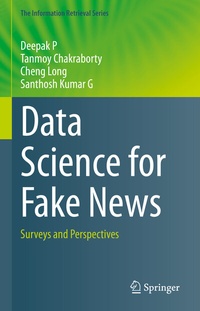
Data Science for Fake News
Surveys and Perspectives
1st Edition
Published on 29. April 2021
XIV, 302 pages
978-3-030-62696-9 (ISBN)
Description

This book provides an overview of fake news detection, both through a variety of tutorial-style survey articles that capture advancements in the field from various facets and in a somewhat unique direction through expert perspectives from various disciplines. The approach is based on the idea that advancing the frontier on data science approaches for fake news is an interdisciplinary effort, and that perspectives from domain experts are crucial to shape the next generation of methods and tools.
The fake news challenge cuts across a number of data science subfields such as graph analytics, mining of spatio-temporal data, information retrieval, natural language processing, computer vision and image processing, to name a few. This book will present a number of tutorial-style surveys that summarize a range of recent work in the field. In a unique feature, this book includes perspective notes from experts in disciplines such as linguistics, anthropology, medicine and politics that will help to shape the next generation of data science research in fake news.
The main target groups of this book are academic and industrial researchers working in the area of data science, and with interests in devising and applying data science technologies for fake news detection. For young researchers such as PhD students, a review of data science work on fake news is provided, equipping them with enough know-how to start engaging in research within the area. For experienced researchers, the detailed descriptions of approaches will enable them to take seasoned choices in identifying promising directions for future research.
The fake news challenge cuts across a number of data science subfields such as graph analytics, mining of spatio-temporal data, information retrieval, natural language processing, computer vision and image processing, to name a few. This book will present a number of tutorial-style surveys that summarize a range of recent work in the field. In a unique feature, this book includes perspective notes from experts in disciplines such as linguistics, anthropology, medicine and politics that will help to shape the next generation of data science research in fake news.
The main target groups of this book are academic and industrial researchers working in the area of data science, and with interests in devising and applying data science technologies for fake news detection. For young researchers such as PhD students, a review of data science work on fake news is provided, equipping them with enough know-how to start engaging in research within the area. For experienced researchers, the detailed descriptions of approaches will enable them to take seasoned choices in identifying promising directions for future research.
More details
Series
Language
English
Place of publication
Cham
Switzerland
Publishing group
Springer International Publishing
Target group
Professional and scholarly
Illustrations
XIV, 302 p. 70 illus., 17 illus. in color.
File size
9,47 MB
ISBN-13
978-3-030-62696-9 (9783030626969)
DOI
10.1007/978-3-030-62696-9
Schweitzer Classification
Other editions
Additional editions
Book
04/2021
Springer
€171.19
Shipment within 7-9 days
Persons
Deepak P
is an Assistant Professor of Computer Science at Queen's University Belfast, UK. Prior to this, he was a research scientist at IBM Research. His research interests include ethics for machine learning, natural language processing, and information retrieval. He is a senior member of the IEEE and the ACM, and has authored 90+ publications and is an inventor on 10+ patents.
Tanmoy Chakraborty is an Assistant Professor at the Department of Computer Science and Engineering, IIIT Delhi, India. Prior to this, he was a postdoctoral associate at University of Maryland, College Para, USA. His research interests include data mining, social media analysis and natural language processing.
Cheng Long is an Assistant Professor at the School of Computer Science and Engineering, Nanyang Technological University, Singapore. From 2016 to 2018, he worked as a lecturer at Queen's University Belfast, UK. His research interests are in data management, data mining and machine learning.
Tanmoy Chakraborty is an Assistant Professor at the Department of Computer Science and Engineering, IIIT Delhi, India. Prior to this, he was a postdoctoral associate at University of Maryland, College Para, USA. His research interests include data mining, social media analysis and natural language processing.
Cheng Long is an Assistant Professor at the School of Computer Science and Engineering, Nanyang Technological University, Singapore. From 2016 to 2018, he worked as a lecturer at Queen's University Belfast, UK. His research interests are in data management, data mining and machine learning.
Santhosh Kumar G is a full Professor at the Department of Computer Science, Cochin University of Science and Technology, Kerala, India. His research interests include cyber physical systems, machine learning and natural language processing.
Content
A Multifaceted Approach to Fake News.- Part I: Survey.- On Unsupervised Methods for Fake News Detection.- Multi-modal Fake News Detection.- Deep Learning for Fake News Detection.- Dynamics of Fake News Diffusion.- Neural Language Models for (Fake?) News Generation.- Fact Checking on Knowledge Graphs.- Graph Mining Meets Fake News Detection.- Part II: Perspectives.- Fake News in Health and Medicine.- Ethical Considerations in Data-Driven Fake News Detection.- A Political Science Perspective on Fake News.- A Political Science Perspective on Fake News.- Fake News and Social Processes: A Short Review.- Misinformation and the Indian Election: Case Study.- STS, Data Science, and Fake News: Questions and Challenges.- Linguistic Approaches to Fake News Detection.
