

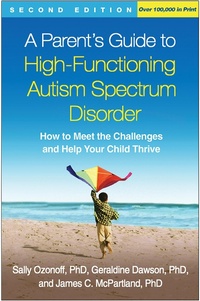
A Parent's Guide to High-Functioning Autism Spectrum Disorder
How to Meet the Challenges and Help Your Child Thrive
2nd Edition
Published on 27. November 2014
308 pages
978-1-4625-1869-2 (ISBN)
Description

Parents of children (ages 2 to 15) with high-functioning ASD; also of interest to health care professionals and educators.
More details
Other editions
Additional editions
Sally Ozonoff | Geraldine Dawson | James C. McPartland
A Parent's Guide to High-Functioning Autism Spectrum Disorder, Second Edition
How to Meet the Challenges and Help Your Child Thrive
Book
01/2015
2nd Edition
Guilford Press
€21.50
Shipment within 15-20 days
Persons
Sally Ozonoff, PhD, is Endowed Professor and Vice Chair for Research in the Department of Psychiatry and the MIND Institute--a national center for the study and treatment of ASD--at the University of California, Davis. Dr. Ozonoff is widely known for her research and teaching in the areas of early diagnosis and assessment of ASD, and has an active clinical practice.
Geraldine Dawson, PhD, is the William Cleland Distinguished Professor of Psychiatry and Behavioral Sciences, Professor of Pediatrics, and Professor of Psychology and Neuroscience at Duke University, and is founding Director of the Duke Center for Autism and Brain Development. She also directs the Duke NIH Autism Center of Excellence. A child psychologist and researcher, Dr. Dawson has published more than 400 articles and chapters and 13 books on early autism detection and intervention and brain development. Her studies have been recognized as among the top 20 annual advances in autism research by the National Institutes of Health 13 times. Dr. Dawson has served as president of the International Society for Autism Research (INSAR) and was the first Chief Science Officer for Autism Speaks, the largest autism science and advocacy organization. She is a member of the American Academy of Arts and Sciences and a Fellow of the American Psychological Association, the Association for Psychological Science, and INSAR, and has received numerous awards for her contributions to research. She is ranked in the top 1% of Clarivate Analytics Highly Cited Researchers.
James C. McPartland, PhD, is Assistant Professor, Director of the Developmental Disabilities Clinic, and Associate Director of the Developmental Electrophysiology Laboratory at the Yale Child Study Center, Yale University School of Medicine. Dr. McPartland's research focuses on the clinical neuroscience of autism spectrum disorders from infancy through adulthood. He is a recipient of honors including the Behavioral Science Track Award for Rapid Transition and a Patient-Oriented Research Career Development Award from the National Institute of Mental Health, the NARSAD Atherton Young Investigator Award, the Young Investigator Award from the International Society for Autism Research, and the Klerman Prize for Exceptional Achievement in Clinical Research from the Brain and Behavior Research Foundation.
Geraldine Dawson, PhD, is the William Cleland Distinguished Professor of Psychiatry and Behavioral Sciences, Professor of Pediatrics, and Professor of Psychology and Neuroscience at Duke University, and is founding Director of the Duke Center for Autism and Brain Development. She also directs the Duke NIH Autism Center of Excellence. A child psychologist and researcher, Dr. Dawson has published more than 400 articles and chapters and 13 books on early autism detection and intervention and brain development. Her studies have been recognized as among the top 20 annual advances in autism research by the National Institutes of Health 13 times. Dr. Dawson has served as president of the International Society for Autism Research (INSAR) and was the first Chief Science Officer for Autism Speaks, the largest autism science and advocacy organization. She is a member of the American Academy of Arts and Sciences and a Fellow of the American Psychological Association, the Association for Psychological Science, and INSAR, and has received numerous awards for her contributions to research. She is ranked in the top 1% of Clarivate Analytics Highly Cited Researchers.
James C. McPartland, PhD, is Assistant Professor, Director of the Developmental Disabilities Clinic, and Associate Director of the Developmental Electrophysiology Laboratory at the Yale Child Study Center, Yale University School of Medicine. Dr. McPartland's research focuses on the clinical neuroscience of autism spectrum disorders from infancy through adulthood. He is a recipient of honors including the Behavioral Science Track Award for Rapid Transition and a Patient-Oriented Research Career Development Award from the National Institute of Mental Health, the NARSAD Atherton Young Investigator Award, the Young Investigator Award from the International Society for Autism Research, and the Klerman Prize for Exceptional Achievement in Clinical Research from the Brain and Behavior Research Foundation.
Content
I. Understanding High-Functioning Autism Spectrum Disorder
1. What Is High-Functioning Autism Spectrum Disorder?
2. The Diagnostic Process
3. Causes of Autism Spectrum Disorder
4. Treatments for High-Functioning Autism Spectrum Disorder
II. Living with High-Functioning Autism Spectrum Disorder
5. Channeling Your Child's Strengths: A Guiding Principle
6. High-Functioning Autism Spectrum Disorder at Home
7. High-Functioning Autism Spectrum Disorder at School
8. The Social World of Children and Adolescents with High-Functioning Autism Spectrum Disorder
9. Looking Ahead: High-Functioning Autism Spectrum Disorder in Late Adolescence and Adulthood
Resources
References
1. What Is High-Functioning Autism Spectrum Disorder?
2. The Diagnostic Process
3. Causes of Autism Spectrum Disorder
4. Treatments for High-Functioning Autism Spectrum Disorder
II. Living with High-Functioning Autism Spectrum Disorder
5. Channeling Your Child's Strengths: A Guiding Principle
6. High-Functioning Autism Spectrum Disorder at Home
7. High-Functioning Autism Spectrum Disorder at School
8. The Social World of Children and Adolescents with High-Functioning Autism Spectrum Disorder
9. Looking Ahead: High-Functioning Autism Spectrum Disorder in Late Adolescence and Adulthood
Resources
References
