

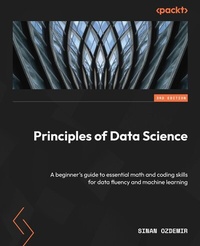
Principles of Data Science
A beginner's guide to essential math and coding skills for data fluency and machine learning
3rd Edition
Published on 23. September 2024
326 pages
978-1-83763-600-6 (ISBN)
Description

Transform your data into insights with must-know techniques and mathematical concepts to unravel the secrets hidden within your data
Key Features
Learn practical data science combined with data theory to gain maximum insights from data
Discover methods for deploying actionable machine learning pipelines while mitigating biases in data and models
Explore actionable case studies to put your new skills to use immediately
Purchase of the print or Kindle book includes a free PDF eBook
Book DescriptionPrinciples of Data Science bridges mathematics, programming, and business analysis, empowering you to confidently pose and address complex data questions and construct effective machine learning pipelines. This book will equip you with the tools to transform abstract concepts and raw statistics into actionable insights. Starting with cleaning and preparation, you'll explore effective data mining strategies and techniques before moving on to building a holistic picture of how every piece of the data science puzzle fits together. Throughout the book, you'll discover statistical models with which you can control and navigate even the densest or the sparsest of datasets and learn how to create powerful visualizations that communicate the stories hidden in your data. With a focus on application, this edition covers advanced transfer learning and pre-trained models for NLP and vision tasks. You'll get to grips with advanced techniques for mitigating algorithmic bias in data as well as models and addressing model and data drift. Finally, you'll explore medium-level data governance, including data provenance, privacy, and deletion request handling. By the end of this data science book, you'll have learned the fundamentals of computational mathematics and statistics, all while navigating the intricacies of modern ML and large pre-trained models like GPT and BERT.What you will learn
Master the fundamentals steps of data science through practical examples
Bridge the gap between math and programming using advanced statistics and ML
Harness probability, calculus, and models for effective data control
Explore transformative modern ML with large language models
Evaluate ML success with impactful metrics and MLOps
Create compelling visuals that convey actionable insights
Quantify and mitigate biases in data and ML models
Who this book is forIf you are an aspiring novice data scientist eager to expand your knowledge, this book is for you. Whether you have basic math skills and want to apply them in the field of data science, or you excel in programming but lack the necessary mathematical foundations, you'll find this book useful. Familiarity with Python programming will further enhance your learning experience.
Key Features
Learn practical data science combined with data theory to gain maximum insights from data
Discover methods for deploying actionable machine learning pipelines while mitigating biases in data and models
Explore actionable case studies to put your new skills to use immediately
Purchase of the print or Kindle book includes a free PDF eBook
Book DescriptionPrinciples of Data Science bridges mathematics, programming, and business analysis, empowering you to confidently pose and address complex data questions and construct effective machine learning pipelines. This book will equip you with the tools to transform abstract concepts and raw statistics into actionable insights. Starting with cleaning and preparation, you'll explore effective data mining strategies and techniques before moving on to building a holistic picture of how every piece of the data science puzzle fits together. Throughout the book, you'll discover statistical models with which you can control and navigate even the densest or the sparsest of datasets and learn how to create powerful visualizations that communicate the stories hidden in your data. With a focus on application, this edition covers advanced transfer learning and pre-trained models for NLP and vision tasks. You'll get to grips with advanced techniques for mitigating algorithmic bias in data as well as models and addressing model and data drift. Finally, you'll explore medium-level data governance, including data provenance, privacy, and deletion request handling. By the end of this data science book, you'll have learned the fundamentals of computational mathematics and statistics, all while navigating the intricacies of modern ML and large pre-trained models like GPT and BERT.What you will learn
Master the fundamentals steps of data science through practical examples
Bridge the gap between math and programming using advanced statistics and ML
Harness probability, calculus, and models for effective data control
Explore transformative modern ML with large language models
Evaluate ML success with impactful metrics and MLOps
Create compelling visuals that convey actionable insights
Quantify and mitigate biases in data and ML models
Who this book is forIf you are an aspiring novice data scientist eager to expand your knowledge, this book is for you. Whether you have basic math skills and want to apply them in the field of data science, or you excel in programming but lack the necessary mathematical foundations, you'll find this book useful. Familiarity with Python programming will further enhance your learning experience.
All prices
More details
Edition
3rd Revised edition
Language
English
Place of publication
Birmingham
United Kingdom
Target group
Professional and scholarly
US School Grade: College Graduate Student
Edition type
Revised edition
Product notice
Reflowable
File size
8,98 MB
ISBN-13
978-1-83763-600-6 (9781837636006)
Copyright in bibliographic data and cover images is held by Nielsen Book Services Limited or by the publishers or by their respective licensors: all rights reserved.
Schweitzer Classification
Other editions
Additional editions
Sinan Ozdemir
Principles of Data Science
A beginner's guide to essential math and coding skills for data fluency and machine learning
Book
01/2024
3rd Edition
Packt Publishing
€47.20
Shipment within 3-4 weeks
Previous edition
Sinan Ozdemir
Principles of Data Science
Mathematical techniques and theory to succeed in data-driven industries
E-Book
06/2024
1st Edition
Packt Publishing Limited
from
€38.39
Available for download
Person
Ozdemir Sinan :
Sinan is an active lecturer focusing on large language models and a former lecturer of data science at the Johns Hopkins University. He is the author of multiple textbooks on data science and machine learning including "Quick Start Guide to LLMs". Sinan is currently the founder of LoopGenius which uses AI to help people and businesses boost their sales and was previously the founder of the acquired Kylie.ai, an enterprise-grade conversational AI platform with RPA capabilities. He holds a Master's Degree in Pure Mathematics from Johns Hopkins University and is based in San Francisco.
Sinan is an active lecturer focusing on large language models and a former lecturer of data science at the Johns Hopkins University. He is the author of multiple textbooks on data science and machine learning including "Quick Start Guide to LLMs". Sinan is currently the founder of LoopGenius which uses AI to help people and businesses boost their sales and was previously the founder of the acquired Kylie.ai, an enterprise-grade conversational AI platform with RPA capabilities. He holds a Master's Degree in Pure Mathematics from Johns Hopkins University and is based in San Francisco.
Content
Table of Contents
Data Science Terminology
Types of Data
The Five Steps of Data Science
Basic Mathematics
Impossible or Improbable - A Gentle Introduction to Probability
Advanced Probability
What are the Chances? An Introduction to Statistics
Advanced Statistics
Communicating Data
How to Tell if Your Toaster is Learning - Machine Learning Essentials
Predictions Don't Grow on Trees, or Do They?
Introduction to Transfer Learning and Pre-trained Models
Mitigating Algorithmic Bias and Tackling Model and Data Drift
AI Governance
Navigating Real-World Data Science Case Studies in Action
Data Science Terminology
Types of Data
The Five Steps of Data Science
Basic Mathematics
Impossible or Improbable - A Gentle Introduction to Probability
Advanced Probability
What are the Chances? An Introduction to Statistics
Advanced Statistics
Communicating Data
How to Tell if Your Toaster is Learning - Machine Learning Essentials
Predictions Don't Grow on Trees, or Do They?
Introduction to Transfer Learning and Pre-trained Models
Mitigating Algorithmic Bias and Tackling Model and Data Drift
AI Governance
Navigating Real-World Data Science Case Studies in Action
