

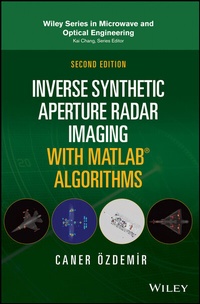
Inverse Synthetic Aperture Radar Imaging With MATLAB Algorithms
Description

The newly revised Second Edition of Inverse Synthetic Aperture Radar Imaging with MATLAB Algorithms covers in greater detail the fundamental and advanced topics necessary for a complete understanding of inverse synthetic aperture radar (ISAR) imaging and its concepts. Distinguished author and academician, Caner Özdemir, describes the practical aspects of ISAR imaging and presents illustrative examples of the radar signal processing algorithms used for ISAR imaging. The topics in each chapter are supplemented with MATLAB codes to assist readers in better understanding each of the principles discussed within the book.
This new edition incudes discussions of the most up-to-date topics to arise in the field of ISAR imaging and ISAR hardware design. The book provides a comprehensive analysis of advanced techniques like Fourier-based radar imaging algorithms, and motion compensation techniques along with radar fundamentals for readers new to the subject.
The author covers a wide variety of topics, including:
* Radar fundamentals, including concepts like radar cross section, maximum detectable range, frequency modulated continuous wave, and doppler frequency and pulsed radar
* The theoretical and practical aspects of signal processing algorithms used in ISAR imaging
* The numeric implementation of all necessary algorithms in MATLAB
* ISAR hardware, emerging topics on SAR/ISAR focusing algorithms such as bistatic ISAR imaging, polarimetric ISAR imaging, and near-field ISAR imaging,
* Applications of SAR/ISAR imaging techniques to other radar imaging problems such as thru-the-wall radar imaging and ground-penetrating radar imaging
Perfect for graduate students in the fields of electrical and electronics engineering, electromagnetism, imaging radar, and physics, Inverse Synthetic Aperture Radar Imaging With MATLAB Algorithms also belongs on the bookshelves of practicing researchers in the related areas looking for a useful resource to assist them in their day-to-day professional work.
More details
Other editions
Additional editions
Person
CANER ÖZDEMIR, PHD, teaches undergraduate and graduate courses on electromagnetics, antennas, radar, and signal processing at Mersin University in Turkey. He has published over 150 scientific journal articles and is the recipient of the URSI EMT-S Young Scientist Award in the 2004 International Symposium on Electromagnetic Theory, as well as the 2016 Best Paper Award in SPIE-Journal of Applied Remote Sensing.
Content
Preface to the Second Edition xvi
Acknowledgments xix
Acronyms xx
1 Basics of Fourier Analysis 1
1.1 Forward and Inverse Fourier Transform 1
1.1.1 Brief History of FT 1
1.1.2 Forward FT Operation 2
1.1.3 IFT 3
1.2 FT Rules and Pairs 3
1.2.1 Linearity 3
1.2.2 Time Shifting 3
1.2.3 Frequency Shifting 4
1.2.4 Scaling 4
1.2.5 Duality 4
1.2.6 Time Reversal 4
1.2.7 Conjugation 4
1.2.8 Multiplication 4
1.2.9 Convolution 5
1.2.10 Modulation 5
1.2.11 Derivation and Integration 5
1.2.12 Parseval's Relationship 5
1.3 Time-Frequency Representation of a Signal 5
1.3.1 Signal in the Time Domain 6
1.3.2 Signal in the Frequency Domain 6
1.3.3 Signal in the Joint Time-Frequency (JTF) Plane 7
1.4 Convolution and Multiplication Using FT 11
1.5 Filtering/Windowing 12
1.6 Data Sampling 14
1.7 DFT and FFT 16
1.7.1 DFT 16
1.7.2 FFT 17
1.7.3 Bandwidth and Resolutions 17
1.8 Aliasing 19
1.9 Importance of FT in Radar Imaging 19
1.10 Effect of Aliasing in Radar Imaging 23
1.11 Matlab Codes 26
References 33
2 Radar Fundamentals 35
2.1 Electromagnetic Scattering 35
2.2 Scattering from PECs 38
2.3 Radar Cross Section 39
2.3.1 Definition of RCS 40
2.3.2 RCS of Simple-Shaped Objects 43
2.3.3 RCS of Complex-Shaped Objects 44
2.4 Radar Range Equation 44
2.4.1 Bistatic Case 46
2.4.2 Monostatic Case 49
2.5 Range of Radar Detection 50
2.5.1 Signal-to-Noise Ratio 51
2.6 Radar Waveforms 53
2.6.1 Continuous Wave 53
2.6.2 Frequency-Modulated Continuous Wave 56
2.6.3 Stepped-Frequency Continuous Wave 59
2.6.4 Short Pulse 61
2.6.5 Chirp (LFM) Pulse 62
2.7 Pulsed Radar 69
2.7.1 Pulse Repetition Frequency 69
2.7.2 Maximum Range and Range Ambiguity 69
2.7.3 Doppler Frequency 70
2.8 Matlab Codes 74
References 82
3 Synthetic Aperture Radar 85
3.1 SAR Modes 86
3.2 SAR System Design 87
3.3 Resolutions in SAR 88
3.4 SAR Image Formation 91
3.5 Range Compression 92
3.5.1 Matched Filter 92
3.5.1.1 Computing Matched Filter Output via Fourier Processing 95
3.5.1.2 Example for Matched Filtering 96
3.5.2 Ambiguity Function 99
3.5.2.1 Relation to Matched Filter 100
3.5.2.2 Ideal Ambiguity Function 101
3.5.2.3 Rectangular-Pulse Ambiguity Function 102
3.5.2.4 LFM-Pulse Ambiguity Function 102
3.5.3 Pulse Compression 105
3.5.3.1 Detailed Processing of Pulse Compression 105
3.5.3.2 Bandwidth, Resolution, and Compression Issues for LFM Signal 109
3.5.3.3 Pulse Compression Example 110
3.6 Azimuth Compression 110
3.6.1 Processing in Azimuth 110
3.6.2 Azimuth Resolution 116
3.6.3 Relation to ISAR 117
3.7 SAR Imaging 118
3.8 SAR Focusing Algorithms 118
3.8.1 RDA 119
3.8.1.1 Range Compression in RDA 120
3.8.1.2 Azimuth Fourier Transform 126
3.8.1.3 Range Cell Migration Correction 128
3.8.1.4 Azimuth Compression 129
3.8.1.5 Simulated SAR Imaging Example 130
3.8.1.6 Drawbacks of RDA 133
3.8.2 Chirp Scaling Algorithm 133
3.8.3 The ¿-kA 133
3.8.4 Back-Projection Algorithm 134
3.9 Example of a Real SAR Imagery 135
3.10 Problems in SAR Imaging 136
3.10.1 Range Migration and Range Walk 136
3.10.2 Motion Errors 137
3.10.3 Speckle Noise 140
3.11 Advanced Topics in SAR 140
3.11.1 SAR Interferometry 140
3.11.2 SAR Polarimetry 142
3.12 Matlab Codes 143
References 158
4 Inverse Synthetic Aperture Radar Imaging and Its Basic Concepts 162
4.1 SAR versus ISAR 162
4.2 The Relation of Scattered Field to the Image Function in ISAR 166
4.3 One-Dimensional (1D) Range Profile 167
4.4 1D Cross-Range Profile 172
4.5 Two-Dimensional (2D) ISAR Image Formation (Small Bandwidth, Small Angle) 176
4.5.1 Resolutions in ISAR 180
4.5.1.1 Range Resolution 181
4.5.1.2 Cross-Range Resolution: 181
4.5.2 Range and Cross-Range Extends 181
4.5.3 Imaging Multibounces in ISAR 182
4.5.4 Sample Design Procedure for ISAR 185
4.5.4.1 ISAR Design Example #1: "Aircraft Target" 189
4.5.4.2 ISAR Design Example #2: "Military Tank Target" 193
4.6 2D ISAR Image Formation (Wide Bandwidth, Large Angles) 197
4.6.1 Direct Integration 198
4.6.2 Polar Reformatting 201
4.7 3D ISAR Image Formation 205
4.7.1 Range and Cross-Range resolutions 209
4.7.2 A Design Example for 3D ISAR 210
4.8 Matlab Codes 217
References 243
5 Imaging Issues in Inverse Synthetic Aperture Radar 246
5.1 Fourier-Related Issues 246
5.1.1 DFT Revisited 246
5.1.2 Positive and Negative Frequencies in DFT 250
5.2 Image Aliasing 252
5.3 Polar Reformatting Revisited 255
5.3.1 Nearest Neighbor Interpolation 255
5.3.2 Bilinear Interpolation 258
5.4 Zero Padding 260
5.5 Point Spread Function 264
5.6 Windowing 269
5.6.1 Common Windowing Functions 269
5.6.1.1 Rectangular Window 269
5.6.1.2 Triangular Window 269
5.6.1.3 Hanning Window 272
5.6.1.4 Hamming Window 272
5.6.1.5 Kaiser Window 272
5.6.1.6 Blackman Window 276
5.6.1.7 Chebyshev Window 277
5.6.2 ISAR Image Smoothing via Windowing 277
5.7 Matlab Codes 280
References 304
6 Range-Doppler Inverse Synthetic Aperture Radar Processing 306
6.1 Scenarios for ISAR 306
6.1.1 Imaging Aerial Targets via Ground-Based Radar 307
6.1.2 Imaging Ground/Sea Targets via Aerial Radar 309
6.2 ISAR Waveforms for Range-Doppler Processing 312
6.2.1 Chirp Pulse Train 312
6.2.2 Stepped Frequency Pulse Train 314
6.3 Doppler Shift's Relation to Cross-Range 316
6.3.1 Doppler Frequency Shift Resolution 317
6.3.2 Resolving Doppler Shift and Cross-Range 318
6.4 Forming the Range-Doppler Image 319
6.5 ISAR Receiver 320
6.5.1 ISAR Receiver for Chirp Pulse Radar 320
6.5.2 ISAR Receiver for SFCW Radar 321
6.6 Quadrature Detection 323
6.6.1 I-Channel Processing 324
6.6.2 Q-Channel Processing 324
6.7 Range Alignment 326
6.8 Defining the Range-Doppler ISAR Imaging Parameters 327
6.8.1 Image Frame Dimension (Image Extends) 327
6.8.2 Range and Cross-Range Resolution 328
6.8.3 Frequency Bandwidth and the Center Frequency 328
6.8.4 Doppler Frequency Bandwidth 328
6.8.5 Pulse Repetition Frequency 329
6.8.6 Coherent Integration (Dwell) Time 329
6.8.7 Pulse Width 330
6.9 Example of Chirp Pulse-Based Range-Doppler ISAR Imaging 331
6.10 Example of SFCW-Based Range-Doppler ISAR Imaging 336
6.11 Matlab Codes 339
References 347
7 Scattering Center Representation of Inverse Synthetic Aperture Radar 349
7.1 Scattering/Radiation Center Model 350
7.2 Extraction of Scattering Centers 352
7.2.1 Image Domain Formulation 352
7.2.1.1 Extraction in the Image Domain: The "CLEAN" Algorithm 352
7.2.1.2 Reconstruction in the Image Domain 355
7.2.2 Fourier Domain Formulation 362
7.2.2.1 Extraction in the Fourier Domain 362
7.2.2.2 Reconstruction in the Fourier Domain 364
7.3 Matlab Codes 368
References 382
8 Motion Compensation for Inverse Synthetic Aperture Radar 385
8.1 Doppler Effect Due to Target Motion 386
8.2 Standard MOCOMP Procedures 388
8.2.1 Translational MOCOMP 389
8.2.1.1 Range Tracking 389
8.2.1.2 Doppler Tracking 390
8.2.2 Rotational MOCOMP 390
8.3 Popular ISAR MOCOMP Techniques 392
8.3.1 Cross-Correlation Method 392
8.3.1.1 Example for the Cross-Correlation Method 394
8.3.2 Minimum Entropy Method 398
8.3.2.1 Definition of Entropy in ISAR Images 398
8.3.2.2 Example for the Minimum Entropy Method 399
8.3.3 JTF-Based MOCOMP 402
8.3.3.1 Received Signal from a Moving Target 403
8.3.3.2 An Algorithm for JTF-Based Rotational MOCOMP 404
8.3.3.3 Example for JTF-Based Rotational MOCOMP 406
8.3.4 Algorithm for JTF-Based Translational and RotationalMOCOMP 408
8.3.4.1 A Numerical Example 410
8.4 Matlab Codes 415
References 436
9 Bistatic ISAR Imaging 440
9.1 Why Bi-ISAR Imaging? 440
9.2 Geometry for Bi-Isar Imaging and the Algorithm 444
9.2.1 Bi-ISAR Imaging Algorithm for a Point Scatterer 444
9.2.2 Bistatic ISAR Imaging Algorithm for a Target 448
9.3 Resolutions in Bistatic ISAR 449
9.3.1 Range Resolution 449
9.3.2 Cross-Range Resolution 450
9.3.3 Range and Cross-Range Extends 451
9.4 Design Procedure for Bi-ISAR Imaging 452
9.5 Bi-Isar Imaging Examples 455
9.5.1 Bi-ISAR Design Example #1 455
9.5.2 Bi-ISAR Design Example #2 457
9.6 Mu-ISAR Imaging 465
9.6.1 Challenges in Mu-ISAR Imaging 467
9.6.2 Mu-ISAR Imaging Example 468
9.7 Matlab Codes 472
References 483
10 Polarimetric ISAR Imaging 484
10.1 Polarization of an Electromagnetic Wave 484
10.1.1 Polarization Type 485
10.1.2 Polarization Sensitivity 486
10.1.3 Polarization in Radar Systems 487
10.2 Polarization Scattering Matrix 488
10.2.1 Relation to RCS 490
10.2.2 Polarization Characteristics of the Scattered Wave 491
10.2.3 Polarimetric Decompositions of EM Wave Scattering 493
10.2.4 The Pauli Decomposition 494
10.2.4.1 Description of Pauli Decomposition 494
10.2.4.2 Interpretation of Pauli Decomposition 495
10.2.4.3 Polarimetric Image Representation Using Pauli Decomposition 496
10.3 Why Polarimetric ISAR Imaging? 497
10.4 ISAR Imaging with Full Polarization 497
10.4.1 ISAR Data in LP Basis 497
10.4.2 ISAR Data in CP Basis 498
10.5 Polarimetric ISAR Images 499
10.5.1 Pol-ISAR Image of a Benchmark Target 499
10.5.1.1 The "SLICY" Target 499
10.5.1.2 Fully Polarimetric EM Simulation of SLICY 499
10.5.1.3 LP Pol-ISAR Images of SLICY 500
10.5.1.4 CP Pol-ISAR Images of SLICY 502
10.5.1.5 Pauli Decomposition Image of SLICY 503
10.5.2 Pol-ISAR Image of a Complex Target 507
10.5.2.1 The "Military Tank" Target 507
10.5.2.2 Fully Polarimetric EM Simulation of "Tank" Target 508
10.5.2.3 LP Pol-ISAR Images of "Tank" Target 508
10.5.2.4 CP Pol-ISAR Images of "Tank" Target 510
10.5.2.5 Pauli Decomposition Image of "Tank" Target 512
10.6 Feature Extraction from Polarimetric Images 515
10.7 Matlab Codes 515
References 529
11 Near-Field ISAR Imaging 533
11.1 Definitions of Far and Near-Field Regions 534
11.1.1 The Far-Field Region 534
11.1.1.1 The Far-Field Definition Based on Target's Cross-Range Extend 534
11.1.1.2 The Far-Field Definition Based on Target's Range Extend 535
11.1.2 The Near-Field Region 537
11.2 Near-Field Signal Model for the Back-Scattered Field 537
11.3 Near-Field ISAR Imaging Algorithms 540
11.3.1 "Focusing Operator" Algorithm 540
11.3.2 Back-Projection Algorithm 541
11.3.2.1 Fourier Slice Theorem 542
11.3.2.2 BPA Formulation (3D Case) 543
11.3.2.3 BPA Formulation (2D Case) 544
11.4 Data Sampling Criteria and the Resolutions 546
11.5 Near-Field ISAR Imaging Examples 547
11.5.1 Point Scatterers in the Near-Field: Comparison of Far- and Near-Field Imaging Algorithms 547
11.5.2 Near-Field ISAR Imaging of a Large Object 552
11.5.3 Near-Field ISAR Imaging of a Small Object 555
11.6 Matlab Codes 560
References 569
12 Some Imaging Applications Based on SAR/ISAR 571
12.1 Imaging Subsurface Objects: GPR-SAR 572
12.1.1 The GPR Problem 572
12.1.2 B-Scan GPR in Comparison to Strip-Map SAR 577
12.1.3 Focused GPR Images Using SAR 577
12.1.3.1 GPR Focusing with ¿-k Algorithm (¿-kA) 579
12.1.3.2 GPR Focusing with BPA 582
12.1.3.3 Other Popular GPR Focusing Techniques 589
12.2 Thru-the-Wall Imaging Radar Using SAR 590
12.2.1 Challenges in TWIR 591
12.2.2 Techniques to Improve Cross-Range Resolution in TWIR 591
12.2.3 The Use of SAR in TWIR 592
12.2.4 Example of SAR-Based TWIR 594
12.3 Imaging Antenna-Platform Scattering: ASAR 596
12.3.1 The ASAR Imaging Algorithm 597
12.3.2 Numerical Example for ASAR Imagery 603
12.4 Imaging Platform Coupling Between Antennas: ACSAR 605
12.4.1 The ACSAR Imaging Algorithm 606
12.4.2 Numerical Example for ACSAR 609
12.4.3 Applying ACSAR Concept to the GPR Problem 611
References 615
Appendix 619
Index 628
1
Basics of Fourier Analysis
1.1 Forward and Inverse Fourier Transform
Fourier transform (FT) is a common and useful mathematical tool that is utilized in innumerous applications in science and technology. FT is quite practical especially for characterizing nonlinear functions in nonlinear systems, analyzing random signals, and solving linear problems. FT is also a very important tool in radar imaging applications as we shall investigate in the forthcoming chapters of this book. Before starting to deal with the FT and inverse Fourier transform (IFT), a brief history of this useful linear operator, and its founders are presented.
1.1.1 Brief History of FT
Jean Baptiste Joseph Fourier, a great mathematician, was born in 1768, Auxerre, France. His special interest in heat conduction led him to describe a mathematical series of sine and cosine terms that could be used to analyze propagation and diffusion of heat in solid bodies. In 1807, he tried to share his innovative ideas with researchers by preparing an essay entitled as On the Propagation of Heat in Solid Bodies. The work was examined by Lagrange, Laplace, Monge, and Lacroix. Lagrange's oppositions caused the rejection of Fourier's paper. This unfortunate decision cost colleagues to wait for 15 more years to meet his remarkable contributions to mathematics, physics, and especially on signal analysis. Finally, his ideas were published thru the book The Analytic Theory of Heat in 1822 (Fourier 1955).
Discrete Fourier transform (DFT) was developed as an effective tool in calculating this transformation. However, computing FT with this tool in the nineteenth century was taking a long time. In 1903, C. Runge has studied on the minimization of the computational time of the transformation operation (Runge 1903). In 1942, Danielson and Lanczos had utilized the symmetry properties of FT to reduce the number of operations in DFT (Danielson and Lanczos 1942). Before the advent of digital computing technologies, James W. Cooley and John W. Tukey developed a fast method to reduce the computation time of DFT operation. In 1965, they published their technique that later on has become famous as the fast Fourier transform (FFT) (Cooley and Tukey 1965).
1.1.2 Forward FT Operation
The FT can be simply defined as a certain linear operator that maps functions or signals defined in one domain to other functions or signals in another domain. The common use of FT in electrical engineering is to transform signals from time domain to frequency domain or vice-versa. More precisely, forward FT decomposes a signal into a continuous spectrum of its frequency components such that the time signal is transformed to a frequency domain signal. In radar applications, these two opposing domains are usually represented as "spatial-frequency (or wave-number)" and "range (distance)." Such use of FT will be often examined and applied throughout this book.
The forward FT of a continuous signal g(t) where -8 < t < 8 is described as
(1.1)where represents the forward FT operation that is defined from time domain to frequency domain.
To appreciate the meaning of FT, the multiplying function exp(-j2pft) and operators (multiplication and integration) on the right of side of Eq. 1.1 should be examined carefully: The term is a complex phasor representation for a sinusoidal function with the single frequency of "fi." This signal oscillates with the single frequency of "fi" and does not contain any other frequency component. Multiplying the signal in interest, g(t) with provides the similarity between each signal, that is, how much of g(t) has the frequency content of "fi." Integrating this multiplication over all time instants from -8 to 8 will sum the "fi" contents of g(t) over all time instants to give G(fi) that is the amplitude of the signal at the particular frequency of "fi." Repeating this process for all the frequencies from -8 to 8 will provide the frequency spectrum of the signal represented as G(f). Therefore, the transformed signal represents the continuous spectrum of frequency components; i.e. representation of the signal in "frequency domain."
1.1.3 IFT
This transformation is the inverse operation of the FT. IFT, therefore, synthesizes a frequency-domain signal from its spectrum of frequency components to its time domain form. The IFT of a continuous signal G(f) where -8 < f < 8 is described as
(1.2)where the IFT operation from frequency domain to time domain is represented by .
1.2 FT Rules and Pairs
There are many useful Fourier rules and pairs that can be very helpful when applying the FT or IFT to different real-world applications. We will briefly revisit them to remind the properties of the FT to the reader. Provided that FT and IFT are defined as in Eqs. 1.1 and 1.2, respectively, FT pair is denoted as
(1.3)and the corresponding alternative pair is given by
(1.4)Based on these notations, the properties of FT are listed briefly below.
1.2.1 Linearity
If G(f) and H(f) are the FTs of the time signals g(t) and h(t), respectively, the following equation is valid for the scalars a and b.
(1.5)Therefore, the FT is a linear operator.
1.2.2 Time Shifting
If the signal is shifted in time with a value of to, then the corresponding frequency signal will have the form of
(1.6)1.2.3 Frequency Shifting
If the time signal is multiplied by a phase term of , then the FT of this time signal is shifted in frequency by fo as given below
(1.7)1.2.4 Scaling
If the time signal is scaled by a constant a, then the spectrum is also scaled with the following rule
(1.8)1.2.5 Duality
If the spectrum signal G(f) is taken as a time signal G(t), then, the corresponding frequency domain signal will be the time reversal equivalent of the original time domain signal, g(t) as
(1.9)1.2.6 Time Reversal
If the time is reversed for the time-domain signal, then the frequency is also reversed in the frequency domain signal.
(1.10)1.2.7 Conjugation
If the conjugate of the time-domain signal is taken, then the frequency-domain signal conjugated and frequency-reversed.
(1.11)1.2.8 Multiplication
If the time-domain signals, g(t) and h(t) are multiplied in time, then their spectrum signals G(f) and H(f) are convolved in frequency.
(1.12)1.2.9 Convolution
If the time-domain signals, g(t) and h(t) are convolved in time, then their spectrum signals G(f) and H(f) are multiplied in the frequency domain.
(1.13)1.2.10 Modulation
If the time-domain signal is modulated with sinusoidal functions, then the frequency-domain signal is shifted by the amount of the frequency at that particular sinusoidal function.
(1.14)1.2.11 Derivation and Integration
If the derivative or integration of a time-domain signal is taken, then the corresponding frequency-domain signal is given as below.
(1.15)1.2.12 Parseval's Relationship
A useful property that was claimed by Parseval is that since the FT (or IFT) operation maps a signal in one domain to another domain, their energies should be exactly the same as given by the following relationship.
(1.16)1.3 Time-Frequency Representation of a Signal
While the FT concept can be successfully utilized for the stationary signals, there are many real-world signals whose frequency contents vary over time. To be able to display these frequency variations over time; therefore, joint time-frequency (JTF) transforms/representations are being used.
1.3.1 Signal in the Time Domain
The term "time domain" is used while describing functions or physical signals with respect to time either continuous or discrete. The time-domain signals are usually more comprehensible than the frequency-domain signals since most of the real-world signals are recorded and displayed versus time. Common equipment is to analyze time-domain signals is the oscilloscope. In Figure 1.1, a time-domain...
