

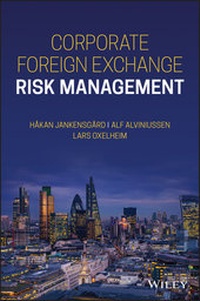
Corporate Foreign Exchange Risk Management
Description

A practical and accessible guide that demystifies ForEx risk for managers in all areas of business
Virtually any organisation active in the global economy is impacted by fluctuations in foreign exchange (FX or ForEx) markets. Managers need to understand this increasingly complex issue and measure their firm's exposure to risk. Corporate Foreign Exchange Risk Management is an in-depth yet accessible guide on effective ForEx exposure management. Designed for professionals responsible for managing a profit & loss or balance sheet influenced by ForEx fluctuations, it enables risk managers to navigate the interconnected worlds of financial management and economics.
This innovative guide integrates academic discussion of the economics of risk management decisions and pragmatic advice for various situations in which performance measures affected by accounting standards are paid considerable attention. Readers are provided with the tools and knowledge required to handle a broad range of issues related to ForEx risk management. Clear, non-technical chapters demystify concepts that often appear complicated and confusing to managers. Written by globally-recognised experts in corporate finance, risk management and international business, this book:
- Employs a reader-friendly narrative style to explain complex concepts
- Provides a clear, actionable risk management strategy which can be used in a variety of businesses
- Places all concepts in relatable, real-world contexts
- Explains important academic research to practitioners in plain English
- Includes effective pedagogical tools and explanations, straightforward examples and end-of-chapter summaries which highlight key points
Corporate Foreign Exchange Risk Management is a must-read for any manager who deals with corporate exposure to ForEx risk, as well as analysts wishing to better understand the relation between corporate performance and ForEx fluctuations and students of corporate risk management.
More details
Other editions
Additional editions
Persons
HÅKAN JANKENSGÅRD is Associate Professor in Corporate Finance at Lund University where he teaches a Master-level course in corporate risk management. He has done extensive academic research on firms' risk management strategies and frameworks for integrated risk management. Previously, Dr Jankensgård was corporate risk manager at Norsk Hydro.
ALF ALVINIUSSEN has 42 years of experience in leading positions within Corporate Finance and Treasury at Norsk Hydro ASA. Mr Alviniussen is now an independent consultant and since 2013 a member of Stakeholder Groups of the EU regulatory bodies European Banking Authority (EBA) and European Insurance and Occupational Pension Authority (EIOPA).
LARS OXELHEIM is professor of International Business and Finance at the University of Agder, Kristiansand, Norway and affiliated with the Research Institute of Industrial Economics (IFN), Stockholm, Sweden. His research interests include the interplay between the firm and its macroeconomic environment, encompassing economic and financial integration as well as managerial aspects, corporate governance, and risk management. He has published some 45 books and numerous academic articles many of which address macroeconomic influences on corporate performance.
Content
Acknowledgements vii
About the Authors ix
Preface xiii
Key Terms and Abbreviations xvii
Introduction 1
Chapter 1: Why Manage Foreign Exchange Risk? 15
Chapter 2: Commercial Exposure to FX 29
Chapter 3: Net Income Exposure to FX 49
Chapter 4: Balance Sheet Exposure to FX 65
Chapter 5: FX Derivatives Explained 83
Chapter 6: Hedge Accounting Explained 105
Chapter 7: Centralizing Exposure Management 127
Chapter 8: Integrated Risk Management 141
Chapter 9: Managing FX Risk Exposures 159
Chapter 10: Communicating FXRM 177
Index 199
Introduction
An exchange rate is the price of one country's currency in units of another currency. For example, on 12 August 2019, the USD/EUR exchange rate was 0.8927. This is the price of one US dollar expressed in terms of euros. It is the rate any treasurer or accountant dealing with these currencies would use to convert his or her cash flows (or assets) into units of the home currency on that day. They do so because a company operating internationally must be able to express its financial position in home currency terms.
This might give the impression that exchange rates are merely relative prices that are observed in the market and then applied in the everyday administration of a company. Nothing could be further from the truth. The exchange of foreign currencies is big business, and part of the agenda of world leaders and corporate management teams around the globe.
As this book is being written, the USA is embroiled in a rancorous trade war with China. While the grievances of US policymakers with China are many and varied, a key claim backing the hard line taken is that the Chinese government has been heavily manipulating the value of their currency (the renminbi). Such manipulation, the argument goes, keeps the value of the renminbi artificially low vis-à-vis the US dollar, creating an unfair advantage for Chinese exporters in the US market. Obviously, US firms also find it harder to make inroads into the Chinese market when the US dollar is strong. Considering the size of these two consumer markets, the sums at stake are enormous.
Accusations of foul play are not only directed at China. Some European countries have also been reviled for pursuing a kind of trade war against the USA. In this case, the culprit is the low interest rate set by the European Central Bank. This rate was brought historically low after the European debt crisis that erupted in 2009 in an attempt to stimulate growth in the euro-area and to bring back the inflation rate to its target level. The argument here is that the low interest rate weakens the euro, again making it harder for American companies to defend their market shares.
Exchange rates impact the competitiveness of important sectors of the economy, and therefore job creation, and this is why governments care about them. Firms have a more immediate concern in that exchange rates determine the home currency value of their foreign exchange-denominated assets, liabilities, and cash flows in every quarter. Profit margins, market shares, and balance sheets can be greatly affected by exchange rate fluctuations. Firms need to take seriously how changes in exchange rates can affect their competitiveness. A company with a cost base in a currency that appreciates compared to that of its main foreign competitors may find it more difficult to compete and execute its strategy. Its competitors can utilize such a new-found relative advantage to capture market share by lowering product prices in a way the disadvantaged firm cannot match. Even firms that are purely domestic in their operations, and thus seemingly unexposed to foreign exchange rates, can in fact be exposed through indirect competitive effects and recognize the possibility of being outcompeted in their home market due to an adverse exchange rate change.
Two Stylized Facts About Exchange Rates
The importance of exchange rates to governments and businesses alike should be clear. But what do we know about exchange rates? Given their central role in the financial system, a vast number of studies have been carried out examining the behaviour of exchange rates from various points of view. We will limit ourselves to two stylized facts about them that are of particular relevance to foreign exchange risk management (FXRM) in firms.
- Changes in exchange rates are largely unpredictable, at least in the short to medium term.
- Exchange rates can fluctuate significantly over time.
Considerable intellectual firepower has been devoted to the issue of whether exchange rates can be successfully predicted. Why do people think that should be possible in the first place? The idea is that exchange rates, in principle, ought to be determined by fundamental macroeconomic variables such as gross domestic product, aggregate income, interest rates, and trade imbalances. These economic fundamentals are to a fair degree possible to forecast. Hence, one might argue, future exchange rates should also be predictable.
The Law of One Price certainly suggests predictability in exchange rates. This is the idea that, given free trade, exchange rates are set in such a way as to equalize prices of goods and services across different currency regimes.1 The Big Mac Index, an invention of the London-based magazine The Economist, is an application of this logic. The Big Mac is a flagship item on the menu of McDonalds. Because it is standardized and looks more or less the same wherever one goes in the world, its price should, according to the Law of One Price, equalize across borders through the exchange rate. A Big Mac in Oslo, for example, ought to cost the same bought in Norwegian kroner as one in Stockholm, multiplied by the NOK/SEK exchange rate. If the hamburger costs 50 Swedish krona in Stockholm and it takes 1.2 krona to buy one Norwegian krone, the model predicts that a hamburger in Oslo costs 41.67 kroner. Then a Swede with 50 Swedish krona can buy a hamburger on either side of the border for his or her money.2
Taken as a whole, however, empirical studies have shown that exchange rates are not predictable. Meese and Rogoff published an important early study on this subject in 1983. They found that the model that best predicted exchange rates was a simple so-called 'random walk', in which the forecast is set equal to today's exchange rate (the spot rate). In other words, our best guess for what tomorrow's exchange rate is going to be is today's exchange rate. Adding economic fundamentals to the model and using more elaborate econometric techniques did not improve the forecasting ability noticeably. More recent studies have investigated ever more sophisticated algorithms and worked through ever larger quantities of data, yet there is still no leading indicator that reliably and consistently helps us forecast changes in exchange rates.
The fact that we cannot predict changes in exchange rates has an important corollary. It means that a principle in international economics known as the 'International Fisher Effect' does not hold. According to this idea, proposed by economist Irving Fisher, the expected change in an exchange rate depends on the difference between the nominal interest rates in the countries concerned. If the yield in the money market for papers with a one-year maturity is 3% in the USA but only 1% in the euro-area, we would expect the US dollar to weaken by approximately 2% over the course of the year. A change in the exchange rate of this size is, according to Fisher's idea, what equalizes the two investment opportunities in the eyes of investors.
Interest rate differentials do not predict future spot rates well, however, at least not in the way envisioned by Fisher. Reflecting this fact, historically it has paid off to invest in the higher-yielding currency: you earn a higher interest rate, but the exchange rate does not move enough to offset this gain. This pattern is the basis of the so-called 'carry trade', a trading strategy that involves borrowing money in a low-yield currency (e.g. the Japanese yen) and investing it in a higher-yielding currency (e.g. the Australian dollar). While typically producing consistent gains over significant periods of time, such a strategy comes with an obvious catch: foreign exchange risk. If there is a sudden spike in exchange rate volatility, then many years of small gains can be turned into a major loss.
This brings us to our second stylized fact about exchange rates, namely that they can fluctuate significantly over time. For example, the exchange rate between two of the world's major currencies, the US dollar and the euro, has seen economically very significant fluctuations since the launch of the euro in 1999. In late 2005, the euro was trading at US$1.2, after which the dollar lost in value, reaching US$1.55 in mid-2008. After a strengthening of the dollar during 2009, which sent the exchange rate below US$1.3, the euro again rose back to over US$1.5 in late 2010, only to quickly drop towards US$1.2 again in the early part of 2011. These gyrations mean that either currency can gain or lose 20-30% of its value in a relatively short amount of time. The implications for exporting firms with their cost base largely concentrated in one of these currencies are significant, as their ability to compete and make money is directly affected by such changes.
Why are exchange rates so volatile? To address this question, it should be remembered that currencies are fiat money, which is to say that they are valid by government decree. They have a value basically because we agree that they have one. A distinction can be made between 'paper money' issued at discretion by the country's central bank and money whose value is guaranteed by ultimately being convertible into gold or some other precious metal. Today, currencies are essentially paper money. What is more, since 1973 the exchange rates between most major currencies in the world have been floating rather than fixed. This followed the break-down of the Bretton Woods Agreement, under which...
