

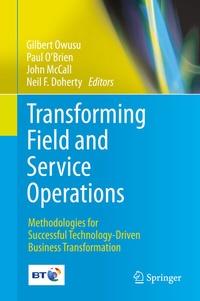
Transforming Field and Service Operations
Description

The drive to realise operational efficiencies, improve customer service, develop new markets and accelerate the introduction of new products has substantially increased the complexity of field service operations. To maximise the efficiency and effectiveness of these operations, organisations have embarked on a wide range of transformation programmes that have sought to introduce automation through the use of workforce management technologies. Despite the potential business value that can be provided by such transformation programmes, too often, the automation technologies have not been fully utilised and their expected benefits have as such not been realised.
Scholars of organisation change argue that the success of any transformation programme is a function of how well the technical, political, structural and social aspects of a specific project have been managed. The objective of this edited book is to provide insights into how organisations might successfully transform their field service operations with the help of workforce management technologies. Accordingly, the book is organised into four sections: Section A "The Case for Transforming Service and Field Operations" explains the rationale as to why organisations should actively consider transforming their service and field operations, while Section B presents various "Methods, Models and Enabling Technologies for Transforming Service and Field Operations". In Section C, a number of "Case Studies" illustrate how new technologies can be applied to field and service operations to deliver concrete business benefits. Lastly, Section D considers "Challenges, Outcomes and Future Directions".
Overall, this book provides valuable insights into how to successfully transform field service operations with automated technologies. It draws on years of experience from different industries and from different perspectives on realising change. It is aimed at managers, technologists, change agentsand scholars who are interested in field service operations in general and the use of advanced computing technologies in this area in particular.
More details
Other editions
Additional editions
Persons
Gilbert Owusu heads the resource management technologies research at BT and is Visiting Professor at the University of Essex. The technologies developed by Gilbert and his team have underpinned major transformation programmes and led to improved customer experience, cost savings and increased resource productivity in BT. His current research focuses on developing technologies that provide a coherent approach to optimising (i) resource utilisation; and (ii) an organisation's service production lines with external partners.
Paul O'Brien leads the Business and Operational Transformation Practice in BT, an award winning practice delivering innovative solutions for transforming BTs business and its operations. He has over 20 years of experience in applying new technologies to the telecommunications industry. His interests include artificial intelligence, advanced data analytics, production management and operational modelling.
John McCall is Professor of Computing Science at Robert Gordon University, where he leads Digital Technologies research in the IDEAS Research Institute. He specializes in industrially-focussed research projects to add intelligent components to existing commercial software or to new software tools for optimization and decision support. Industrial collaborators have included large corporations in telecommunications and oil and gas as well as small to medium sized enterprises. His research in computational intelligence has been published in over 90 books, journals and conference papers.
Neil F. Doherty holds the Professorial Chair in Information Management in the School of Business and Economics, at Loughborough University. In addition to benefits measurement and management, his research interests include: IT-enabled business transformation; information security management; and the impact and uptake of electronic commerce. Neil is currently serving as a Senior Editor for the Information Systems Journal, and as an Associate Editor for Information Technology and People.
Content
- Intro
- Foreword
- Introduction
- Part I: The Case for Transforming Service and Field Operations
- Part II: Methods, Models and Enabling Technologies for Transforming Service and Field Operations
- Part III: Case Studies
- Part IV: Challenges, Outcomes and Future Directions
- Acknowledgements
- Contents
- List of Contributors
- Part I: The Case for Transforming Service and Field Operations
- Chapter 1: IT Exploitation Through Business Transformation: Experiences and Implications
- 1.1 Introduction
- 1.2 The Commoditisation of Information Technology
- 1.3 The Organisational Impacts of IT
- 1.4 Do IT Investment Projects Deliver Value?
- 1.5 Moving Towards an IT Exploitation Agenda
- 1.6 Conclusions
- References
- Chapter 2: Transforming Field and Service Operations with Automation
- 2.1 Introduction
- 2.2 Service Production Management: Challenges in Realising an ERP for Service Industries
- 2.2.1 Background
- 2.2.2 Management of Change
- 2.2.3 Introduction of New Technology
- 2.3 Realising a Successful Service Production Management Implementation
- 2.3.1 Maturity Framework: The 4 Cs
- 2.3.2 Innovation-Driven Development
- 2.4 Case Study: BT´s Optimisation and Planning for Field Engineers
- 2.5 Control of Workflow
- 2.6 Increased Efficiency Through Simplicity
- 2.7 Conclusions
- References
- Part II: Methods, Models and Enabling Technologies for Transforming Service and Field Operations
- Chapter 3: Designing Effective Operations: Balancing Multiple Business Objectives Using Simulation Models
- 3.1 Introduction
- 3.2 Different Approaches to the Complexity Problem
- 3.2.1 The Problem of Complexity
- 3.2.2 Current Organisational Approaches
- 3.2.3 A New Approach
- 3.3 Characterisation of the Organisation and Its Environment
- 3.3.1 Characterising the Organisation: Cybernetics
- 3.3.2 Characterising the Environment: Dimensions of Variety
- 3.4 The Model
- 3.4.1 Constructing the Model
- 3.4.2 Control Loops and Information Flows
- 3.4.3 Simulations to Explore Process Robustness
- 3.5 Insights
- 3.5.1 Balancing Performance Metrics
- 3.5.2 The Effects of Enterprise Data Quality on Performance
- 3.5.2.1 Technical, Organisational and Human Aspects
- 3.6 Conclusions
- 3.6.1 Practices
- 3.6.2 Organisational Decision-Making
- References
- Chapter 4: System Dynamics Models of Field Force Operations
- 4.1 Introduction
- 4.2 Modelling Service Operations
- 4.2.1 The `Hydraulics´ Approach and Field Operations
- 4.2.2 Dynamic vs. Detail Complexity
- 4.2.3 Methodology: Performance, Targets and Tension
- 4.2.4 Testing the `Tension´ Hypothesis
- 4.2.5 Modelling Resource Adjustments
- 4.3 Simulation Experiments
- 4.3.1 Simplified Model
- 4.3.2 Simulation Results
- 4.3.2.1 Overview
- 4.3.2.2 Spike in Demand
- 4.3.2.3 Reduction in Target Cycle Time
- 4.3.2.4 Demand Variability
- 4.3.3 Uncertainty Analysis
- 4.4 Case Study: Modelling the Field Operations of a Major Line of Business
- 4.5 Challenges and Limitations
- 4.6 Conclusions
- References
- Chapter 5: Understanding the Risks of Forecasting
- 5.1 Introduction
- 5.2 Understanding a Time Series
- 5.2.1 Forecasting Methods
- 5.2.2 Measuring Forecast Accuracy
- 5.3 The Signal-to-Noise Ratio
- 5.3.1 A Definition
- 5.3.2 A Simple Example
- 5.4 Understanding the Limits to Forecast Accuracy?
- 5.4.1 Experimental Design
- 5.4.2 Limitation
- 5.4.3 Results
- 5.4.4 Deriving Forecast Limits for a given Signal-to-Noise Ratio
- 5.5 What Is the Benefit to Your Business?
- 5.5.1 Example: Work Volume Forecasting
- 5.6 Conclusion
- References
- Chapter 6: Modern Analytics in Field and Service Operations
- 6.1 Introduction
- 6.2 Business Process Mining
- 6.2.1 The Aperture Process Mining Tool
- 6.2.2 Process Analysis
- 6.2.3 Common Issues in Business Processes
- 6.3 Detecting Change Over Time
- 6.3.1 From Hypothesis Testing to Generating Hypotheses
- 6.3.2 Application Example
- 6.3.3 Drill Down from High-Level Trends: Top-Down Analysis
- 6.3.4 Detect and Aggregate Low-Level Trends: Bottom-Up Analysis
- 6.4 Conclusions
- References
- Chapter 7: Enhancing Field Service Operations via Fuzzy Automation of Tactical Supply Plan
- 7.1 Introduction
- 7.2 Current Approaches to TSP
- 7.3 Benefits of TSP Automation
- 7.3.1 Optimal Planning
- 7.3.2 Rapid Scenario Modelling
- 7.3.3 Cost-Effective
- 7.3.4 Human Error Elimination
- 7.3.5 Improved Customer Satisfaction
- 7.4 Current Automation: Trends
- 7.5 Fuzzy Logic-Based TSP
- 7.5.1 Problem Formulation
- 7.5.2 Methodology
- 7.5.2.1 Parameter Calculation
- 7.5.2.2 The Type-2 FLS Operation
- 7.5.2.3 Rule Base
- 7.5.2.4 Output
- 7.6 Conclusions
- References
- Part III: Case Studies
- Chapter 8: The Role of Search for Field Force Knowledge Management
- 8.1 Introduction
- 8.2 Software Architecture and Design
- 8.2.1 The Web Application
- 8.2.2 The External Components
- 8.2.3 The User Interface
- 8.3 Related Work
- 8.4 Search Framework to Support the Mobile Workforce
- 8.4.1 Problem Description
- 8.4.2 System Setup
- 8.5 Adaptive Query Suggestions
- 8.5.1 Experiments
- 8.5.2 Results and Discussion
- 8.5.3 Time Comparison
- 8.6 Conclusions
- References
- Chapter 9: Application of AI Methods to Practical GPON FTTH Network Design and Planning
- 9.1 Introduction
- 9.2 Related Work
- 9.3 GPON/FTTH Network Structure
- 9.4 Optimisation Objectives and Network Model
- 9.5 Network Optimisation Module
- 9.5.1 Building the Solution
- 9.5.2 Updating the Pheromone Information
- 9.5.3 Post-Optimisation
- 9.6 Software Deployment Approach
- 9.7 Worked Examples
- 9.8 Conclusions
- References
- Chapter 10: The Role of Service Quality in Transforming Operations
- 10.1 Introduction
- 10.2 The Service Operation: Development and Delivery of a Production Management System in BT
- 10.3 Background
- 10.4 Methodology
- 10.5 Research Findings
- 10.6 The Service Quality Improvement Strategy: Implications for the Development and Delivery Teams
- 10.7 Conclusions
- References
- Chapter 11: Field Force Management at eircom
- 11.1 Introduction
- 11.1.1 The Factors Affecting Field Force Management
- 11.1.2 Core Challenge: Balancing Service Level and Productivity
- 11.2 eircom´s Field Force Challenges
- 11.2.1 Impact on eircom´s Field Force Performance
- 11.3 Why Simulation Modelling?
- 11.3.1 The Simulation Model
- 11.3.2 Model Overview
- 11.3.3 How to Manage Competing Demands
- 11.4 eircom´s Response
- 11.5 How Is eircom Unique in Its Use of Simulation?
- 11.5.1 Dispatching the Next Generation
- 11.6 Conclusions
- References
- Chapter 12: Understanding Team Dynamics with Agent-Based Simulation
- 12.1 Introduction
- 12.2 Team Dynamics in Field Service Operations
- 12.3 Representations and Algorithms
- 12.3.1 Representations
- 12.3.2 Algorithms
- 12.4 Evaluation
- 12.4.1 Pearson Correlation Score
- 12.4.2 Mean Absolute Percentage Error
- 12.4.3 Overall Simulation Score
- 12.4.4 Objectives
- 12.5 Experiments and Results
- 12.5.1 Algorithm-Specific Settings
- 12.5.2 Solution Caching
- 12.5.3 Results
- 12.5.4 Discussion
- 12.6 Conclusions
- References
- Chapter 13: Effective Engagement of Field Service Teams
- 13.1 Introduction
- 13.2 Why Bother with Engagement?
- 13.3 Background and Approach
- 13.4 What Is Engagement?
- 13.5 The Key Components of Employee Engagement
- 13.5.1 Management Style
- 13.5.2 Interpersonal Relationships and Team Collaboration
- 13.5.3 Incentives (and the Associated Stick)
- 13.5.4 Measures and Targets (and a Quick Word About Goals)
- 13.5.5 Knowledge and Relevant Data
- 13.5.6 Continuous Improvement
- 13.5.7 Job Design
- 13.5.8 Career, Mastery and Advancement
- 13.5.9 Work Environment
- 13.6 Conclusions
- References
- Chapter 14: The Asset Replacement Problem State of the Art
- 14.1 Introduction
- 14.2 The General Classifications of Fleet (Asset) Replacement Models
- 14.3 Approaches for Replacement Decisions
- 14.3.1 Approaches Based on the ``Economic Life´´
- 14.3.2 Approaches That Consider a Repair-Cost Limit
- 14.3.3 Comprehensive Cost Minimisation Models
- 14.3.3.1 Objective Function
- 14.3.3.2 Modelling Fleet Life Conditions
- 14.4 The General Parallel Replacement Problem
- 14.4.1 An Integer Programming Formulation of the Parallel Replacement Problem
- 14.4.2 A General Parallel Heterogeneous Asset Leasing Replacement Model
- 14.4.2.1 Exploiting Asset Portfolio for Fleet Replacement
- 14.5 Insights from the Literature on Fleet Replacement Models
- 14.6 Practical Challenges for the Fleet Replacement Problem
- 14.7 Conclusions
- References
- Part IV: Challenges, Outcomes and Future Directions
- Chapter 15: Enabling Smart Logistics for Service Operations
- 15.1 Introduction
- 15.2 Lesson from Logistics: Literature Review
- 15.3 Inter-organisational Communication Flexibility
- 15.3.1 Transactional Layer
- 15.3.2 Operational Layer
- 15.3.3 Strategic Layer
- 15.4 Current Developments in ICT Use in Inventory Management
- 15.4.1 Telecommunications
- 15.4.2 Health
- 15.4.3 Utilities
- 15.4.4 Transport
- 15.4.5 Automotive
- 15.5 Conclusions
- References
- Chapter 16: Measuring and Managing the Benefits from IT Projects: A Review and Research Agenda
- 16.1 Introduction
- 16.2 Conceptualising IS-/IT-Enabled Benefits
- 16.3 The Academic Literature on Benefits Measurement
- 16.4 Objective Measures of IS-/IT-Enabled Benefits
- 16.5 Perceptual Measures of IS-/IT-Enabled Benefits
- 16.6 Benefits Measurement in Practice
- 16.7 Conclusions: The Future of Benefits-Oriented Research
- References
- Index
