

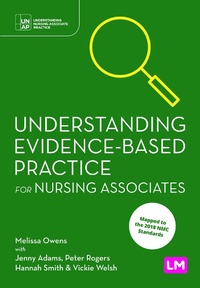
Understanding Evidence-Based Practice for Nursing Associates
1st Edition
Published on 3. April 2024
144 pages
978-1-5296-1784-9 (ISBN)
Description

Providing evidence-based care is fundamental to working safely and effectively as a nursing associate. This book equips you with the skills to identify, evaluate and apply evidence and research to your practice. From day-to-day procedures and decision-making, to addressing health inequalities and implementing service improvement, it develops your confidence in using evidence to underpin all aspects of your role.
Key features
- Fully mapped to the NMC Standards of Proficiency for Nursing Associates (2018)
- Explains the principles of evidence-based practice in clear, straightforward language
- Case studies and activities illustrate evidence-based practice across a range of different patient groups and care settings
- Written specifically to address the unique experiences, challenges and requirements of the nursing associate role
Key features
- Fully mapped to the NMC Standards of Proficiency for Nursing Associates (2018)
- Explains the principles of evidence-based practice in clear, straightforward language
- Case studies and activities illustrate evidence-based practice across a range of different patient groups and care settings
- Written specifically to address the unique experiences, challenges and requirements of the nursing associate role
More details
Series
Language
English
Place of publication
London
United Kingdom
Publishing group
Sage Publications Ltd
Target group
College/higher education
ISBN-13
978-1-5296-1784-9 (9781529617849)
Copyright in bibliographic data and cover images is held by Nielsen Book Services Limited or by the publishers or by their respective licensors: all rights reserved.
Schweitzer Classification
Other editions
Additional editions
Melissa Owens | Jenny Adams | Peter Rogers
Understanding Evidence-Based Practice for Nursing Associates
Book
04/2024
1st Edition
SAGE Publications Ltd
€40.70
Shipment within 3-4 weeks
Melissa Owens | Jenny Adams | Peter Rogers
Understanding Evidence-Based Practice for Nursing Associates
Book
04/2024
1st Edition
SAGE Publications Ltd
€89.50
Shipment within 3-4 weeks
Persons
Melissa Owens is Director of Nursing at the University of York and has responsibility for their Nursing and Nursing Associate Programmes. She has previously been a Nursing Associate Programme Leader. She has a particular interest in evidence-based practice, which forms a major part of her teaching. She is a Registered Nurse: Learning Disabilities and her research and publications have an educational focus. Melissa also has a particular interest in interprofessional education and is a Board member of CAIPE (Centre for the Advancement of Interprofessional Education) and co-leads their Faculty Develop Sub-Group. She previously led their Research Development Sub-Group and in November 2023 was part of a team who won an International Global Award for interprofessional team working. She completed her Doctorate of Education in 2015, which focused on collaborative working in primary.
Jenny Adams is an Assistant Professor at the University of Bradford and developed the original pilot Foundation Degree (Science) Nursing Associate Programme as well as the current NMC approved programme. She continues to act as module leader for two of the level 4 modules on the programme. In addition, she has developed undergraduate and postgraduate programmes in non- medical prescribing and advanced practice. Her clinical experience was mostly as a health visitor and practice development nurse in the community setting. Jenny is an enthusiastic teacher and passionate about developing safe nursing practice to meet the changing demands of healthcare. Peter Rogers is an Assistant Professor at the University of Bradford and has been involved in the delivery of the Foundation Degree (Science) Nursing Associate Programme at the University of Bradford since its inception in 2017. Peter acted as deputy programme leader for the original pilot of the programme and continues to be actively involved in its delivery. Prior to joining the University of Bradford Peter held positions with both within NHS England and the NHS Clinical Governance Support Team, where as Associate Director of Education he was responsible for developing and leading clinical service improvement programmes across the NHS in England and supporting similar development in Wales and Northern Ireland. After the dissolution of the NHS Modernisation Agency, he held a number of consultancy positions supporting change projects ranging from national programmes including CfH and the NHS Integrated Service Improvement Programme to others designed to deliver service improvements at NHS Trust level. Peter is module leader for the final level five module which focuses on improving care quality which includes a significant level of content relating to evidence-based practice. Hannah Smith is a freelance nurse and lecturer, who worked as a Lecturer at the University of Bradford for two years, during which time she was the deputy programme lead for the Foundation Degree (Science) Nursing Associate Programme, and was also involved in the delivery. Hannah was the module leader for their first level five module which focuses on integrated care. She also taught on postgraduate critical care modules, and has a particular interest in promoting equity and inclusivity. Prior to commencing at the university, Hannah worked as a clinical nurse educator in critical care and has almost 20 years of acute care experience, both as a nurse and midwife. Vickie Welsh is a Senior Lecturer at the University of Leeds where she leads the Independent and Supplementary Prescribing module for Nurses and Midwives. She has been involved in the delivery of the Foundation Degree (Science) Nursing Associate Programme at the University of Bradford, where she offered specific support to small employers in the practice setting and assisted in the development and delivery of clinical skills. Vickie is enthusiastic about supporting students both in university and in clinical practice to ensure they meet their goals and succeed
Jenny Adams is an Assistant Professor at the University of Bradford and developed the original pilot Foundation Degree (Science) Nursing Associate Programme as well as the current NMC approved programme. She continues to act as module leader for two of the level 4 modules on the programme. In addition, she has developed undergraduate and postgraduate programmes in non- medical prescribing and advanced practice. Her clinical experience was mostly as a health visitor and practice development nurse in the community setting. Jenny is an enthusiastic teacher and passionate about developing safe nursing practice to meet the changing demands of healthcare. Peter Rogers is an Assistant Professor at the University of Bradford and has been involved in the delivery of the Foundation Degree (Science) Nursing Associate Programme at the University of Bradford since its inception in 2017. Peter acted as deputy programme leader for the original pilot of the programme and continues to be actively involved in its delivery. Prior to joining the University of Bradford Peter held positions with both within NHS England and the NHS Clinical Governance Support Team, where as Associate Director of Education he was responsible for developing and leading clinical service improvement programmes across the NHS in England and supporting similar development in Wales and Northern Ireland. After the dissolution of the NHS Modernisation Agency, he held a number of consultancy positions supporting change projects ranging from national programmes including CfH and the NHS Integrated Service Improvement Programme to others designed to deliver service improvements at NHS Trust level. Peter is module leader for the final level five module which focuses on improving care quality which includes a significant level of content relating to evidence-based practice. Hannah Smith is a freelance nurse and lecturer, who worked as a Lecturer at the University of Bradford for two years, during which time she was the deputy programme lead for the Foundation Degree (Science) Nursing Associate Programme, and was also involved in the delivery. Hannah was the module leader for their first level five module which focuses on integrated care. She also taught on postgraduate critical care modules, and has a particular interest in promoting equity and inclusivity. Prior to commencing at the university, Hannah worked as a clinical nurse educator in critical care and has almost 20 years of acute care experience, both as a nurse and midwife. Vickie Welsh is a Senior Lecturer at the University of Leeds where she leads the Independent and Supplementary Prescribing module for Nurses and Midwives. She has been involved in the delivery of the Foundation Degree (Science) Nursing Associate Programme at the University of Bradford, where she offered specific support to small employers in the practice setting and assisted in the development and delivery of clinical skills. Vickie is enthusiastic about supporting students both in university and in clinical practice to ensure they meet their goals and succeed
Content
Chapter 1: Providing evidence-based practice
Chapter 2: Using evidence in contemporary practice
Chapter 3: Understanding Research
Chapter 4: Critical Appraisal of Research
Chapter 5: Health Inequalities, Evidence-Based Practice and the Nursing Associate
Chapter 6: Decision-Making in Evidence-Based Practice: The Law, Ethics and Values
Chapter 7: Change for Quality Improvement: Putting Evidence into Practice
Chapter 2: Using evidence in contemporary practice
Chapter 3: Understanding Research
Chapter 4: Critical Appraisal of Research
Chapter 5: Health Inequalities, Evidence-Based Practice and the Nursing Associate
Chapter 6: Decision-Making in Evidence-Based Practice: The Law, Ethics and Values
Chapter 7: Change for Quality Improvement: Putting Evidence into Practice
