

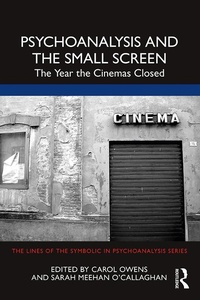
Psychoanalysis and the Small Screen
The Year the Cinemas Closed
1st Edition
Published on 11. August 2023
220 pages
978-1-000-91724-6 (ISBN)
Description

Psychoanalysis and the Small Screen examines the impact of cinema closures and the shift to small-screen consumption on our aesthetic and subjective desires during the COVID-19 pandemic from a Lacanian perspective.
The chapters in this text hold a unique focus on the intersections of film, psychoanalysis, and the subjective implications of the shift from cinema to the small screen of domestic space. The subjects span historical and current Lacanian thinking, including the representation of psychoanalysis as artifice, Lacan appearing on television, the travails and tribulations of computer mediated analysis, the traumatrope, and the techno-inflected imagined social bond of what Jacques Lacan called the 'alethosphere'. In this collection, the socio-cultural narratives and Real disruptions of the pandemic are framed as a function of the paradoxes of enjoyment characteristic of Lacanian psychoanalysis rather than merely the psychosocial repercussions of a planetary and contingent disaster.
With contributions from practicing psychoanalysts, as well as academics working in related interdisciplinary areas, Psychoanalysis and the Small Screen will have appeal to readers of contemporary Lacanian work in general, to readers and researchers of contemporary psychoanalytic studies, and transdisciplinary and intersectional scholars engaged in psychoanalytic, cultural, and psycho-social research.
The chapters in this text hold a unique focus on the intersections of film, psychoanalysis, and the subjective implications of the shift from cinema to the small screen of domestic space. The subjects span historical and current Lacanian thinking, including the representation of psychoanalysis as artifice, Lacan appearing on television, the travails and tribulations of computer mediated analysis, the traumatrope, and the techno-inflected imagined social bond of what Jacques Lacan called the 'alethosphere'. In this collection, the socio-cultural narratives and Real disruptions of the pandemic are framed as a function of the paradoxes of enjoyment characteristic of Lacanian psychoanalysis rather than merely the psychosocial repercussions of a planetary and contingent disaster.
With contributions from practicing psychoanalysts, as well as academics working in related interdisciplinary areas, Psychoanalysis and the Small Screen will have appeal to readers of contemporary Lacanian work in general, to readers and researchers of contemporary psychoanalytic studies, and transdisciplinary and intersectional scholars engaged in psychoanalytic, cultural, and psycho-social research.
Reviews / Votes
"For most film lovers, the turn to the small screen has been something to lament. But Carol Owens and Sarah Meehan O'Callaghan, along with their excellent contributors, show that with something lost, something has also been gained. In a series of illuminating essays, Psychoanalysis and the Small Screen shows us the incredible theoretical riches that the small screen makes evident, riches that the cinematic experience often obscures. For anyone wanting to understand why we are always looking at our screens and for those who want to make sense of our contemporary moment, this is a collection absolutely not to be missed." - Todd McGowan, Professor of Film Studies, University of Vermont."Carol Owens and Sarah Meehan O'Callaghan in this compelling collection of essays invite us to reflect on the question of subjectivity once again during the latest pandemic, the year when cinemas closed. Broad in its scope - ranging from socio-cultural studies, philosophy and art to psychoanalysis - the contributors to this collection have provided a new perspective on what shapes our reality in the contemporary techno-mediated world. This collection with a Lacanian focus offers a unique way to explore and investigate different dimensions of the impact of screens on the theory and practice of psychoanalysis." - Berjanet Jazani, M.D, Author, Psychoanalyst, President of The College of Psychoanalysts UK
"In the old days we used to enter into the dark room of a cinema to behold a feast laid out before our eyes, larger than life. This phantasmagoria has now entered into our lives on small screens that consume us. Welcome to the metaverse! Though none of us has a hold, reading this book helps to find the ground only psychoanalysis can begin again to put beneath our feet." - Jamieson Webster, Psychoanalyst, Author, Asst. Professor, New School for Social Research, NYC. "For most film lovers, the turn to the small screen has been something to lament. But Carol Owens and Sarah Meehan O'Callaghan, along with their excellent contributors, show that with something lost, something has also been gained. In a series of illuminating essays, Psychoanalysis and the Small Screen shows us the incredible theoretical riches that the small screen makes evident, riches that the cinematic experience often obscures. For anyone wanting to understand why we are always looking at our screens and for those who want to make sense of our contemporary moment, this is a collection absolutely not to be missed." Todd McGowan, Professor of Film Studies, University of Vermont, USA
"Carol Owens and Sarah Meehan O'Callaghan in this compelling collection of essays invite us to reflect on the question of subjectivity once again during the latest pandemic, the year when cinemas closed. Broad in its scope - ranging from socio-cultural studies, philosophy and art to psychoanalysis - the contributors to this collection have provided a new perspective on what shapes our reality in the contemporary techno-mediated world. This collection with a Lacanian focus offers a unique way to explore and investigate different dimensions of the impact of screens on the theory and practice of psychoanalysis." Berjanet Jazani, M.D, Author, Psychoanalyst, President of The College of Psychoanalysts UK
"In the old days we used to enter into the dark room of a cinema to behold a feast laid out before our eyes, larger than life. This phantasmagoria has now entered into our lives on small screens that consume us. Welcome to the metaverse! Though none of us has a hold, reading this book helps to find the ground only psychoanalysis can begin again to put beneath our feet." Jamieson Webster, Psychoanalyst, Author, Assistant Professor, New School for Social Research, NYC, USA
More details
Series
Edition
1. Auflage
Language
English
Place of publication
London
United Kingdom
Publishing group
Taylor & Francis Ltd
Target group
College/higher education
Professional and scholarly
Product notice
Reflowable
Illustrations
1 Line drawings, black and white; 1 Illustrations, black and white
ISBN-13
978-1-000-91724-6 (9781000917246)
Copyright in bibliographic data and cover images is held by Nielsen Book Services Limited or by the publishers or by their respective licensors: all rights reserved.
Schweitzer Classification
Other editions
Additional editions
Carol Owens | Sarah Meehan O'Callaghan
Psychoanalysis and the Small Screen
The Year the Cinemas Closed
Book
08/2023
1st Edition
Routledge
€50.80
Shipment within 10-20 days
Carol Owens | Sarah Meehan O'Callaghan
Psychoanalysis and the Small Screen
The Year the Cinemas Closed
Book
08/2023
1st Edition
Routledge
€206.20
Shipment within 10-20 days

Psychoanalysis and the Small Screen
The Year the Cinemas Closed
Book
07/2023
Routledge
Unfortunately, price unknown
Available (delivery time upon request)
Persons
Carol Owens is a psychoanalyst and psychoanalytic scholar in Dublin, Ireland. She is the founder of the Dublin Lacan study group, co-organiser of the Irish Psychoanalytic Film Festival, and has published widely on the theory and practice of Lacanian psychoanalysis. She is series editor for Routledge's Studying Lacan's Seminars series. Her most recent book is Psychoanalysing Ambivalence: On and Off the Couch with Freud and Lacan (with Stephanie Swales, Routledge, 2020).
Sarah Meehan O'Callaghan is an independent scholar within the fields of Lacanian psychoanalysis, body/disability, drama, and sexuality studies. Her PhD was an interdisciplinary study of the trauma of the body in the drama of Artaud, Beckett and Genet within a Lacanian psychoanalytic perspective. She has published psychoanalytic articles on themes such as disability, sexuality, the phallus, and the intersections of phenomenology and psychoanalysis. She is co-organiser of the Irish Psychoanalytic Film Festival.
Sarah Meehan O'Callaghan is an independent scholar within the fields of Lacanian psychoanalysis, body/disability, drama, and sexuality studies. Her PhD was an interdisciplinary study of the trauma of the body in the drama of Artaud, Beckett and Genet within a Lacanian psychoanalytic perspective. She has published psychoanalytic articles on themes such as disability, sexuality, the phallus, and the intersections of phenomenology and psychoanalysis. She is co-organiser of the Irish Psychoanalytic Film Festival.
Content
Series Preface - Ian Parker
Introduction - Sarah Meehan O'Callaghan and Carol Owens
(In)Continent Topology of Pandemics, Screens, and Scripts
Don Kunze
Digital Tectonics and Cinematic Intimacy: An Epidemiological/Psychoanalytic Perspective
Robert Kilroy
At the Mercy of the Screen: Passivity and its Vicissitudes in a Time of Crisis
Sarah Meehan O'Callaghan
Undine: Siren Screens
Jessica Datema and Manya Steinkoler
Prohibition and Power: Normal People as Pandemic Pornography
Erica Galioto
Weeping on and off Screen - Truth, Falsity, and Art
Miles Link
"The Thing did not Dissatisfy me?" Lacanian Perspectives on Transference and AI-Driven Psychotherapeutic Chatbots
Mike Holohan
The rise of the lathouses: Some consequences for the speaking being and the social bond
Hilda Fernandez-Alvarez
Lacan on the Telly: Psychoanalysis on the Small Screen(s)
Carol Owens and Eve Watson
Power and Politics in Adam Curtis' 'Can't Get you out of my Head: An Emotional History of the Modern World': A Discussion
Isabel Millar, Brett Nicholls, Rosemary Overell, Daniel Tutt
Afterword - Olga Cox Cameron
Introduction - Sarah Meehan O'Callaghan and Carol Owens
(In)Continent Topology of Pandemics, Screens, and Scripts
Don Kunze
Digital Tectonics and Cinematic Intimacy: An Epidemiological/Psychoanalytic Perspective
Robert Kilroy
At the Mercy of the Screen: Passivity and its Vicissitudes in a Time of Crisis
Sarah Meehan O'Callaghan
Undine: Siren Screens
Jessica Datema and Manya Steinkoler
Prohibition and Power: Normal People as Pandemic Pornography
Erica Galioto
Weeping on and off Screen - Truth, Falsity, and Art
Miles Link
"The Thing did not Dissatisfy me?" Lacanian Perspectives on Transference and AI-Driven Psychotherapeutic Chatbots
Mike Holohan
The rise of the lathouses: Some consequences for the speaking being and the social bond
Hilda Fernandez-Alvarez
Lacan on the Telly: Psychoanalysis on the Small Screen(s)
Carol Owens and Eve Watson
Power and Politics in Adam Curtis' 'Can't Get you out of my Head: An Emotional History of the Modern World': A Discussion
Isabel Millar, Brett Nicholls, Rosemary Overell, Daniel Tutt
Afterword - Olga Cox Cameron
