

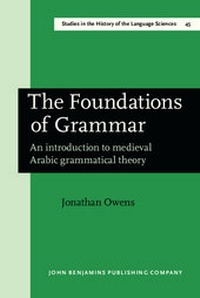
The Foundations of Grammar
An introduction to medieval Arabic grammatical theory
1st Edition
Published on 1. January 1988
XII, 371 pages
978-90-272-7863-0 (ISBN)
Description

The Arabic grammatical tradition is one of the great traditions in the history of linguistics, yet it is also one that is comparatively unknown to modern western linguistics. The purpose of the present book is to provide an introduction to this grammatical tradition not merely by summarizing it, but by putting it into a perspective that will make it accessible to any linguist trained in the western tradition. The reader should not by put off by the word 'medieval': Arabic grammatical theory shares a number of fundamental similarities with modern linguistic theory. Indeed, one might argue that one reason Arabic theory has gone unappreciated for so long is that nothing like it existed in the West at the time of its 'discovery' by Europeans in the 19th century, when the European orientalist tradition was formed, and that it it only with the development of a Saussurean and Bloomfieldian structural tradition that a better perspective has become possible.
More details
Other editions
Additional editions
Book
01/1988
John Benjamins Publishing Co
€132.50
Shipment within 10-15 days
Person
Content
- THE FOUNDATIONS OF GRAMMAR AN INTRODUCTION TO MEDIEVAL ARABIC GRAMMATICAL THEORY
- Editorial page
- Title page
- Copyright page
- Dedication
- Table of contents
- Symbols and conventions
- PREFACE
- 1. INTRODUCTION
- 1. Aims of the Work
- 1.1 What the work does and does not do
- 1.1.1 What it does
- 1.1.2 What the study does not do
- 1.1.2.1 Not a grammar of Arabic
- 1.1.2.2 Not a comprehensive treatment of Arabic theory
- 1.1.2.3 History of Arabic theory
- 1.1.2.4 Individual authors
- 1.1.2.5 Historical and cultural perspectives
- 1.2 Who Were the Arabic grammarians?
- 1.2.1 The schools of grammar
- 1.2.1.1 The nature of the disputes
- two examples
- 1.2.1.2 References to Kufa and Basra in ninth century work
- 1.2.2 Post-ninth century
- 1.3 Arabic grammatical work
- 1.3.1 Descriptive grammars
- 1.3.2 Specialized subjects
- 1.3.3 General principles
- 1.3.4 Rhetoric (balâgha)
- 1.3.5 Lexicography (cf. Wild 1956, Rippen 1983)
- 1.3.6 Quranic interpretation
- 1.3.7 Bio-bibliographical sources
- 1.3.8 Ancillary works
- 1.4 The data
- 1.5 The descriptive technique
- 1.6 Western linguistic principles
- 1.7 Language diversity and language change
- 1.7.1 Dialect differences
- 1.7.2 Language change?
- 1.8 Organization of grammars
- 2. STRUCTURE, FUNCTION, CLASS and DEPENDENCY
- 2.1 Structure and function
- 2.1.1 Position and item realizing position
- 2.1.2 Terminology of position
- 2.2 Terms for sentence, kalâm and jumla
- 2.3 Governance/dependency, cAmal
- 2.3.1 The Arabic definition of dependency
- 2.3.2 The western conception
- 2.3.3 An initial comparison
- 2.3.4 Detailed comparison
- 2.3.4.1 One governor per item
- 2.3.4.1.1 Sarrâj
- 2.3.4.1.2 Ibn Yacîsh
- 2.3.4.2 Governor and governed adjacent (condition 13d)
- 2.3.4.3 The exception that proves the rule
- 2.3.5 Three further observations
- 2.3.5.1 Governor-governed: a one-many relation
- 2.3.5.2 Dependency is unidirectional
- 2.3.4.3 Sequence generalization
- 2.3.6 Differences
- 2.3.6.1 The independent item
- 2.3.6.2 Modifiers
- 2.3.7 Governance and surface form
- 2.4 Six explanations for Case Form
- 2.4.1 Governance by syntactic position
- 2.4.2 Obligatory occurrence
- 2.4.3 By referential non-identity
- 2.4.4. Explanation by cross-categorical similarity: indicative verb
- 2.4.5 By speaker
- 2.4.6 By governing item
- 2.5 The function of inflection
- 2.5.1 Inflection of the verb
- 2.5.2 Governance of the noun
- 2.6 Uninflected words
- 2.7 Class
- 2.7.1 Sarrâj's summary
- 2.7.2 Class in morpho phonology
- 2.7.3 Class in morphology
- 2.8 Non-dependency relations and dependency
- 2.9 Constituency in Arabic theory
- 2.9.1 Syntactic position
- 2.9.2 Dependency
- 2.9.3 Dependency in Sîbawaih
- 2.9.4 Substitution
- 2.10 Complementary distribution
- 2.11 Morphological structure in Arabic theory
- 2.12 The structural nature of Arabic theory
- 2.12.1 Can a condition (hâl) or specifier (tamyîz) become the agent of a passive sentence ?
- 2.12.2 Constraints on embedding
- 3. MORPHOLOGY
- 3.1 The linguistic sign: Kalâm, Kalima and Lafdh
- 3.1.1 Kalâm and Kalima
- 3.1.2 Lafdh "form
- 3.2 Three preliminary remarks
- 3.2.1 Orthography
- 3.2.2 The root system
- 3.2.3 The Firthian nature of Arabic phonology and morphophono1ogy
- 3.3 Tasrîf
- 3.3.1 Tasrif: distinguishing basic and non-basic sounds
- 3.3.2 Tasrîf: total range of morphological patterns
- 3.3.3 Sub-categories of tasrîf
- 3.3.4 Borderline cases and the breakdown of the morphology/ syntax, tasrîf/nahw model
- 3.4 'Ishtiqâq "Derivation
- 3.5 Morphemes and added sounds
- 3.5.1 Added sounds and bound morphemes
- 3.5.1.1 Kalima: word or morpheme?
- 3.5.1.2 Not all morphemes are kalima
- 3.5.2 The rationale behind the added letters
- 3.5.2.1 Meaning
- 3.5.2.2 Non-basic sounds without a meaning
- 3.5.2.2.1 Meaning
- 3.5.2.2.2 Morphotactical constraints
- 3.5.2.2.3 Derivation (ishtiqâq)
- 3.5.3 Other morphological patterns
- 3.6 The Tasrîf of a root
- 3.7 Arabic morphemic theory
- 3.8 Morphology as a generative system
- 3.9 Compounding (tarkîb)
- 3.10 Summary
- 4. WORD CLASSES
- 4.1 Phonological
- 4.2 Morphological
- 4.2.1 Nouns
- 4.2.2 Verbs
- 4.3 Syntactic
- 4.3.1 Noun
- 4.3.2 Verbs
- 4.4 Semantic (cf. Frank 1975: 272 ff.)
- 4.4.1 Nouns
- 4.4.2 Verbs'
- 4.4.3 Particles
- 4.5 Problems in the criteria
- 4.6 Sub-classes
- 4.7 The circumstance (Dharf)
- 4.7.1 Dharf "circumstance" as word class vs. functional category
- 4.7.2 Semantic unity, syntactic distinction?
- 4.7.3 Mubarrad's treatment
- 4.7.4 The meaning of mutamakkin for the circumstantials
- 4.7.5 Later accounts
- 4.8 The active participle (AP)
- 4.8.1 Aspect
- 4.8.2 Irregularities
- 4.9 The 'verb' of exclamation
- 4.9.1 Kufan arguments
- 4.9.2 Basran arguments
- 4.9.3 Basran rejoinders
- 4.9.4 Conclusion
- 5. THE NOUN PHRASE
- 5.1 What is a noun phrase and what does it do?
- 5.2 The noun phrase components in Arabic theory
- 5.3 Noun-noun relations
- 5.3.1 Possessed-possessor
- 5.3.2 Modifiers, tawâbic
- 5.3.3 The relative clause
- 5.4 The noun phrase as a unit
- 5.4.1 Informal evidence
- 5.4.1.1 Phrase level vs. sentence level
- 5.4.1.2 Substitution
- 5.4.2 The noun phrase as a formal unit
- 5.4.2.1 Three principles
- 5.4.2.2 The modifiers
- 5.4.3 A further principle: pairwise relations and sequence
- 5.5 Summary
- 6. TRANSITIVITY
- 6.1 Types of objects
- 6.1.1 Direct objects (mafc û1 bihi)
- 6.1.2 Two interpretations of 'transitive' (mutacaddi)
- 6.2 More objects
- 6.3 Optionality
- 6.4 Causative
- 6.4.1 Causativization as a unitary process
- 6.4.2 Lexical nature of causatives
- 6.5 Voice and verb derivation
- 6.6 The passive
- 6.6.1 Description
- 6.6.2 Passivization as a process
- 7. ELLIPSIS
- 7.1 Contextual
- 7.2 Structural
- 7.2.1 Sarrâj's example
- 7.2.2 'Ishtighâl
- 7.2.3 Predicate locative
- 7.2.4 Vocative
- 7.3 Non-deletion
- 7.4 Ibn Hishâm's summary
- 7.4.1 Information
- 7.4.2 Operation of opposite processes
- 7.4.3 Restrictions on reduction
- 7.4.4 Grammatical constraints
- 7.5 Extension of function ('ittisâc)
- 7.6 The status of deletion
- 7.6.1 Contexts where ellipsis is not good
- 7.6.2 Allowed
- 7.6.3 The ellipted item cannot be expressed
- 7.7 Kufan-Basran arguments
- 7.8 Not all implicit relations are due to deletion
- 7.9 Comparison with deletions in transformational grammar
- 8. MARKEDNESS IN ARABIC THEORY
- 8.1 What is markedness?
- 8.2 An aside for terminology
- 8.3 Markedness in Arabic theory: Sîbawaih
- 8.4 Examples from later grammarians
- 8.4.1 'akhaff -'athgal "lighter-heavier
- 8.4.2 'aqwâ-'adcaf "strong-weak
- 8.4.3 'awwal, qabl "first, before
- 8.4.4 'asl-farc
- 8.5 Two interpretations of Anbârî's markedness schema
- 8.6 Anbârî's schema exemplified
- 8.6.1 The inflected verb
- 8.6.2 Uninflected nouns, mabnî
- 8.6.3 Partially inflected nouns
- 8.6.4 Unmarked members of a word class
- 8.6.5 The form of the nominative
- 8.7 Sequence
- 8.7.1 Sequence with morphologically irregular verbs
- 8.7.2 Morphologically regular verbs
- 8.8 The 'asl-farc distinction as one of markedness
- 8.9 Comparison with transformational-generative grammar
- 8.9.1 Two aspects of TG
- 8.9.2 Two differences with Arabic theory
- 8.9.3 A TG vocabulary?
- 9. SYNTAX, SEMANTICS AND PRAGMATICS
- 9.1 Semantic observations
- 9.1.1 Acceptability and sentence types
- 9.1.1.1 Sîbawaih
- 9.1.1.2 Fârisî
- 9.1.2 Lexical items
- 9.2 Syntax and semantics
- 9.2.1 Correspondence
- 9.2.2 Lack of correspondence
- 9.2.2.1 Sentence and lexical items
- 9.2.2.2 Lack of correspondence and linguistic explanation
- 9.2.2.2.1 Ibn Hishâm and Ibn Jinnî
- 9.2.2.2.2 Semantics and the re-analysis of syntactic explanation
- 9.2.2.2.3 Semantic constraints on syntactic processes: the specifier and fronting
- 9.2.2.2.4 Structural similarities, differences, and semantic generalizations: the nawâsikh
- 9.2.2.2.5 Possession and the dictates of general assumptions
- 9.3 A separate semantic level?
- 9.4 Arabic grammar and transformational theory
- 9.5 Jurjânî, language and communication
- 9.6 Jurjânî and the Arabic linguistic tradition
- 9.7 Word order
- 9.7.1 Topic-comment and verb-predicate
- 9.7.1.1 Important item first
- 9.7.1.2 New/old information
- 9.7.1.2.1 Yes-no
- 9.7.1.2.2 Negative
- 9.7.1.2.3 Indicative
- 9.7.2 Multi-systemic analyses
- 9.7.3 unmarked sequence
- 9.7.4 Terminological difficulties
- 9.7.5 Definite topic-comment sentence
- 9.8 Epilogue
- NOTES
- Chapter 1
- Chapter 2
- Chapter 3
- Chapter 4
- Chapter 5
- Chapter 6
- Chapter 7
- Chapter 8
- Chapter 9
- APPENDIX I. LIST OF MEDIEVAL ARABIC LINGUISTICS WHOSE WORKS ARE CITED
- APPENDIX II. BRIEF SUMMARY OF GRAMMATICAL CONSTRUCTIONS
- APPENDIX III. ORIGINAL ARABIC QUOTES
- BIBLIOGRAPHY
- Primary sources
- Secondary sources
- INDEX OF NAMES FROM THE CLASSICAL PERIOD
- SUBJECT INDEX
- INDEX OF ARABIC GRAMMATICAL TERMS
