

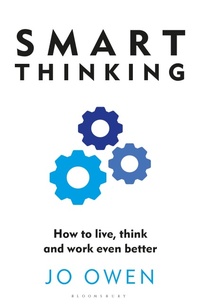
Smart Thinking
How to Live, Think and Work Even Better
1st Edition
Published on 7. November 2024
208 pages
978-1-3994-1519-4 (ISBN)
Description

You are living proof that you are already a smart thinker - you've navigated life well enough to have survived so far. From the author of Smart Leadership, Smart Thinking gives you the tools to be an even smarter thinker so that you can thrive, not just survive, in a challenging world.
Smart Thinking focuses on common thinking challenges - both rational and emotional - and gives you an array of practical solutions, helping you deal with unexpected problems and difficult decisions simply and effectively.
From getting the best out of others, to thinking more creatively about financial struggles, Jo Owen tackles 42 of the most common 'thinking' challenges that can derail even the best-laid plans and intentions. Be more decisive in the face of uncertainty, make better decisions for you and your colleagues, and tackle any of the unexpected problems that our busy work lives can throw at us, with Smart Thinking.
Packed with original research and cases, Smart Thinking might not only entertain you - it might just change your life.
Smart Thinking focuses on common thinking challenges - both rational and emotional - and gives you an array of practical solutions, helping you deal with unexpected problems and difficult decisions simply and effectively.
From getting the best out of others, to thinking more creatively about financial struggles, Jo Owen tackles 42 of the most common 'thinking' challenges that can derail even the best-laid plans and intentions. Be more decisive in the face of uncertainty, make better decisions for you and your colleagues, and tackle any of the unexpected problems that our busy work lives can throw at us, with Smart Thinking.
Packed with original research and cases, Smart Thinking might not only entertain you - it might just change your life.
More details
Edition
1. Auflage
Language
English
Place of publication
London
United Kingdom
Publishing group
Bloomsbury Publishing PLC
File size
0,40 MB
ISBN-13
978-1-3994-1519-4 (9781399415194)
Copyright in bibliographic data and cover images is held by Nielsen Book Services Limited or by the publishers or by their respective licensors: all rights reserved.
Schweitzer Classification
Other editions
Additional editions
Book
11/2024
Bloomsbury Business
€19.00
Available immediately
Person
Jo Owen is the author of over 20 books, including Smart Leadership, which together have been translated into more than 20 languages and over 150,000 copies sold in the UK alone. He is also the only four-time winning author of the Chartered Management Institute Gold Award. In addition to being a writer, Jo was previously the founder of eight NGOs, including Teach First. He appears regularly across national media, and is a sought-after international keynote speaker.
Content
- Intro
- Title Page
- Copyright Page
- Contents
- Introduction: Smart Thinking in a challenging world
- Part One: You are how you think
- Chapter 1: The recovering pessimist's guide to optimism
- Life is better than you think
- The Prince and Princess exercise
- Three good things
- The kindness exercise
- Chapter 2: Pursuing happiness, through the fog
- Exploring seven paths to lasting happiness
- Chapter 3: How to become the luckiest person in town
- Luck never needs to be random
- 2. Practice
- 3. Perspective - once
- Perspective - twice
- Chapter 4: Keep on learning and growing
- How to master anything (but not everything)
- Deliberate practice
- Learn to love learning: growth versus fixed mindset
- Learning in the moment: WWW and EBI
- Chapter 5: How to learn courage
- If you can learn courage, you can learn anything
- Chapter 6: Make friends with negative emotions
- Magic that lets you turn the negative into a positive
- Healthy ways of thinking about negative emotions
- Unhealthy ways of dealing with negative emotions
- Chapter 7: Talking to yourself
- Become the hero of a really great story
- 'I'm not good enough'
- 'I don't belong'
- The art of smart storytelling
- Part Two: Decoding People
- Chapter 8: How to be liked
- Make friends and influence people
- Be a good listener
- Chapter 9: Judging versus thinking
- The curse of moral superiority
- Judging is natural and necessary
- Judging is attractive
- Judging is dangerous
- Judging prevents learning
- Judging creates division and conflict
- Judging harms relationships
- Chapter 10: Labelling
- Describe yourself, in just three words
- Labelling others
- Labelling ourselves
- Chapter 11: Mind reading
- How to lose friends and alienate people
- Passive mind reading
- Active mind reading
- Chapter 12: How to disagree, without being disagreeable
- We do not need to disagree less
- we need to disagree better
- Disagreeing well
- Chapter 13: Decide for yourself
- Resist the hidden persuaders
- Part Three: Thinking and Doing
- Chapter 14: Be productive
- The mindset that makes things happen
- Chapter 15: Thinking about doing
- Why work is more challenging than ever
- Focus on what matters
- Work out how to work
- Not all work was created equal
- Find your routine
- Break work down into bite-sized chunks
- Chapter 16: Visualize your success
- High diving and aiming high
- Chapter 17: Clear your mind
- Unleash your smartest thinking
- Chapter 18: Write it down
- Your pen is mightier than your computer
- Chapter 19: Sleep your way to success
- Sleep is for winners, fatigue is for failures
- Chapter 20: The power of routines
- How black socks will help you lead the free world
- Decision-making
- Anxiety
- Performance
- Chapter 21: Upgrade your reading
- From comprehension to insight
- Chapter 22: Write for impact
- Create whole new worlds out of words
- Write for the reader
- Tell a story
- Keep it short
- Support assertions with facts
- Make it positive
- Part four: Clear thinking
- Chapter 23: Decision-making heaven and hell
- 13 ways bias and assumptions sink good decisions
- 1. Framing and anchoring
- 2. Saliency bias
- 3. Scarcity
- 4. IKEA syndrome (effort justification)
- 5. Paradox of choice
- 6. Sunk cost fallacy
- 7. Confidence bias
- 8. Loss aversion and risk
- 9. Idleness
- 10. Path dependency
- 11. Effect: the power of feelings
- 12. Social proof
- 13. Authority
- Chapter 24: Making decisions in uncertainty
- How to 'keep your head when all about you are losing theirs'
- Chapter 25: Smart thinking at moments of truth
- The great teabag theory of leadership and life
- Buy time to clear your mind
- Have a standard response that is helpful
- Take the emotion out of the situation
- Chapter 26: How to achieve instant insight
- Spontaneity is best rehearsed
- Chapter 27: How to achieve deep insight and innovate
- Chapter 28: Be creative
- Why idleness is good for you
- Chapter 29: Dare to dream: Think big
- Ambition is not a dirty word
- How to think big
- Why thinking big works
- Chapter 30: Debatable debates
- Defending against the dark arts of illogical arguments
- Chapter 31: Discover the truth
- Can listening to the Beatles make you younger?
- Chapter 32: Judgement traps
- Why we are all above average
- Confirmation bias
- Survivor bias
- Groupthink
- Hindsight bias
- Part five: Discovery and deceit: thinking about numbers
- Chapter 33: Lies, damn lies and statistics
- How to prove anything
- Chapter 34: Spreadsheet survival
- Smart questions make for smart thinking
- Chapter 35: Cause and effect
- Does eating pizza result in more satellite launches?
- Chapter 36: Probability and risk
- Witchcraft and insurance in an uncertain world
- Emotional intensity
- Optimism bias
- Risk bias
- Gambler's fallacy
- Control bias
- The randomness curse
- Logical traps
- Chapter 37: Averages
- Why the average human does not exist
- There are at least three completely different averages which mean different things
- Averages may not describe a group reliably
- Averages may not even represent an individual reliably
- Most insight often comes from outliers, not from averages
- Chapter 38: Compounding
- How compounding can make you fabulously rich or fatally poor
- Compounding as your friend
- Compounding as your enemy
- Part six: Discover your future
- Chapter 39: Think about your future
- See your future, without a crystal ball
- Imagine your future self as you want to be
- What will your 60-year-old self thank you for?
- What will your 60-year-old self regret?
- Know yourself today
- Chapter 40: Manage your journey
- How to navigate the random walk of work and life
- Know what you are looking for
- Create opportunities
- Grow your network
- Grow your knowledge
- Test opportunities: from side hustle to main hustle
- Chapter 41: Choose your future
- Three magic questions for your career's moments of truth
- Will I enjoy it?
- Am I set up for success?
- Will it support my longer-term goals?
- Chapter 42: Choose everything
- Smart choices for a smart life
- Choosing how you feel
- Choosing what you believe
- Choosing how you think
- Conclusion
- Smart thinking is about navigating life even better
- You are already a smart thinker
- Assumptions, beliefs and habits normally help us, but occasionally let us down
- Think slow in order to think smart, think better
- Challenge yourself to think better
- Index
