

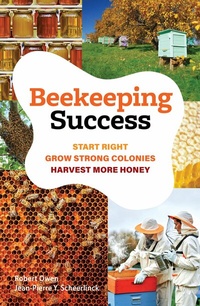
Beekeeping Success
Description

Beekeeping Success is a practical, easy-to-navigate reference for anyone starting out or looking to level up their beekeeping skills.
Written in a clear question-and-answer format, the book solves the most common problems faced by beekeepers - from installing your first colony to managing diseases like Varroa, harvesting honey efficiently, and introducing new queens.
Organized by theme, with step-by-step guidance and hundreds of real-life tips, this is a resource you can dip into whenever you encounter a challenge - or read cover to cover for a comprehensive foundation. Unlike theory-heavy manuals, this book is grounded in practical advice, with solutions tested by real beekeepers across a variety of climates and conditions, including suburban and small-space setups.
Whether you're in the US, UK, Australia, or beyond, Beekeeping Success gives you the confidence to start strong, build resilient colonies, and enjoy the sweet rewards of your efforts.
All prices
More details
Other editions
Additional editions
Content
CHAPTER 1
Getting Started
A beekeeper at peace with his hives.
Technically, a hive is a box where beekeepers keep a managed colony of bees, while a nest is where a feral colony lives. A colony is a collection of bees living in a hive or a nest. Many beekeepers use the terms 'hive' and 'colony' interchangeably, although this is incorrect. For convenience, however, in this book, we use the term 'hive' to mean 'colony' since this is standard usage amongst beekeepers.
What is the best time to start beekeeping?
Problem: Bee colonies can be acquired anytime, but in which season is it best to start beekeeping?
Solution
The best season to acquire bee hives depends on the climate in your area. If your region has a spring where many flowering plants bloom, this would be an excellent time to start beekeeping. Later in the year, it would also be good if flowering plants were abundant. A long late spring and summer with many consistent sources of pollen and nectar is optimal. This gives your new colony time to strengthen and prepare for winter. If you try to establish your new colony near a winter shortage of food sources, you may need help keeping your colony alive. Similarly, in geographical areas where you have hot, dry summers with few flowers, ensure that the hives you purchase in spring have enough supplies to last through the flowerless summer. The seasonality of flowering plants tends to be reduced in cities because keen gardeners often grow a diversity of plants that flower during an extended season (frequently only having no flowers around them when snow is present, which may never be the case in many parts of the world).
Buying an established colony with a local beekeeper or club support is the safest option. With this strategy, it is possible to start beekeeping during less bee-friendly times of the year. However, there are three distinct advantages of starting in spring: (i) it is more likely that beekeepers will have surplus hives due to the need to control swarming, possibly by splitting hives; (ii) the beginner beekeeper will generally like to start with a smaller hive or well-established split because it is easier to transport and is less daunting to manage, (iii) depending on your area, the food resources are more likely to be abundant, (iv) a well-established split with a new queen is very unlikely to swarm until the following spring, giving you more time to learn swarm management techniques (see section on 'Swarming'). Installing packages without local support is the riskiest strategy (see 'How do I successfully install a package of bees into a hive?'). It is best attempted early in the honey-producing season, giving the colony time to build up numbers and store honey and pollen before winter.
A hobby beekeeper inspecting his hive.
How should I start as a beekeeper?
Problem: I want to become a beekeeper but must figure out how to start.
Solution
Many potential beekeepers have little, if any, prior knowledge or experience with beekeeping. Perhaps by talking with friends or workmates who are already beekeepers or watching documentaries about the problems honey bees face, many new beekeepers wonder how they will learn to keep these fascinating creatures and harvest delicious honey every year.
Many new beekeepers are fortunate to have friends who are also beekeepers and can gain knowledge and practical experience from them. Most experienced beekeepers take pride in their hobby and are usually willing to share their expertise with other beekeepers. Alternatively, particularly in larger towns, many beekeeping clubs are available that cater to both new and experienced beekeepers. They often have a dedicated section for new beekeepers, providing beginners' courses and hands-on experience. We recommend that anyone wanting to start keeping bees should contact a local beekeeper or club and experience first-hand what it feels like to handle bees by donning a bee suit and helping with a hive inspection. That hands-on experience will help determine whether beekeeping is something for you. Many beekeeping clubs are on the web if no club is near you. While not offering hands-on experience, they can attract members from across the country, even from other countries, and provide a more comprehensive range of experiences than is often available from local clubs.
Honey bees are hardy creatures, and it is difficult to disturb their daily lives. For many potential beekeepers, buying an established colony in a hive and locating it on their property is a good start. Selecting a suitable location for you, your neighbours, and the bees may take some thought (see 'Where can I place my hive?'). You will also have to quickly learn about minimizing swarming (see chapter on 'Swarming'). Advice from a local club, beekeeper, or the person from whom the bees were bought, can help. While relocating hives within the same property is possible, it is not trivial and requires great care (see 'How can I move my hive to a different location?'). So, choose your initial location wisely.
Is beekeeping expensive?
Problem: I have limited funds and would like to recover costs and build my hobby with honey production and sales proceeds.
Solution
The setup cost for a new 10-frame hive, plus protective clothing and tools, would be between US$240 and US$430, depending on whether you buy just a brood box or a brood box and a super. These figures are from Dadant (U.S. costs). Bees are not included if all the equipment is purchased as a set. These figures were accurate for November 2025. A typical package of bees costs between US$130 and US$200. This gives a total of between US$370 and US$630. These figures do not include extracting equipment, which can run from US$30 to hundreds of dollars, depending on whether you extract by hand or buy an extractor. There may be other setup costs, such as syrup or pollen if the colony needs feeding.
The ongoing costs may be up to US$100 a year, including medication and pest management supplies.
If you join a bee club or search the internet, you may be fortunate to buy used equipment and bees from a beekeeper who is giving up the hobby or downsizing. Be careful when buying used equipment; it should be free from pests and pathogens. The best way to ensure that equipment is sterile is to irradiate it before use. Irradiation is expensive and can only be performed by a commercial irradiating company, which may not be available in your area.
Revenue from the sale of honey varies widely between locations and years. The average beekeeper may expect to harvest between 35 kg and 70 kg (70 lb to 150 lb) per hive yearly. Depending on how you sell your honey and its quality, you can expect to earn between US$4 and US$12 per lb, giving a yearly gross revenue of between US$280 and US$1,800 from a single hive (in 2025). Some beekeepers also sell bee packages, queens, or nucs (a nuc is a small hive used to raise a queen. See 'Where can I obtain bees?' and 'How do I successfully install a package of bees into a hive?'), but that comes at the expense of honey production. Indeed, it is possible to produce honey or bees, but not both simultaneously.
Where can I obtain bees?
Problem: I want to keep bees but do not know where to buy my first colony.
Solution
The first place the authors would ask would be either at a local beekeeping supply store or at a local beekeeping club. Depending on how bees are sold in your area, either would likely have colonies for sale or know a local beekeeper selling hives with colonies or packages. Both groups are likely only to sell better colonies that are free of diseases. Another source would be a local swarm catcher. Again, a local beekeeping supply store, beekeeping club, or even local police or government agencies may know of a swarm catcher. An internet search may also provide details of a swarm collector. Although swarms are a good source of bee colonies since swarms are collected and then sold after a short period of time, swarm catchers often do not have time to check for disease or that the queen is a good egg layer with gentle characteristics (see 'What should I do if my bees are aggressive?'). However, more reputable colony providers may sell a swarm re-queened with a good quality queen.
Future beekeepers who live near larger towns or in agricultural areas where many beekeepers reside usually have little difficulty obtaining their first colony. In the US, future beekeepers who live in more remote areas may be able to order a package or colony and have it delivered by courier. Although in many countries, particularly in North America, packages of bees delivered to a remote address is the norm, the difficulty with this for a future beekeeper is to transfer the colony to a hive without harming the colony or the queen (see 'How do I successfully install a package of bees into a hive?'). The assistance of a local, experienced beekeeper would greatly aid this transfer and help ensure the successful establishment of a robust and healthy colony. To give packaged bees their best chance to get established, obtaining packaged bees in spring or early summer is preferable, allowing them plenty of time to expand, build comb and produce stores for winter.
In any areas with either managed or feral colonies of bees, there will be swarms every spring and often during the summer. With the aid of an experienced beekeeper, it is often easy to collect a swarm and rehouse it into a hive. Also, if time is not a concern for you, an easy...
