

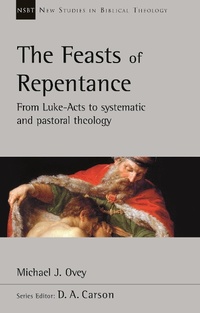
The Feasts of Repentance
Description

In gospel proclamation today, the critical New Testament element of repentance can be far too often ignored, minimalised or dismissed. Yet John the Baptist, Jesus himself, and those he commissioned to spread his gospel all spoke of the urgent need to repent.
Michael Ovey was convinced that a gospel without repentance quickly distorts our view of God, ourselves and one another by undermining grace and ultimately leading to idolatry. Only when we grasp the need for true repentance as consisting of a real change -- a transforming work of the Spirit of God -- can we fully understand the gospel Jesus preached.
With care and clarity, Ovey focuses first on the relevant biblical material in Luke-Acts, examining who repents and who does not, and the characteristics of both groups. He surveys the 'feasts of repentance' of Jesus with Levi, the Pharisees, and Zaccheus, and in the parable of the Lost Son. He then moves to more systematic-theological aspects of repentance, in relation to idolatry and to salvation; and finally to pastoral theology in the corporate life of the people of God today, with regard to self-righteousness, hypocrisy, humility, forgiveness and justice.
More details
Other editions
Additional editions
Person
Michael J. Ovey (1958-2017) served as the Principal of Oak Hill College, London, from 2007 until his unexpected and untimely death. He was the author of Your Will Be Done: Exploring Eternal Subordination, Divine Monarchy and Divine Humility, and co-author of Pierced for Our Transgressions and Confident: Why We can Trust the Bible. The Goldilocks Zone is a posthumous collection of his other writings.
Content
- Intro
- Series preface
- Preface
- Abbreviations
- Chapter One
- Repentance: formality, necessity or optional extra?
- Introduction
- Questions of method: the focus on Luke-Acts
- Procedure: from Luke-Acts to systematic and pastoral theology
- The puzzle: how can the call to repentance be universalized?
- Chapter Two
- Repentants, unrepentants and feasts
- Preliminary: type scenes and feasting
- John the Baptist
- Feasting in Luke 5:1 - 19:10
- The penitent thief (Luke 23:39-43)
- Repentance and forgiveness of sins (Luke 24:46-48)
- Conclusion
- Chapter Three
- Repentance: for Jew and Gentile
- Recap
- The appeal to Jews
- The appeal to Gentiles
- Paul's understanding of his ministry
- Objections to a universal call for repentance
- Conclusion
- Chapter Four
- Repentance: identity and idolatry
- Recap
- Repentance as recognition
- Idolatry as parody
- Idolatry as identity
- Idolatry, agnosticism and atheism: objections to using the idea of idolatry
- Communicating idolatry
- Conclusion
- Chapter Five
- Repentance: faith and salvation
- Recap
- The relation of repentance and faith
- Faith and repentance?
- Barth on repentance
- 'Faith' without repentance: some pastoral implications
- Conclusion
- Chapter Six
- Repentance: forgiveness and the people of God
- Preliminary
- The unrepentant
- The repentant
- Concluding reflections
- Bibliography
- Notes
- Search names for authors
- Search items for Scripture references
