

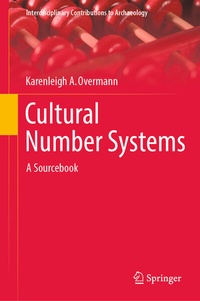
Cultural Number Systems
Description

This sourcebook presents an extensive look at cultural number systems in numeracy and writing systems. Based on a decade of research by the author, the work examines topics such as why Xerxes the First counted his army by having his men march through an enclosure big enough to hold 10,000 of them at a time, why the Hawaiian word for "twenty" means "nine and two," why an ancient Greek mathematician was driven mad by irrational numbers, and how old counting might be and how we might know this.
Along the way, the author describes topics such as dactylonomy, the ancient art of expressing and calculating numbers with the fingers; specified counting, the use of different counting sequences to count different types of objects; and the ephemeral abacus, strategies for counting that involve people and goods but not an actual device. The chapters are organized into six geographical areas (the ancient Near East, Africa, Europe, Asia/India, Oceania, and the Americas).
More details
Other editions
Additional editions
Person
Content
Chapter 1. Introduction.- Part 1. Number systems in the Ancient Near East.- Chapter 2. Sumerian numbers.- Chapter 3. Minority traditions.- Chapter 4. Akkadian numbers.- Chapter 5. Elamite numbers.- Chapter 6. Numbers in the Achaemenid Empire.- Chapter 7. Egyptian numbers.- Part 2. Number systems in Africa.- Chapter 8. The Ishango bone.- Chapter 9. Yoruba numbers.- Chapter 10. Igbo numbers.- Chapter 11. Ngiti numbers.- Chapter 12. Numbers in Sessuto.- Chapter 13. African finger-counting.- Part 3. Number systems in Europe.- Chapter 14. Prehistoric finger-counting.- Chapter 15. The Taï plaque.- Chapter 16. Non-decimal and unusual decimal counting systems.- Chapter 17. Greek numbers.- Chapter 18. Roman numbers.- Chapter 19. Dactylonomy (digital reckoning) .- Part 4. Number systems in Asia.- Chapter 20. Chinese numbers.- Chapter 21. Chinese calculating methods.- Chapter 22. Numbers in Japan.- Chapter 23. Korean numbers and numeral types.- Chapter 24. Numbers in the Philippines.- Chapter 25. Numbers in India.- Part 5. Number systems in Oceania.- Chapter 26. Numbers in New Guinea: body-counting.- Chapter 27. Numbers in New Guinea: yam counting and other counting methods.- Chapter 28. Numbers in Australia.- Chapter 29. Numbers in Melanesia and Micronesia.- Chapter 30. Numbers in Polynesia.- Chapter 31. Misunderstandings, mistakes, and outright frauds.- Part 6. Number systems in the Americas.- Chapter 32. The Arctic: Inuit numbers.- Chapter 33. Northern California: Pomo numbers.- Chapter 34. Northern California: Number systems based on fours and eights.- Chapter 35. Mesoamerica: Maya numbers.- Chapter 36. Western South America: Inka numbers.- Chapter 37. Amazonian number systems: Desana, Mundurukú, and Pirahã.- Chapter 38. Conclusion.
