

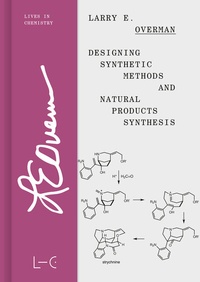
Designing Synthetic Methods and Natural Products Synthesis
Description

LARRY E. OVERMAN , born in 1943 in Chicago, had joined the newly founded Faculty of Chemistry, University of California, Irvine in 1971. It became his homebase for more than 50 years until his retirement as Distinguished Professor of Chemistry, Emeritus.
How come that he and his wife had chosen Irvine? That over 300 graduate students and postdocs have chosen his lab? That he served also as Chair of the Chemistry Section of the US National Academy of Science, as a founder and consultant in the pharmaceutical industry? Who were his mentors, his professional friends? Why did he early on chase "new chemical reactivity" after his first unexpected discovery? Which of his natural product total syntheses are textbook knowledge today? Who of his students became leaders, even a Nobel Laureate? Larry provides answers.
He managed challenges with impressive rigor and elegance. His students praise him and his unique "Let's see what happens" and "research is a group endeavor" approach!
l-i-c.org
More details
Other editions
Additional editions
Person
Larry E. Overman, born in Chicago in 1943, is Distinguished Professor of Chemistry at the University of California, Irvine. He was the recipient of the Arthur C. Cope Award in 2003, and he was awarded the Tetrahedron Prize for Creativity in Organic Chemistry for 2008. Overman's research is focused on the development of new chemical reactions, particularly transition metal catalyzed reactions, and the application of those reactions toward the synthesis of natural products. He is most known for the Overman rearrangement, a Claisen rearrangement of allylic alcohols to give allylic trichloroacetamides.
ISNI:
