

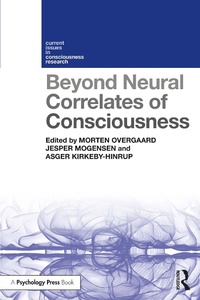
Beyond Neural Correlates of Consciousness
1st Edition
Published on 26. July 2020
196 pages
978-1-351-79350-6 (ISBN)
Description

Drawing on neuroscientific research and metacognitive theory, this groundbreaking volume examines the theoretical implications that are elicited when neural correlates of consciousness (NCC) are identified.
The relationship between consciousness and the brain has concerned philosophers for centuries, yet a tacit assumption in much empirically minded consciousness research seems to be that if we can only develop a map of correlations, no further questions remain to be asked. Beyond Neural Correlates of Consciousness starts where others stop, by asking what these correlations may tell us about the nature of consciousness. The book contains chapters considering the upshots of finding the neural correlates of consciousness in light of the most prominent contemporary theories in the field. This illuminates the theoretical consequences of succeeding in the quest for the neural correlates of consciousness from the perspective of global workspace theory, higher-order thought theory, local recurrency theory, and REFCON models, in addition to considering how this quest is shaped by different conscious phenomena, such as dreaming, altered states of consciousness, and different levels of consciousness.
This insightful text features sophisticated theories that goes beyond correlational inferences and neural mapping, and will be of interest to students and researchers of consciousness, particularly those interested in interpreting neural correlates.
The relationship between consciousness and the brain has concerned philosophers for centuries, yet a tacit assumption in much empirically minded consciousness research seems to be that if we can only develop a map of correlations, no further questions remain to be asked. Beyond Neural Correlates of Consciousness starts where others stop, by asking what these correlations may tell us about the nature of consciousness. The book contains chapters considering the upshots of finding the neural correlates of consciousness in light of the most prominent contemporary theories in the field. This illuminates the theoretical consequences of succeeding in the quest for the neural correlates of consciousness from the perspective of global workspace theory, higher-order thought theory, local recurrency theory, and REFCON models, in addition to considering how this quest is shaped by different conscious phenomena, such as dreaming, altered states of consciousness, and different levels of consciousness.
This insightful text features sophisticated theories that goes beyond correlational inferences and neural mapping, and will be of interest to students and researchers of consciousness, particularly those interested in interpreting neural correlates.
More details
Series
Edition
1. Auflage
Language
English
Place of publication
London
United Kingdom
Publishing group
Taylor & Francis Ltd
Target group
College/higher education
Illustrations
2 Tables, black and white; 7 Line drawings, black and white; 7 Illustrations, black and white
File size
4,15 MB
ISBN-13
978-1-351-79350-6 (9781351793506)
Copyright in bibliographic data and cover images is held by Nielsen Book Services Limited or by the publishers or by their respective licensors: all rights reserved.
Schweitzer Classification
Other editions
Additional editions
Morten Overgaard | Jesper Mogensen | Asger Kirkeby-Hinrup
Beyond Neural Correlates of Consciousness
Book
07/2020
1st Edition
Routledge
€63.00
Shipment within 10-20 days
Morten Overgaard | Jesper Mogensen | Asger Kirkeby-Hinrup
Beyond Neural Correlates of Consciousness
Book
07/2020
1st Edition
Routledge
€205.30
Shipment within 10-20 days
Persons
Morten Overgaard is Professor of Cognitive Neuroscience at the Center for Functionally Integrative Neuroscience, Aarhus University, Denmark. He is the head of the Cognitive Neuroscience Research Group.
Jesper Mogensen is Professor of Neuroscience at the Department of Psychology at the University of Copenhagen, Denmark. He is the head of the Unit for Cognitive Neuroscience and Director for the Research Center for Brain Injury Rehabilitation.
Asger Kirkeby-Hinrup is Postdoctoral Researcher in Theoretical Philosophy at the Department of Philosophy and Cognitive Science, Lund University, Sweden, and the Center for Functionally Integrative Neuroscience, Aarhus University, Denmark.
Jesper Mogensen is Professor of Neuroscience at the Department of Psychology at the University of Copenhagen, Denmark. He is the head of the Unit for Cognitive Neuroscience and Director for the Research Center for Brain Injury Rehabilitation.
Asger Kirkeby-Hinrup is Postdoctoral Researcher in Theoretical Philosophy at the Department of Philosophy and Cognitive Science, Lund University, Sweden, and the Center for Functionally Integrative Neuroscience, Aarhus University, Denmark.
Content
1. Beyond neural correlates of consciousness - an introduction
Jesper Mogensen, Morten Overgaard & Asger Kirkeby-Hinrup
2. Will we explain consciousness when we find the neural correlates of consciousness?
Morten Overgaard & Jesper Mogensen
3. From unconscious to conscious: a spectrum of states
Alice Barra, Manon Carriere, Steven Laureys & Charlotte Martial
4. Multidimensional degrees of consciousness: Qualities of experiences during wakeful perception, working memory tasks, mental imagery, mind wandering and dreaming
Peter Fazekas & Georgina Nemeth
5. Can we see without knowing that we see? Challenges for two theories of consciousness
Victor A.F. Lamme
6. Integrated Information Theory
Larissa Albantakis
7. Global workspace models in a broader perspective
Antonino Raffone & Henk P. Barendregt
8. A higher-order faculty and beyond
Asger Kirkeby-Hinrup
9. An integrative view of the neural correlates of consciousness (NCC) - Reorganization of the connectivity between Elementary Functions as a common mechanism of mental processes
Jesper Mogensen & Morten Overgaard
Jesper Mogensen, Morten Overgaard & Asger Kirkeby-Hinrup
2. Will we explain consciousness when we find the neural correlates of consciousness?
Morten Overgaard & Jesper Mogensen
3. From unconscious to conscious: a spectrum of states
Alice Barra, Manon Carriere, Steven Laureys & Charlotte Martial
4. Multidimensional degrees of consciousness: Qualities of experiences during wakeful perception, working memory tasks, mental imagery, mind wandering and dreaming
Peter Fazekas & Georgina Nemeth
5. Can we see without knowing that we see? Challenges for two theories of consciousness
Victor A.F. Lamme
6. Integrated Information Theory
Larissa Albantakis
7. Global workspace models in a broader perspective
Antonino Raffone & Henk P. Barendregt
8. A higher-order faculty and beyond
Asger Kirkeby-Hinrup
9. An integrative view of the neural correlates of consciousness (NCC) - Reorganization of the connectivity between Elementary Functions as a common mechanism of mental processes
Jesper Mogensen & Morten Overgaard
