

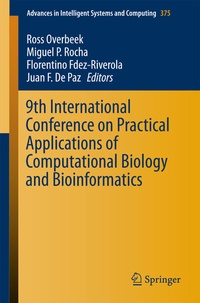
9th International Conference on Practical Applications of Computational Biology and Bioinformatics
Description

This proceedings presents recent practical applications of Computational Biology and Bioinformatics. It contains the proceedings of the 9th International Conference on
Practical Applications of Computational Biology & Bioinformatics held at University of Salamanca, Spain, at June 3rd-5th, 2015. The International Conference on Practical Applications of Computational Biology & Bioinformatics (PACBB) is an annual international meeting dedicated to emerging and challenging applied research in Bioinformatics and Computational Biology. Biological and biomedical research are increasingly driven by experimental techniques that challenge our ability to analyse, process and extract meaningful knowledge from the underlying data. The impressive capabilities of next generation sequencing technologies, together with novel and ever evolving distinct types of omics data technologies, have put an increasingly complex set of challenges for the growing fields of Bioinformatics and Computational Biology. The analysis of the datasets produced and their integration call for new algorithms and approaches from fields such as Databases, Statistics, Data Mining, Machine Learning, Optimization, Computer Science and Artificial Intelligence. Clearly, Biology is more and more a science of information requiring tools from the computational sciences.
More details
Other editions
Additional editions
Content
A Preliminary Assessment of Three Strategies for the Agent-Based Modeling of Bacterial Conjugation.- Carotenoid Analysis of Cassava Genotypes Roots (Manihot Esculenta Crantz) Cultivated in Southern Brazil Using Chemometric Tools.- UV-Visible Scanning Spectrophotometry and Chemometric Analysis As Tools to Build Descriptive And Classification Models for Propolis from Southern Brazil.- UV-Visible Spectrophotometry-Based Metabolomic Analysis of Cedrela Fissilis Velozzo (Meliaceae) Calluses - A Screening Tool for Culture Medium Composition and Cell Metabolic Profiles.- An Integrated Computational Platform for Metabolomics Data Analysis.- Compound Identification in Comprehensive Gas Chromatography - Mass Spectrometry-Based Metabolomics by Blind Source Separation.- Dolphin 1D: Improving Automation of Targeted Metabolomics in Multi-Matrix Datasets Of 1H-NMR Spectra.- A New Dimensionality Reduction Technique Based On HMM for Boosting Document Classification.- Diagnostic Knowledge Extraction from Medlineplus: An Application for Infectious Diseases.- A Text Mining Approach for the Extraction Of Kinetic Information from Literature.- A Novel Search Engine Supporting Specific Drug Queries And Literature Management.- Ganoderma Australe Transcriptome Analysis with Hidden Markov Model And Bayesian Inference Approaches.- A New Bioinformatic Pipeline to Address The Most Common Requirements in RNA-Seq Data Analysis.- Microarray Gene Expression Data Integration: An Application to Brain Tumor Grade Determination.- Obtaining Relevant Genes by Analysis of Expression Arrays with a Multi-Agent System.
