

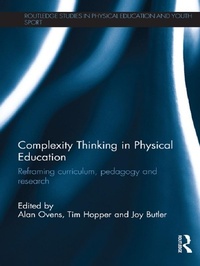
Complexity Thinking in Physical Education
Reframing Curriculum, Pedagogy and Research
1st Edition
Published on 4. January 2013
248 pages
978-1-136-45614-5 (ISBN)
Description

In the past two decades, complexity thinking has emerged as an important theoretical response to the limitations of orthodox ways of understanding educational phenomena. Complexity provides ways of understanding that embrace uncertainty, non-linearity and the inevitable 'messiness' that is inherent in educational settings, paying attention to the ways in which the whole is greater than the sum of its parts. This is the first book to focus on complexity thinking in the context of physical education, enabling fresh ways of thinking about research, teaching, curriculum and learning.
Written by a team of leading international physical education scholars, the book highlights how the considerable theoretical promise of complexity can be reflected in the actual policies, pedagogies and practices of physical education (PE). It encourages teachers, educators and researchers to embrace notions of learning that are more organic and emergent, to allow the inherent complexity of pedagogical work in PE to be examined more broadly and inclusively. In doing so, Complexity Thinking in Physical Education makes a major contribution to our understanding of pedagogy, curriculum design and development, human movement and educational practice.
Written by a team of leading international physical education scholars, the book highlights how the considerable theoretical promise of complexity can be reflected in the actual policies, pedagogies and practices of physical education (PE). It encourages teachers, educators and researchers to embrace notions of learning that are more organic and emergent, to allow the inherent complexity of pedagogical work in PE to be examined more broadly and inclusively. In doing so, Complexity Thinking in Physical Education makes a major contribution to our understanding of pedagogy, curriculum design and development, human movement and educational practice.
More details
Series
Language
English
Place of publication
London
United Kingdom
Publishing group
Taylor & Francis Ltd
Target group
College/higher education
Illustrations
5 s/w Tabellen, 14 s/w Zeichnungen
5 Tables, black and white; 14 Line drawings, black and white
File size
9,53 MB
ISBN-13
978-1-136-45614-5 (9781136456145)
Copyright in bibliographic data and cover images is held by Nielsen Book Services Limited or by the publishers or by their respective licensors: all rights reserved.
Schweitzer Classification
Other editions
Additional editions
Alan Ovens | Tim Hopper | Joy Butler
Complexity Thinking in Physical Education
Reframing Curriculum, Pedagogy and Research
Book
09/2014
1st Edition
Routledge
€65.70
Shipment within 15-20 days
Alan Ovens | Tim Hopper | Joy Butler
Complexity Thinking in Physical Education
Reframing Curriculum, Pedagogy and Research
Book
12/2012
1st Edition
Routledge
€231.80
Shipment within 15-20 days
Persons
Alan Ovens is a Principal Lecturer in the School of Curriculum and Pedagogy at the University of Auckland, New Zealand. His research interests are in the area of teacher education and educational sociology. He coordinates the Faculty's Special Interest Network in Complexity (SINC) and leads a Research Network in HPE Teacher Education.
Tim Hopper is an Associate Professor in the School of Exercise Science, Physical and Health Education in the Faculty of Education at the University of Victoria, British Columbia, Canada. His research interests are in the areas of teacher education, physical education and how complexity thinking informs learning.
Joy Butler is an Associate Professor in the Department of Curriculum and Pedagogy at the University of British Columbia, Canada. Her research interests are in the areas of teacher education, constructivist learning theory, complexity thinking and situated ethics. She is active in international scholarship, organization and advocacy for TGfU.
Tim Hopper is an Associate Professor in the School of Exercise Science, Physical and Health Education in the Faculty of Education at the University of Victoria, British Columbia, Canada. His research interests are in the areas of teacher education, physical education and how complexity thinking informs learning.
Joy Butler is an Associate Professor in the Department of Curriculum and Pedagogy at the University of British Columbia, Canada. Her research interests are in the areas of teacher education, constructivist learning theory, complexity thinking and situated ethics. She is active in international scholarship, organization and advocacy for TGfU.
Content
Chapter 1. Complexity thinking in Physical Education; Reframing pedagogy, curriculum and research Chapter 2. Complexity of Intervention: Implementing Curricula in the Authentic World of Schools Chapter 3. Introducing Conditions of Complexity in the Context of Scottish Physical Education Chapter 4. Complexity, Equity and Critical Approaches to Physical Education Chapter 5. Affordance networks and the complexity of learning Chapter 6. Intentionality, Coordination dynamics and the complexity of human movement Chapter 7. Ongoing adaptation as a feature of complexity: Further thoughts and possible ideas for pedagogy in physical activity Chapter 8. "Another damned, thick, square book!" Tracing learning theory in physical education textbooks, 1900-2010 Chapter 9. Enabling Constraints: Co-creating Situated Learning in Inventing Games Chapter 10. Effective Learning Design for the Individual: A Nonlinear Pedagogical Approach in Physical Education Chapter 11. A nonlinear pedagogy for sports teams as social neurobiological systems: How teams can harness self-organization tendencies Chapter 12. Emergence in School Integrated Teacher Education for elementary PE teachers: Mapping a complex learning system Chapter 13. The "Complex Thinking" paradigm in Physical Education Teacher Education: Perspectives about the "reflective practitioner" concept in France Chapter 14. Modification by Adaptation: Proposing Another Pedagogical Principle for TGfU Chapter 15. Thinking about complexity thinking for physical education
